
Rope anchors: an overview

Premium Members can read the entire article here:
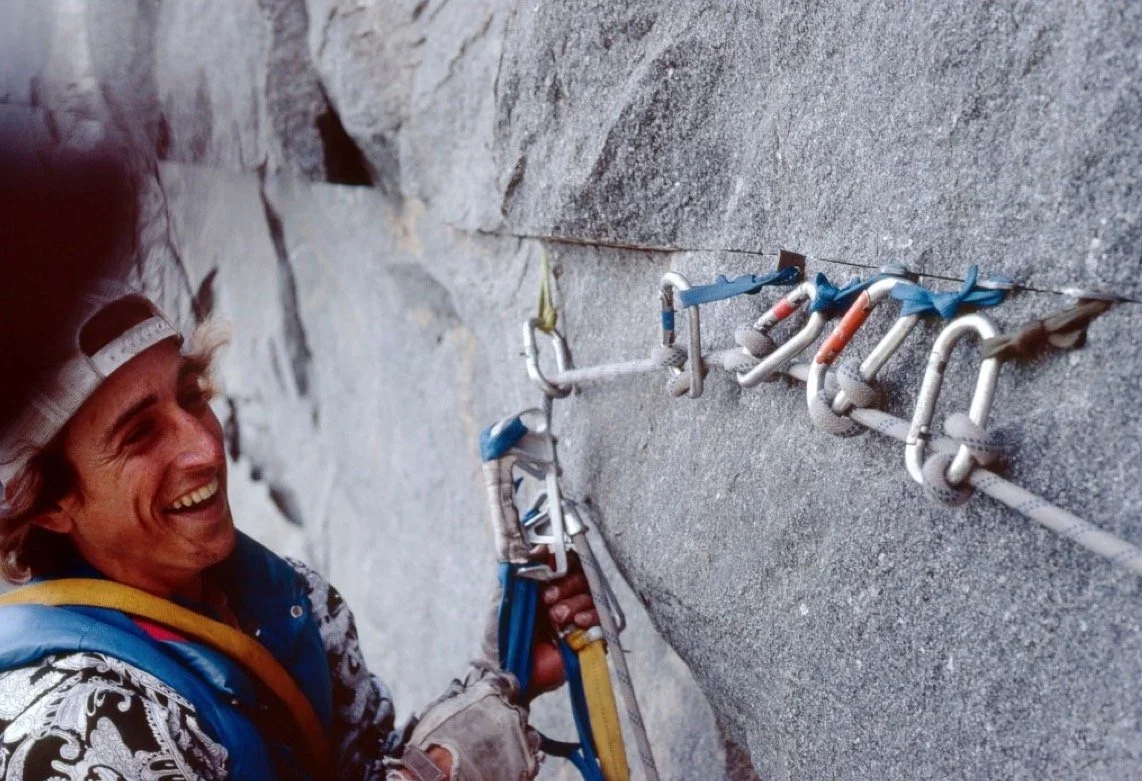
(Photo by Dave Diegelman, climber Dale Bard, Sea of Dreams, El Capitan, 1978, shared with permission)
Let's take a look at some (of the many) ways you can make an anchor with your rope.
This is not meant to be a comprehensive article of every possible flavor of rope anchor, because that’d be a book all by itself. It's more of an overview of some common and some lesser-known methods.
I'm not showing half or twin rope techniques in this article, that's a separate topic.
Hopefully this will inspire you to practice and experiment on your own. Even if you have a lot of experience with rope anchors, I bet there are some here that will be new for you! Enjoy!
Why use a rope anchor?
Forgot the cord or sling, dropped it, left it with your buddy at the last anchor, your dog ate it, etc. A rope is strong, stretchy, durable, and something you always have with you.
When you want to stand / belay farther away from where the ideal anchors are. This could be 2 meters or 12 meters.
Want to earn some old school style points.
If you're British, and you apparently lose your citizenship if you use a cordelette or a quad. =^)
Does a rope reduce force on the anchor?
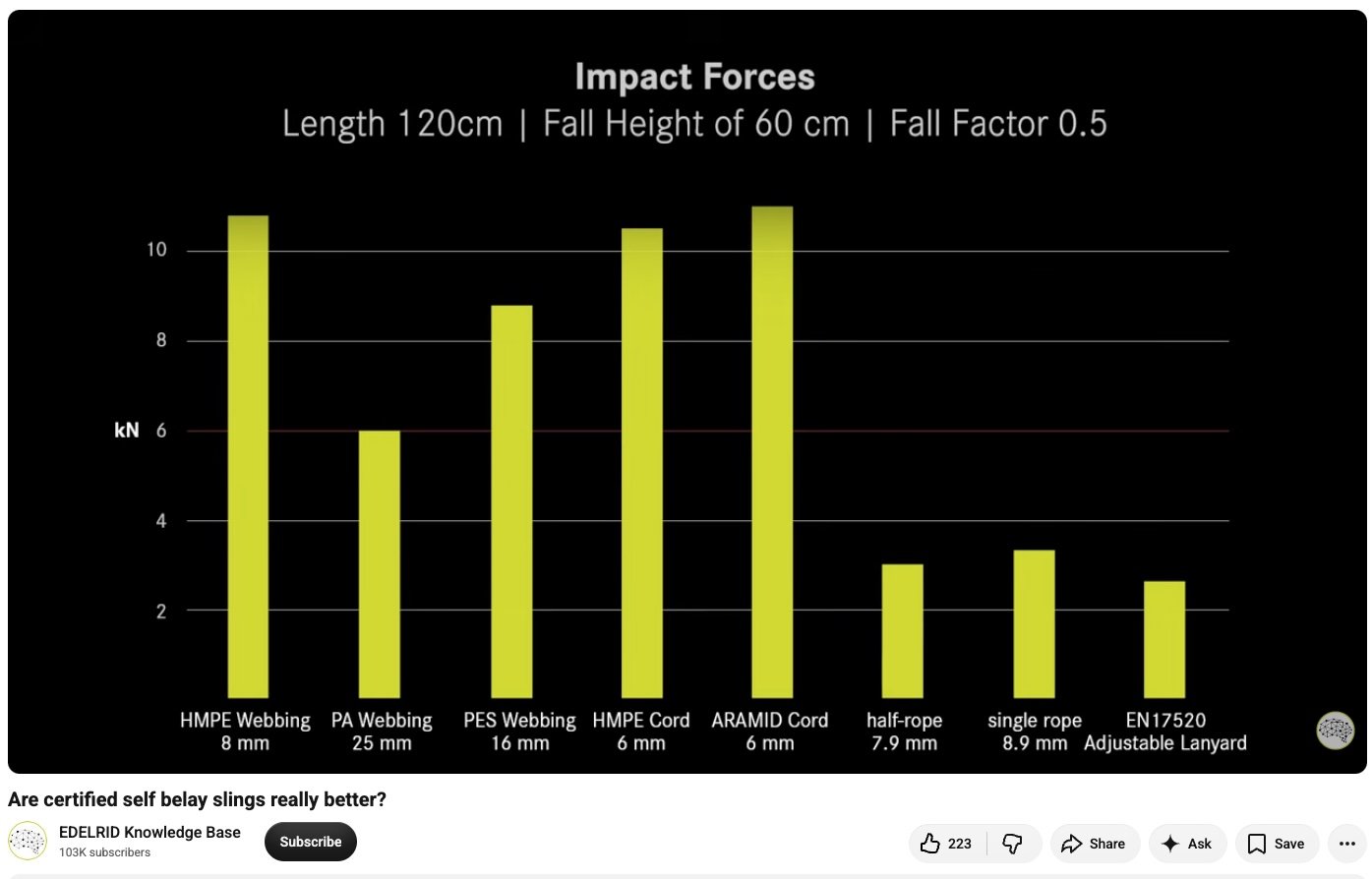
You might be wondering if having only a meter or so of rope involved in the anchor really does much good. The good news is yes, it helps, more than you might think. It can reduce forces on the anchor by about a factor of three, compared with a static sling.
Below is a screen grab from a YouTube video from the excellent Edelrid knowledge base, that did some drop testing comparing low stretch and high stretch materials.
Note that the stretchy ropes and (adjustable lanyard made of rope) on the right side of the graph only put a load on the anchor of about 3 kN, compared to over 10 kN with low stretch materials.
What are some downsides of rope anchors?
There are a few. Most of them are pretty minor.
On a multi pitch, it can complicate block leading (where one person is leading a series of pitches) because sometimes rope anchors don’t give a convenient place for the second to be attached to a master point. (There are solutions to that, details below.)
It can take a bit longer to set up properly.
It can complicate self rescue in some situations.
If the next pitch is the full length of the rope, and you use several meters of rope to make the anchor, that could complicate the next pitch.
If you’re at an exposed stance using several meters of the rope for an anchor, and your partner above you pulls up all the slack rope to put you on belay, you may find yourself having to break down the anchor, which could suddenly introduce lots of slack. (One solution: to clip to one good piece of gear with a PAS/tether, have your attentive partner above pull up ALL the slack rope, you clean the last piece and start climbing.)
Let's look at rope anchors in three main categories, starting with simpler and getting more advanced.
Fixed rope anchors
Top rope anchors
Multi pitch anchors
Fixed rope anchors
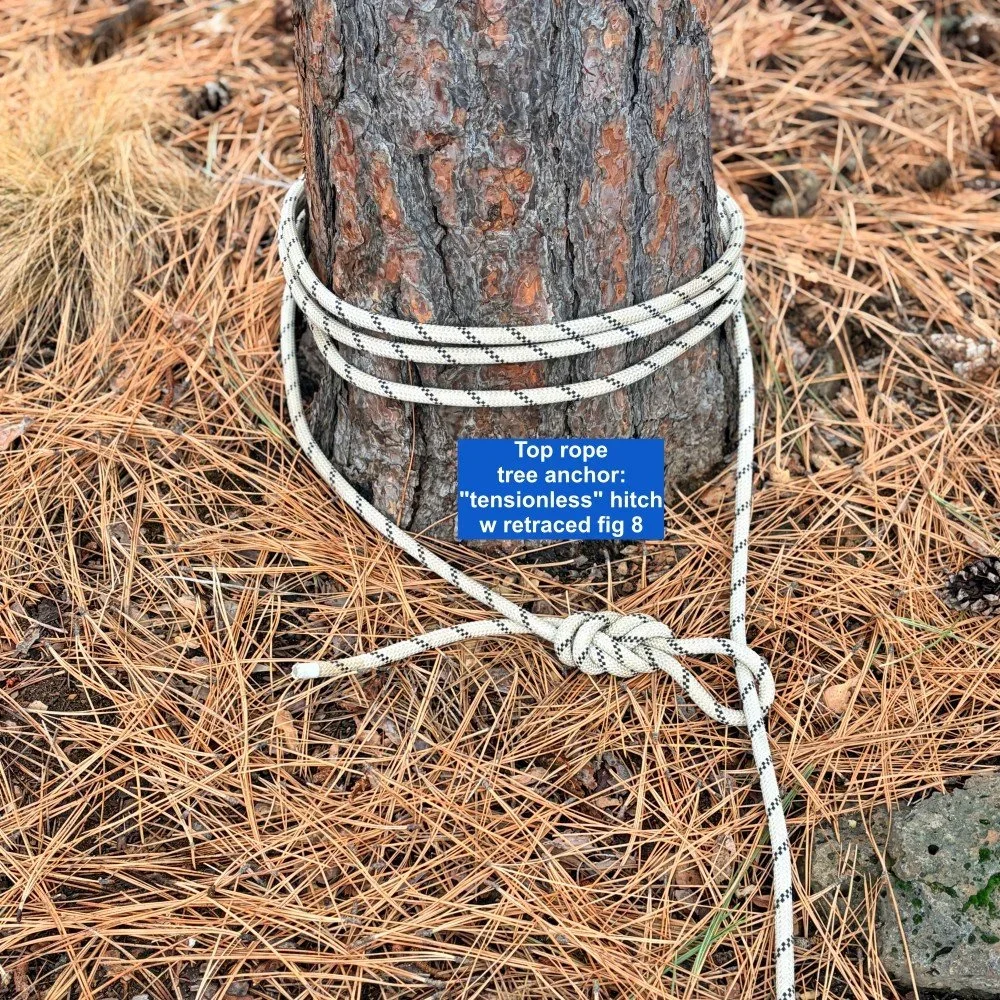
Fixed rope anchor - tensionless hitch
To fix a rope on a single, very stout tree, you can try the tensionless hitch. Take three or four wraps of rope around the tree, and clip or tie the tail of the rope to the load strand.
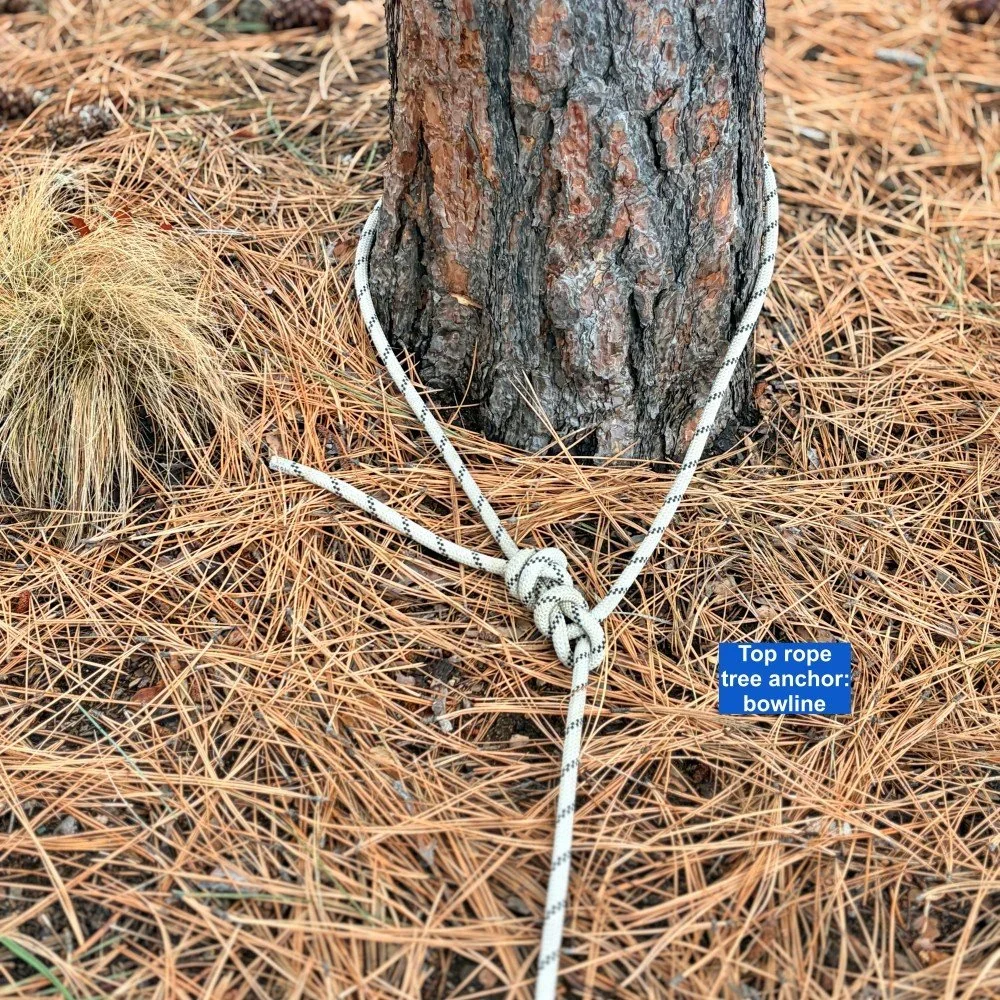
Fixed rope anchor - bowline
Another option with a single very stout tree: tie a bowline around the tree. Be sure to leave an adequate tail, and back up the bowline.
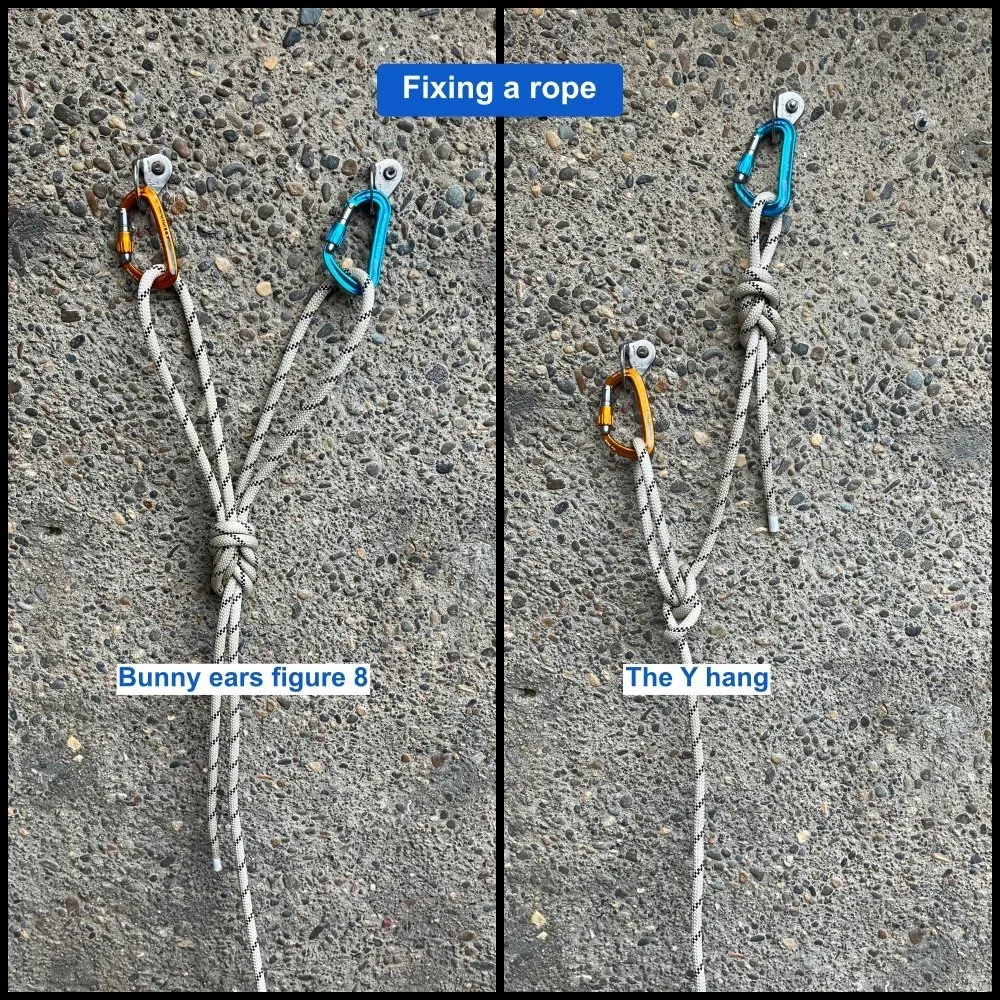
Fixed rope anchor - Bunny ears or Y hang
With two horizontal bolts, try a bunny ears figure 8.
With two vertical bolts, consider a Y Hang (figure it on a bight on the top hanger, butterfly clipped to the lower anchor.)
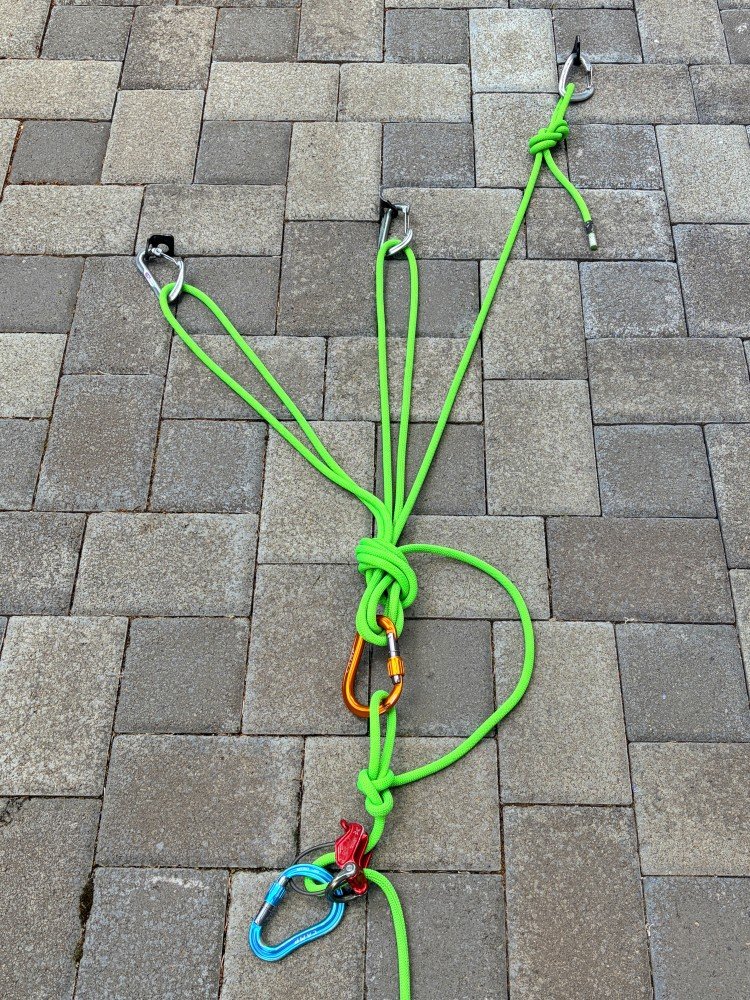
Fixed rope anchor - Rope as cordelette
If you need to fix a rope, and your anchor points are two or more, far back from the edge of the cliff and/or far apart, then you might want to try this method of using your rope like a cordelette.
Top rope anchors
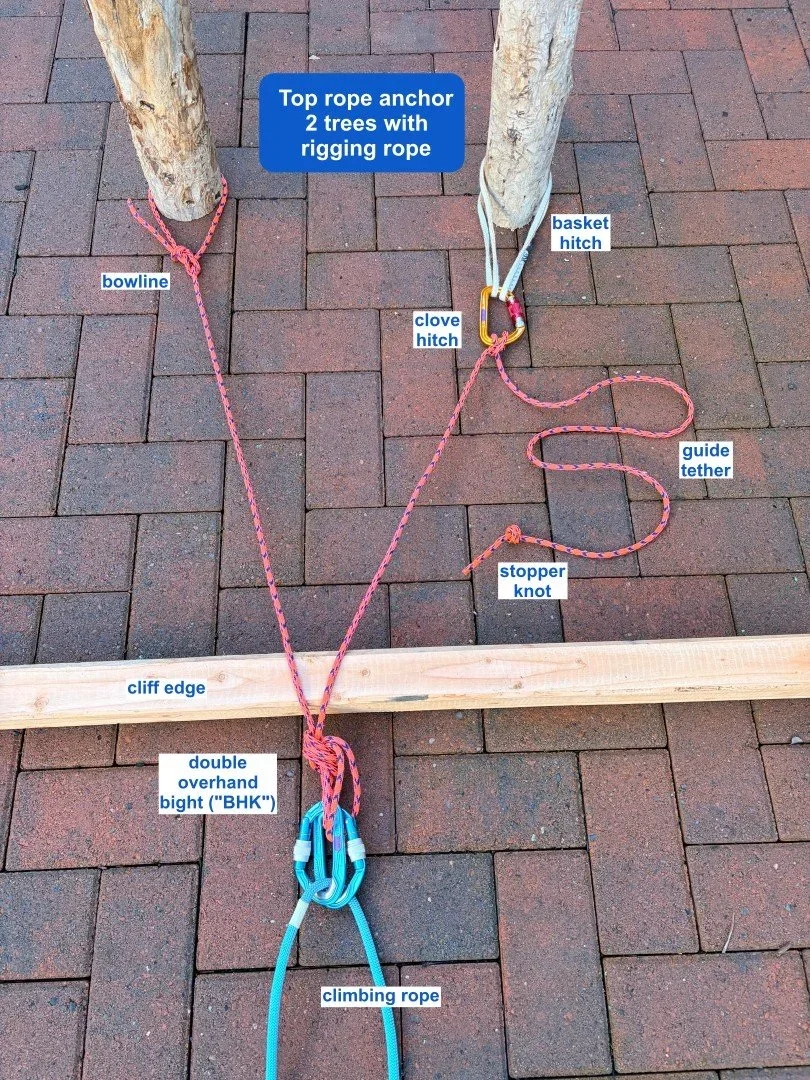
Top rope anchor - Use a separate rigging rope to make your anchor
If you have good access to the cliff up, and the anchor points are far back from the edge, it can be very convenient to have a second rope that's used only for anchor building. It's best to use a static rope, to minimize stretch over the edge, but that's not mandatory.
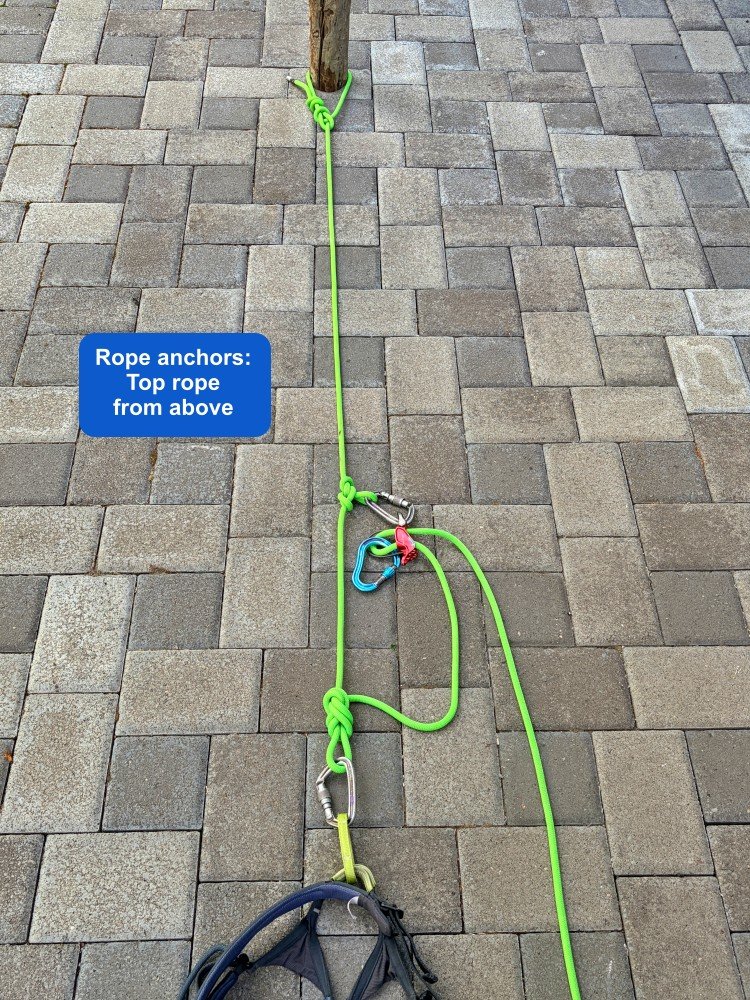
Top rope anchor - belaying from above
This is a somewhat unusual set up, but can be useful in some areas where you can easily access the top of the cliff which has solid anchor points (trees), such as the Ouray Colorado (USA) ice park.
In this case, you start your route from the top, and lower or (maybe rappel) down onto your route. (A rope bag can help to keep things organized.)
Fix the end of the rope to an anchor, here a bowline around a tree.
Walk/scramble carefully, maybe protected with a friction hitch, down to where you want to belay from.
Tie yourself to the rope with a bight knot, and tie a butterfly to belay from.
Have your partner come down, have them tie into the end of the rope, lower them down the route, then they top rope back up to your belay.
Multipitch anchors
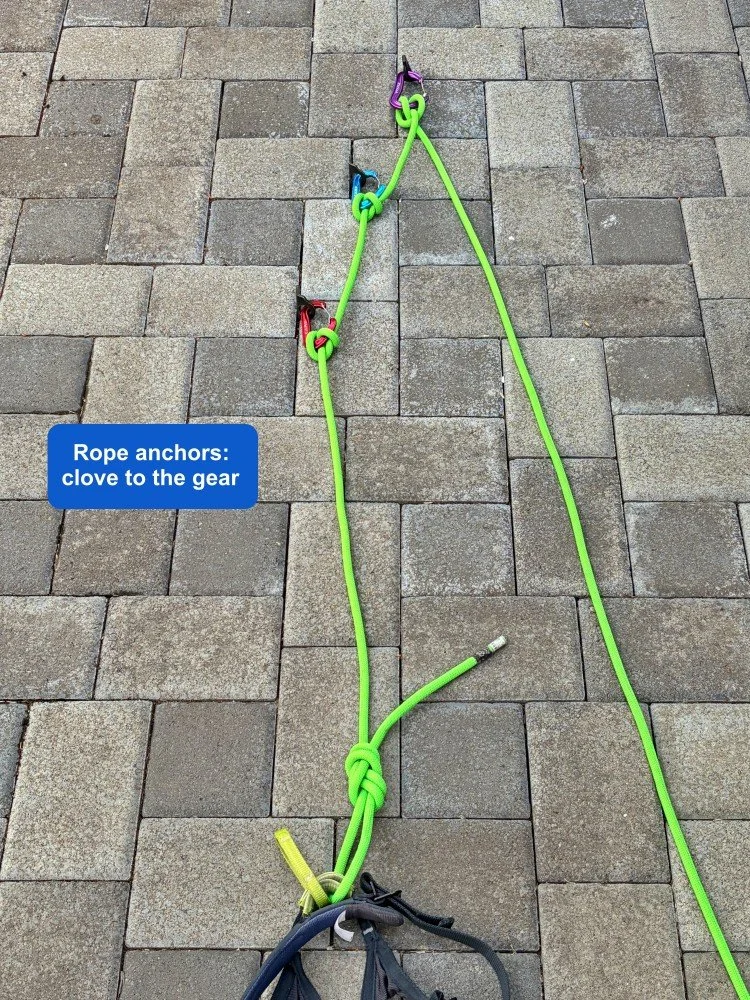
Multipitch - Old school classic: clove hitch to everything
Like the Yosemite classic photo at the top, you can clove hitch the rope directly to the protection.
Requires a bit of practice to set it up quickly with minimum slack between pieces.
Works best in a vertical crack compared to horizontal, because if the first piece blows in a horizontal crack, you're going to generate more shock load on the remaining gear.
If rigged like this, no master point to be belay from.
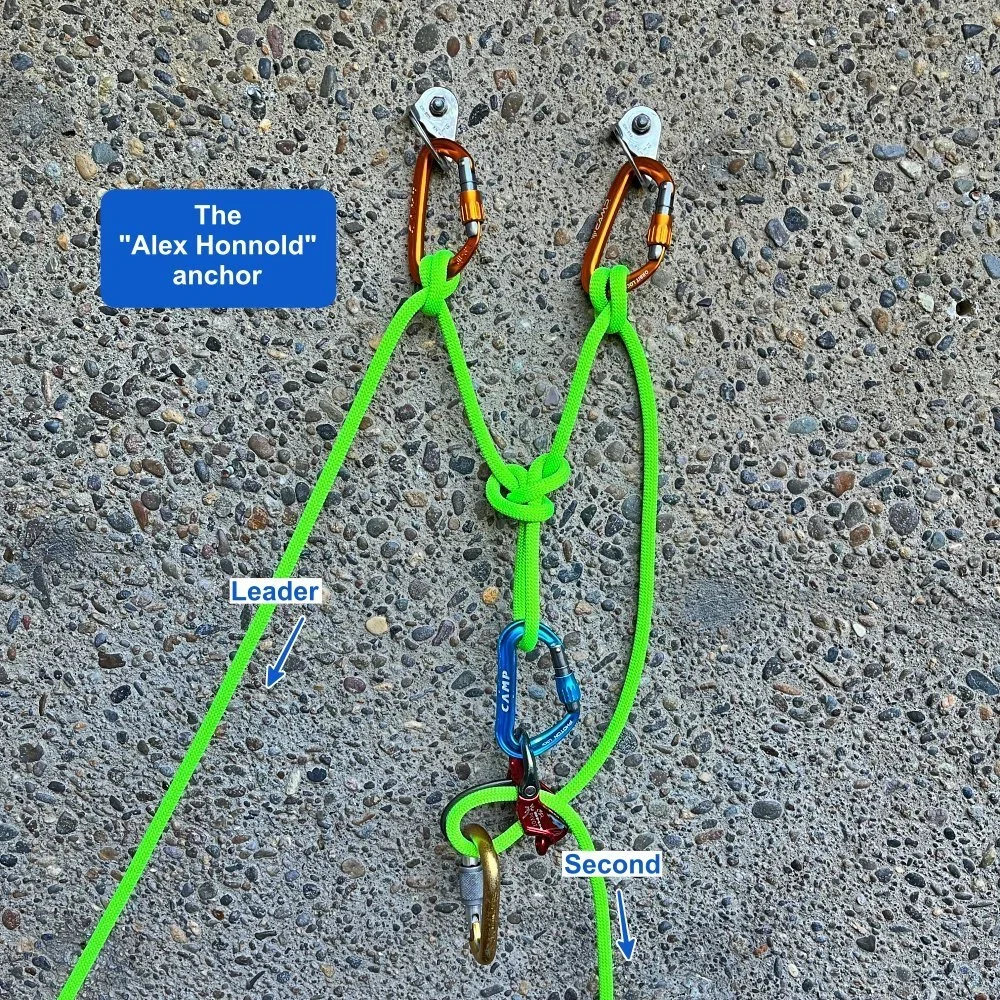
Multipitch - Two piece anchor, equalized with the “Alex Honnold” anchor
You can equalize the load like this. Clove hitch to each bolt with some slack in between, tie a butterfly in the slack for your masterpoint.
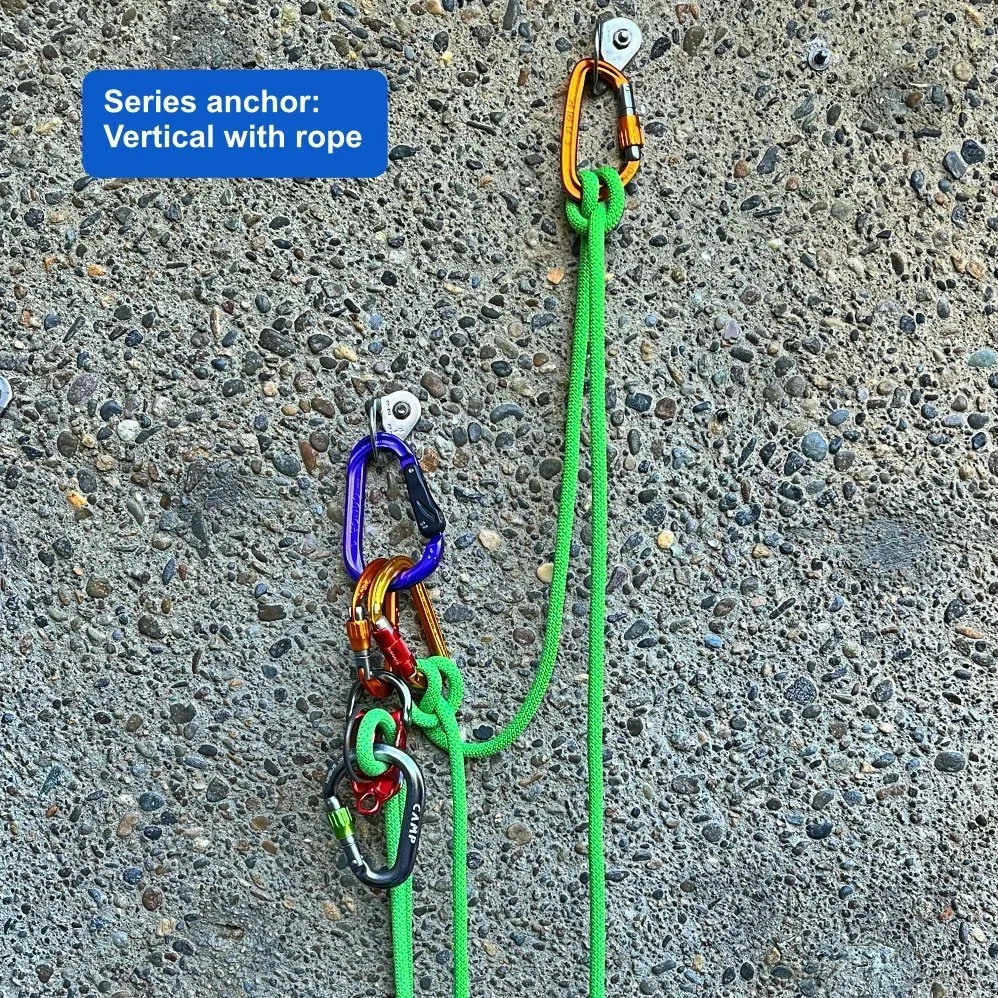
Multipitch - Two piece anchor, redundant (not equalized) with a series anchor
A series anchor puts all the load on one bolt, with the second bolt as a backup in the extremely unlikely event of the first bolt failing. Redundancy, yes, equalization, no. Generally, more common in Europe than the US.
This is an increasingly common European anchor method for ice screws. Because the top screw never takes any of the load, it keeps a bit more strength. It’s only loaded if the bottom one fails.
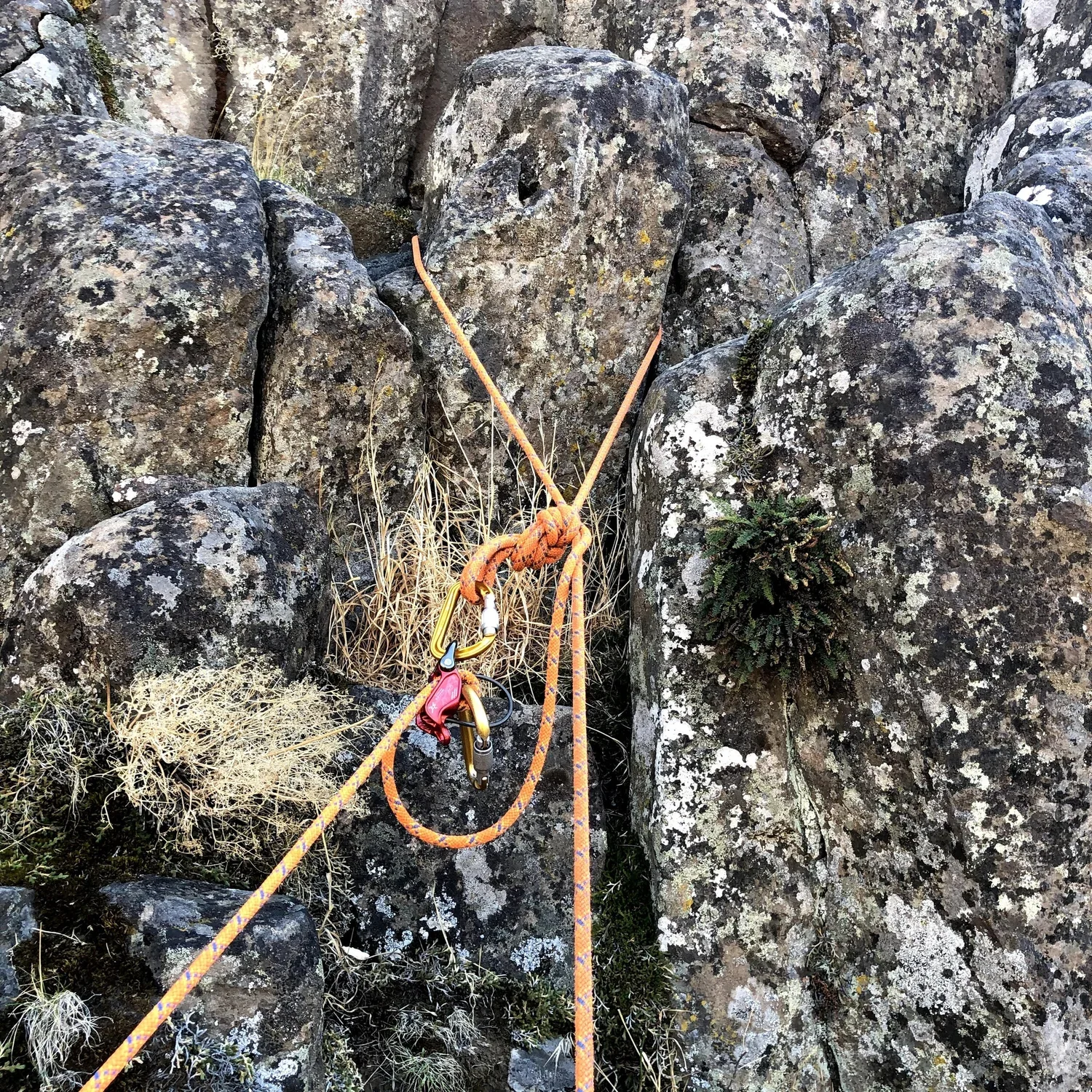
Multipitch - on a boulder
A monolith, aka single point anchor that is unquestionably stout, is usually a solid tree, or a large boulder / rock spike. The technique you use depends on the feature. If it's a boulder or rock, you can flip your rope over the top and tie a BHK (Big Huge Knot, an overhand in both strands)
Here, the boulder is quite small. You can also make it around something that's much larger.
Multipitch - on a tree
Walk around the tree, stand in your preferred belay spot, and tie a BHK in both strands. This secures you, and gives you a convenient master point. It can be any sort of a bight knot - here I'm using a butterfly because it's easiest to untie after being loaded, but an overhand works as well..
This method works well when your anchor point might be far back from the edge of the cliff.
If you want to keep your anchor point potentially higher, and maybe avoid getting tree sap on your rope, you can pass a sling around the tree and clip the rope to that instead. (Tree sap on your rope sucks, ask me how I know.)
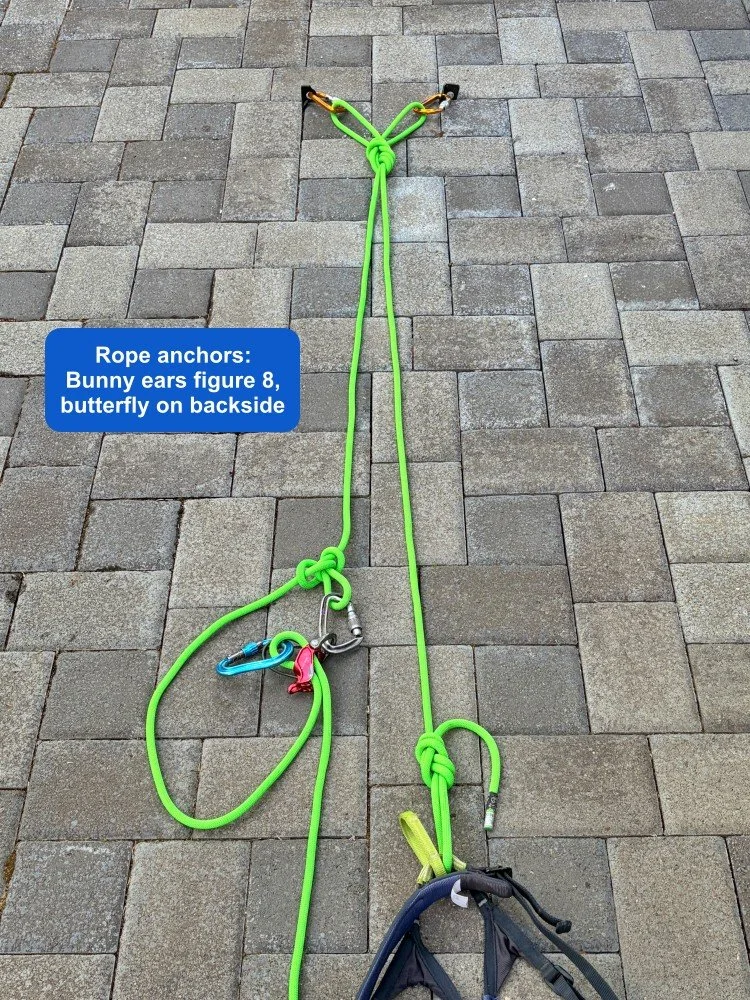
Multipitch - stand farther from the anchor
Tie a double strand bight knot. Here it's a bunny ears figure 8, could also be a bowline on a bight.
Clip each loop to two adjacent bolts.
On the backside of this knot, tie a butterfly as a masterpoint, and belay from this. This works well if you want to stand a ways back from the bolts to belay.
This works with any solid two piece anchor: bolts, very good gear, ice screws, etc.
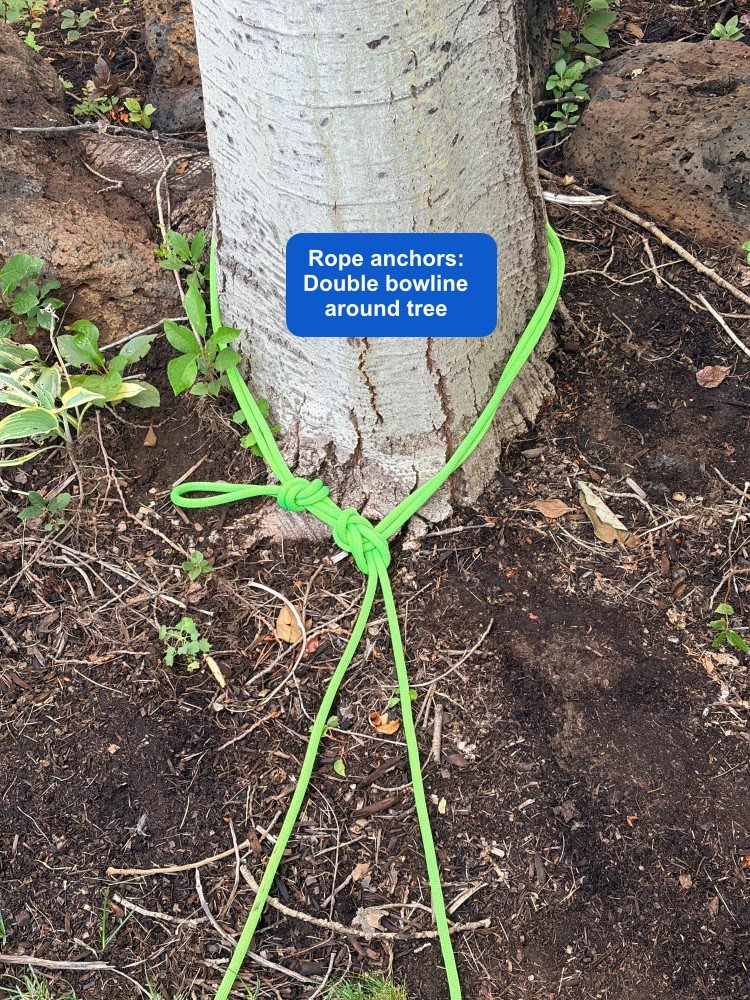
Multipitch - on a tree with a bowline
If it's a tree and for some reason you can't walk around it, you can tie a double strand bowline.
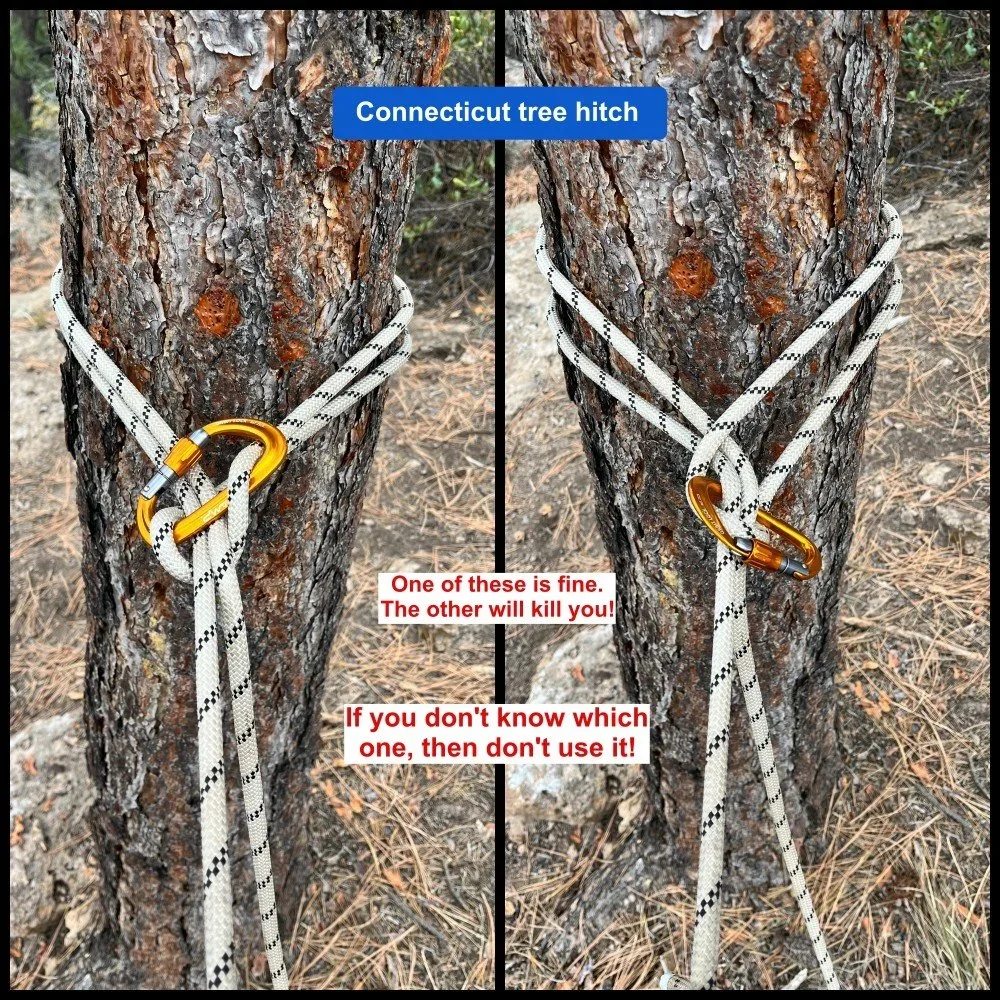
What about the Connecticut tree hitch?
Some people might choose the Connecticut tree hitch as a tree anchor on a multipitch.
I'm not a big fan. Here's why.
The right way to tie this knot looks very similar to the wrong way. If you tie it wrong, you could have an instant catastrophic failure mode, probably killing both you and your partner. So, I choose not to teach or advocate this on my website. If you're curious, do a web search.
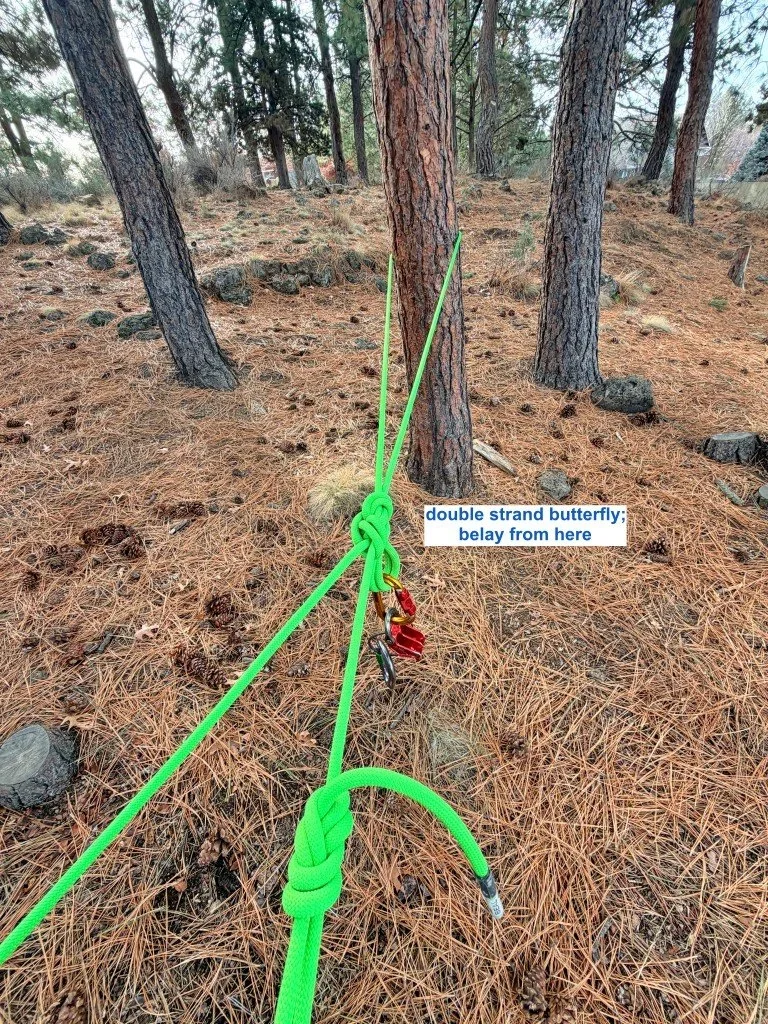
When you extend your tie in point with a rope anchor, what's a trick so you have the exact right length of rope, every time?
Want to see a couple of “UK style” rope anchors, one with a masterpoint and one without?
What’s a way that you can block lead when you have a rope anchor? (Hint, it's not untying from the end of the rope.)
What's a method to fix a rope to a pair of anchors with a double loop knot, no carabiners required?
