
The (load releasable) Helix hitch

Premium Members can read the entire article here:
I think I first learned this hitch from big wall expert Mark Hudon, during an in-person clinic around 2019. Connect with Mark on his website.
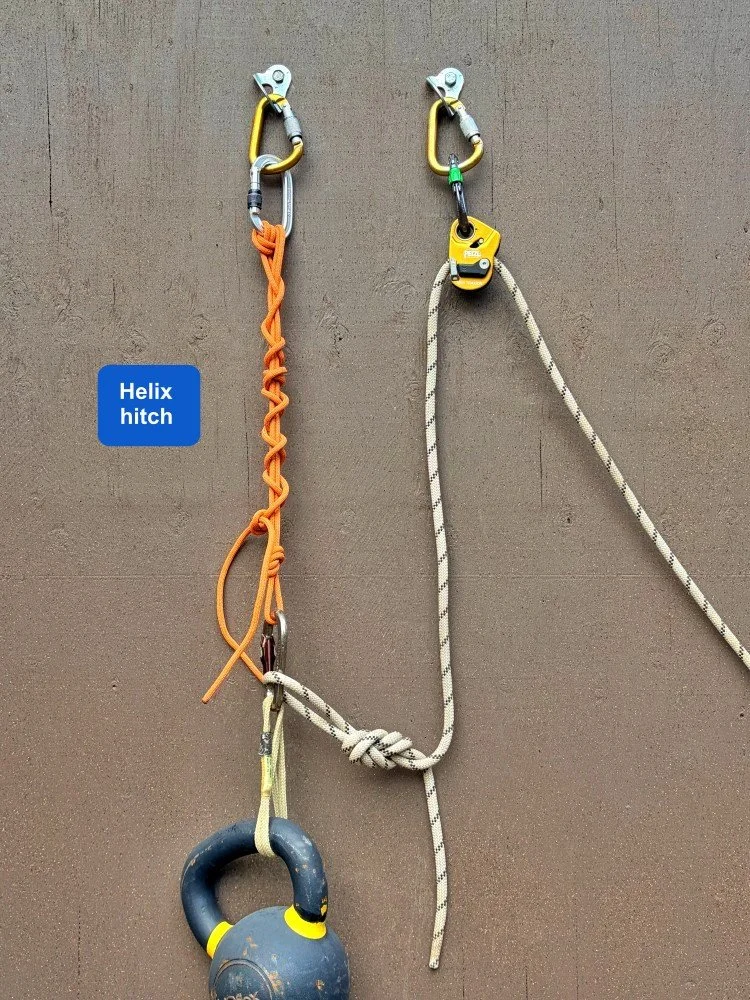
The load releasable Helix hitch is typically used by a big wall climbers to dock their haul bags to an anchor.
A cousin of the Munter Mule Overhand (MMO) and Mariner hitch, this knot gives:
A secure attachment point
An easily releasable system, even under a full 100+ kg load
A long tail of cordage useful for lowering out the bag(s)
The old school method of clipping your haul bag to the anchor with an adjustable sewn loop daisy chain is the Dark Ages compared to this. Use a docking cord and Helix hitch, and TML (Thank Me Later! =^)
The extra long cord gives you some helpful length to do a short lower out of the haul bag as your partner starts lifting it from above. Also, there’s no knot or sling stitches that could potentially get hung up in the Munter at a critical time, because the free ends of the cord smoothly glides through the anchor carabiner as the bag does a lift off.
Can you use an MMO here instead of helix hitch? Sure! Try them both and see which one you like better.
What about that “Helix hitch” name?
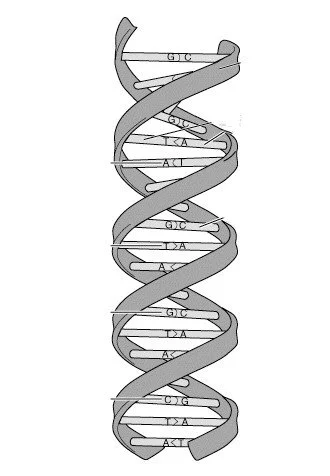
While pretty well known by modern big wall climbers, I've never heard that this hitch actually has a name. So I'm stepping up and call it the Helix hitch, because it looks like the double helix of a DNA spiral.
Yeah, I made that up myself. And yes, I like the alliteration.
The best way to find Truth is to post something wrong on the Internet and wait for people to correct you. So, if you know this hitch by another name, shoot me an email and enlighten me. (In his excellent book “Down”, Andy Kirkpatrick refers to this as the “pig hitch”. Maybe because big wall climbers use it to dock the pig, aka hall bag?
I like my name better, so I'm gonna roll with that. =^)
Here's how to tie it.
Note, in this example, I’m simplifying things for clarity, so you're not distracted by the chaos of a typical big wall anchor.
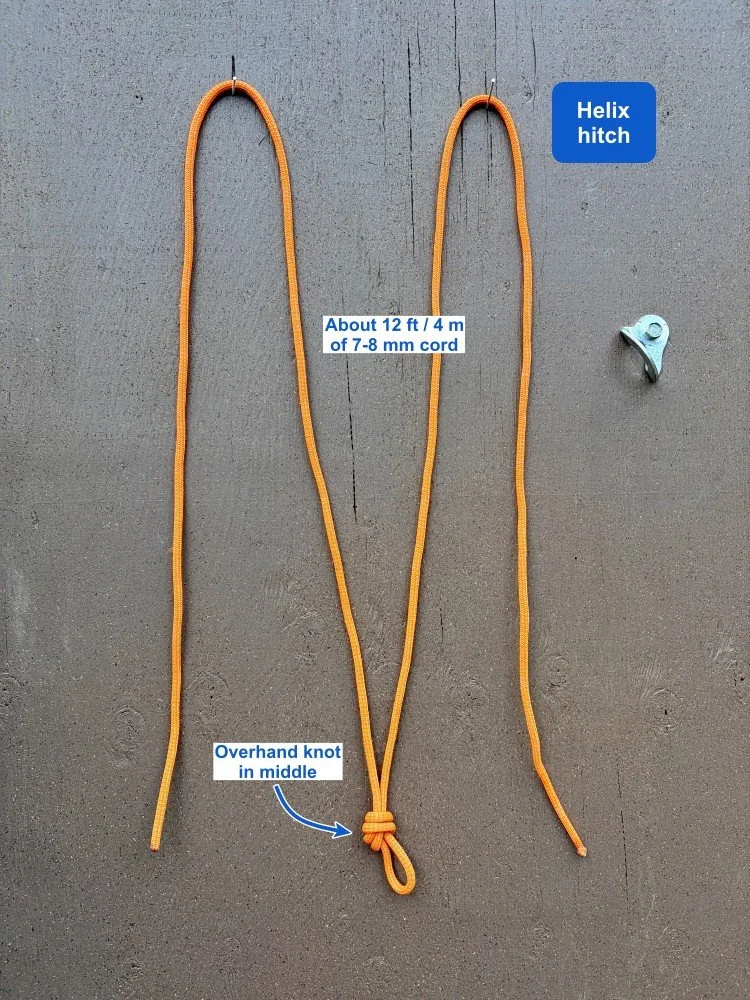
Start with between 10 and 15 feet (3-5 meters) of 8mm cord. This is your “docking cord”. In the middle of your cord, tie an overhand knot. (If you want a fancier version with a sewn eye loop, you can get it from Skot’s Wall Gear.)
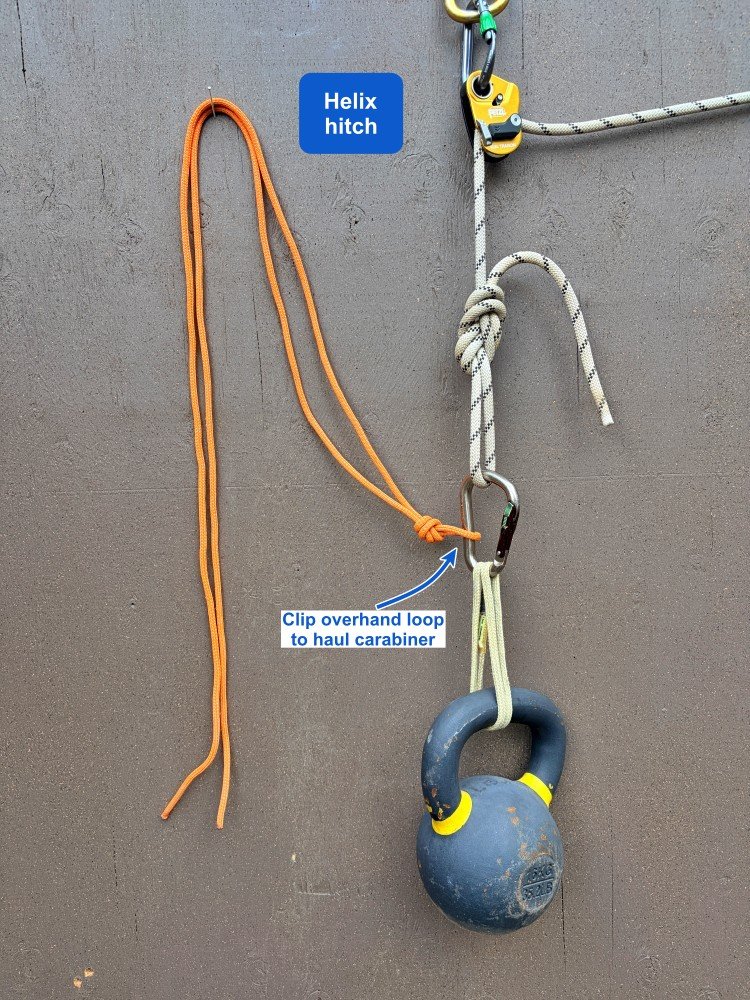
Clip the overhand knot to a locking carabiner that's clipped to your haul bag. (Typically, you’d do this on the ground, and that docking cord stays attached to the haul bag carabiner for the entire climb.)
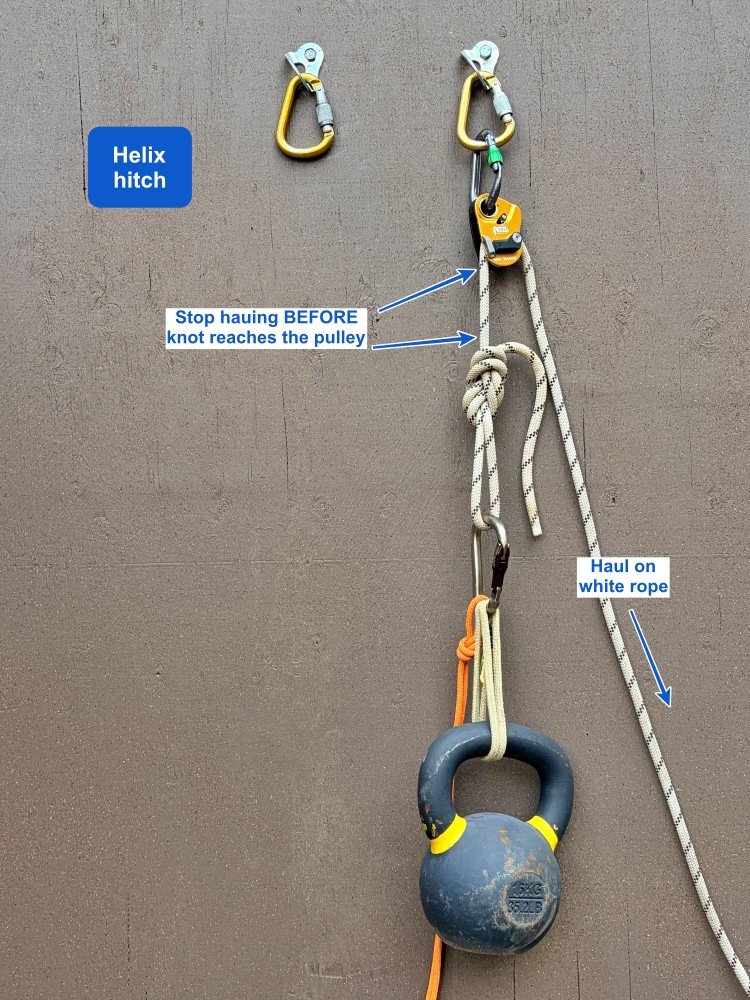
Start hauling. When the bag gets close to the anchor, stop with at least 6 inches / 10 cm or so of rope between the knot and the progress capture pulley.
(Or, to put it another way, don’t yank that figure 8 knot straight into your progress capture pulley, or you won't be able to release it. Yes, I've made that mistake also . . .
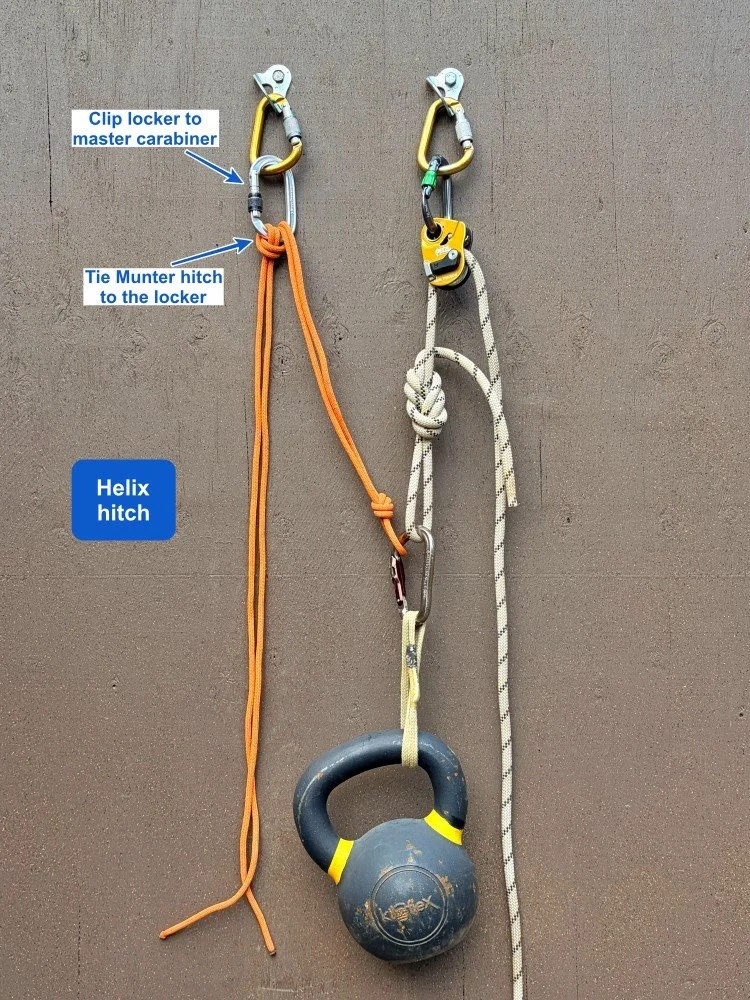
Clip a spare locker onto the master carabiner. An oval locker or HMS is a good choice here. With two strands of cord, tie a Munter hitch to this locker. (Make sure this is NOT a clove hitch, ask me how I know . . .
Pull slack from the end of the cord, so the Munter hitch is pretty snug to the load.
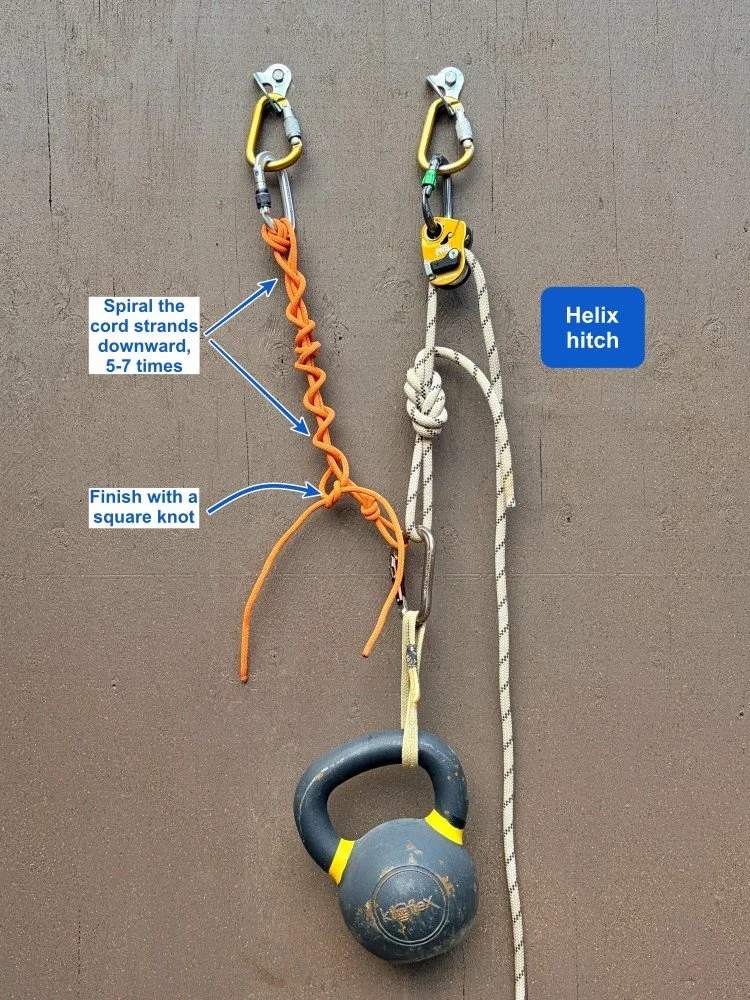
Key move:
With the two ends of cord, start spiraling (helixing?) them in opposite directions down toward the load. Make about 6 wraps at a minimum, more is better.
Finish the wraps with a square knot.
Transfer the load from the progress capture pulley on to the Helix hitch. Tie a backup knot, done! (See video below.)
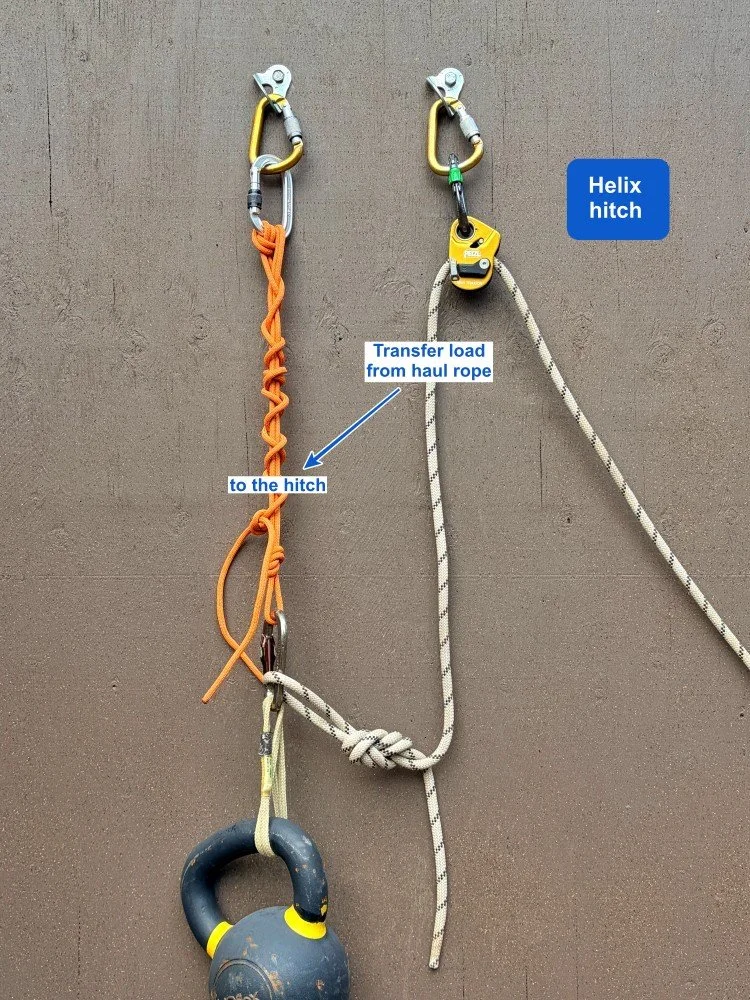
Want to see a video of transferring the load from your pulley to the Helix hitch?
How do you back up the hitch?
What does the leader still need to do to get the haul system rope ready for the next pitch?
How do you release the haul bag?
