
“Knot migration”: what is it, how to fix it?

Premium Members can read the entire article here:
Note - This post discusses techniques and methods used in vertical rope work. If you do them wrong, you could die. Always practice vertical rope techniques under the supervision of a qualified instructor, and ideally in a progression: from flat ground, to staircase, to vertical close to the ground before you ever try them in a real climbing situation.
This article was written with collaboration from expert American alpine climbers Jeff and Priti Wright. Connect with them on Instagram (Priti / Jeff) and their website, alpinevagabonds.com
Summary:
Knot migration can happen when you join two rappel ropes of different diameters.
The different rope diameters can have varying friction in your tube-style rappel device: fatter rope has more friction, skinnier rope has less friction.
If the joining knot is on the side of the fat rope, because of increased friction, the fatter rope may slide less (or even not at all) through your device.
If this happens, the joining knot can start sliding down away from the anchor. This can cause the rope ends to be uneven. This could range from a minor annoyance to a lethal problem.
For most climbers, in most cases, it's best practice to rig to pull the skinny rope. With proper anchor hardware, this prevents the knot from moving.
For expert climbers in certain situations, rigging to pull the fat rope can have some advantages.
Below left: the fat rope is through the hardware, so you pull the skinny rope. This is usually the preferred method.
Below right: the skinny rope is through the hardware, so you pull the fat rope. This is the experts-only method, for specific situations.
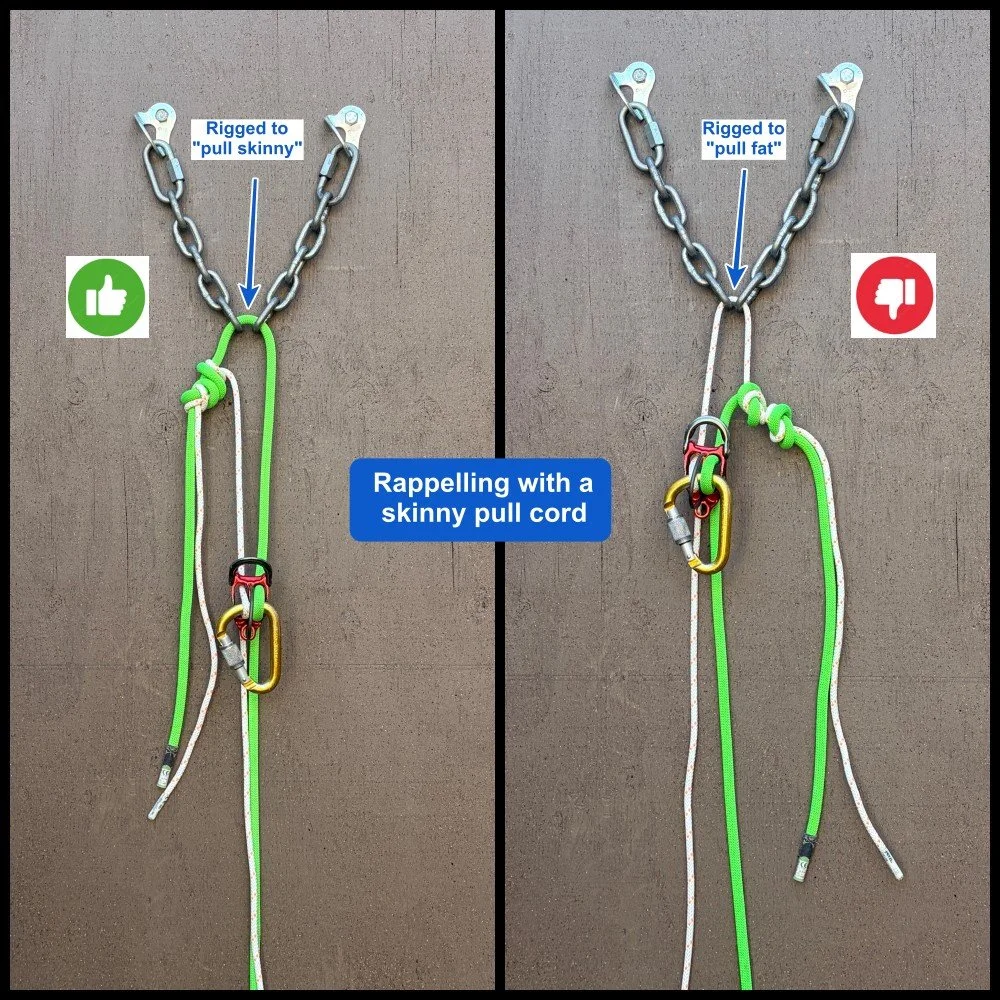
When you rig a rappel with ropes of two different diameters, you always have a choice which rope to pull. The standard rigging: pull the smaller diameter rope.
(The memory jog that I like: “PS”, or “Pull Skinny”.)
Why should you (usually) rig to “pull skinny”?
When rappelling on ropes of two different diameters, the fat rope (usually) has more friction through your rappel device then the skinny rope. This means the skinny rope might pass through your rappel device faster than the fat rope, which moves the joining knot in the direction of the fat rope.
If you rig to pull the skinny rope, the joining knot will usually be pulled a tiny bit into the anchor master point, which is what you want. If your anchor master point is a small chain link or quick link, or even a small loop tied in cord or webbing, the knot jams up against this and stops moving. Not a problem.
What happens if you rig to “pull fat”?
The same issue still happens: increased friction between your rappel device and the fat rope. However, because the joining knot is on the fat side of the rope, the knot doesn't get jammed into the anchor, but instead can “migrate”, or move downward away from the anchor.
The knot moving DOWN means the end of the skinny rope is moving UP.
This can happen with ropes that are just a couple of millimeters different, such as a 10 mm and a 8.5 mm.
It can be more of an issue with a skinny pull cord (often 6 mm) and a standard climbing rope.
I've also heard if one rope is wet and the other one is dry-ish (which could happen with a Dyneema pull cord as it absorbs minimal water) knot migration can be increased. I don't have any personal experience with this.
It can be hard to notice the ropes not moving evenly when rappelling, especially if your fat rope is a solid color and doesn't have a pattern on the sheath.
It tends to happen more at the start of the rappel, when there’s increased friction because of the weight of the rope below you.
If you have a short rappel and/or a lot of extra rope, some knot migration may not be a problem.
However, if it's a longer rappel and you're using a skinny 6 mm pull cord, knot migration can be significant, which can cause some big problems!
In July 2026, there was a fatal accident in Norway involving an American climber.
According to the accident report, the climber rappelled with a set up like the photo above on the right, pulling the fat strand, which was paired with a 6 mm pull cord.
Apparently, the climber chose not to tie stopper knots in the end of either strand. That may not have helped, because a stopper knot in 6mm cord could've pulled through the rappel device anyway. Clipping the end of both strands (or at least the pull cord strand) to their harness would probably have prevented the accident, but that’s sort of a separate issue.
The joining knot migrated down the fat side of the rope, lifting the end of the skinny rope off the ground. The end of the skinny rope passed through their rappel device, resulting in a fatal fall.
Following this accident, the Interweb was full of statements like, “You should ALWAYS rig to pull the skinny rope!”
While I mostly agree with that, it's also important to keep in mind that there are very few black-and-white, “always do this, never do that” rules in climbing. This isn't one of them.
Like most every other technique, there are shades of gray. Yes, most climbers in most situations would benefit by rigging to “pull skinny” as the default.
However, for experts in certain situations, pulling the fat rope can be a good idea, provided you’re aware of all the potential problems, and some ways to solve them.
Here's a short video of how knot migration can happen. (This is kind of an extreme example because I have a thick 10 mm rope paired with a 6 mm Petzl PURline, and my device is set in the normal high friction mode.)
There are two ways that knot migration can happen.
1 - Unintentional
If you rig the standard way to pull skinny, but the master point of the anchor is large enough for the knot to slip through, it's possible that the knot could pass from one side of the anchor through the other.
If you’re rappelling with both strands through your device, this may not be a problem. However, if you're doing a knot block and only rapping on one strand, this could kill you!
You can eliminate this by using a quick link, or if you're using cord, tying a small knot of some kind that prevents the knot from sliding through.
2 - Intentional
Hopefully, fully knowing the pros and cons, you set up your rappel so you pull the fat side of the rope. Yes, this does go against the general rule of “pull skinny”, but for experts, who understand the potential consequences, it can have several advantages.
Why might you want to “pull fat”?
If you have multiple pitches to rappel, you can use the standard technique of feeding the end of the pull stand through the lower anchor and alternating strands as you go down. (If you don't do this, every other rappel requires you to secure the rope, untie the joining knot, thread the rope so you’re pulling skinny, and re-tie the joining knot. This takes more time, and introduces additional issues, like potentially dropping the rope, and maybe tying the joining knot incorrectly.)
It's much easier to pull the rope. The larger diameter rope is easier on your hands, and there's much less weight and friction through the terrain and anchor point because of the lighter and more slippery skinny rope. The heavier weight of the fat rope assists with pulling. In terrain with lots of blocks, features, and maybe slab, this can make a huge difference.
If you pull the end of the skinny rope up out of reach, and then it gets snagged, you have a fat dynamic climbing rope in your hands to hopefully solve the problem, and not a skinny static bit of alpine dental floss.
Pulling fat ONLY works with modern high strength pull cords!
Using some version of a parachute cord / accessory cord / long shoelace as a pull cord has been done for a long time. These cords were never meant to support bodyweight, and were only for pulling down the rope.
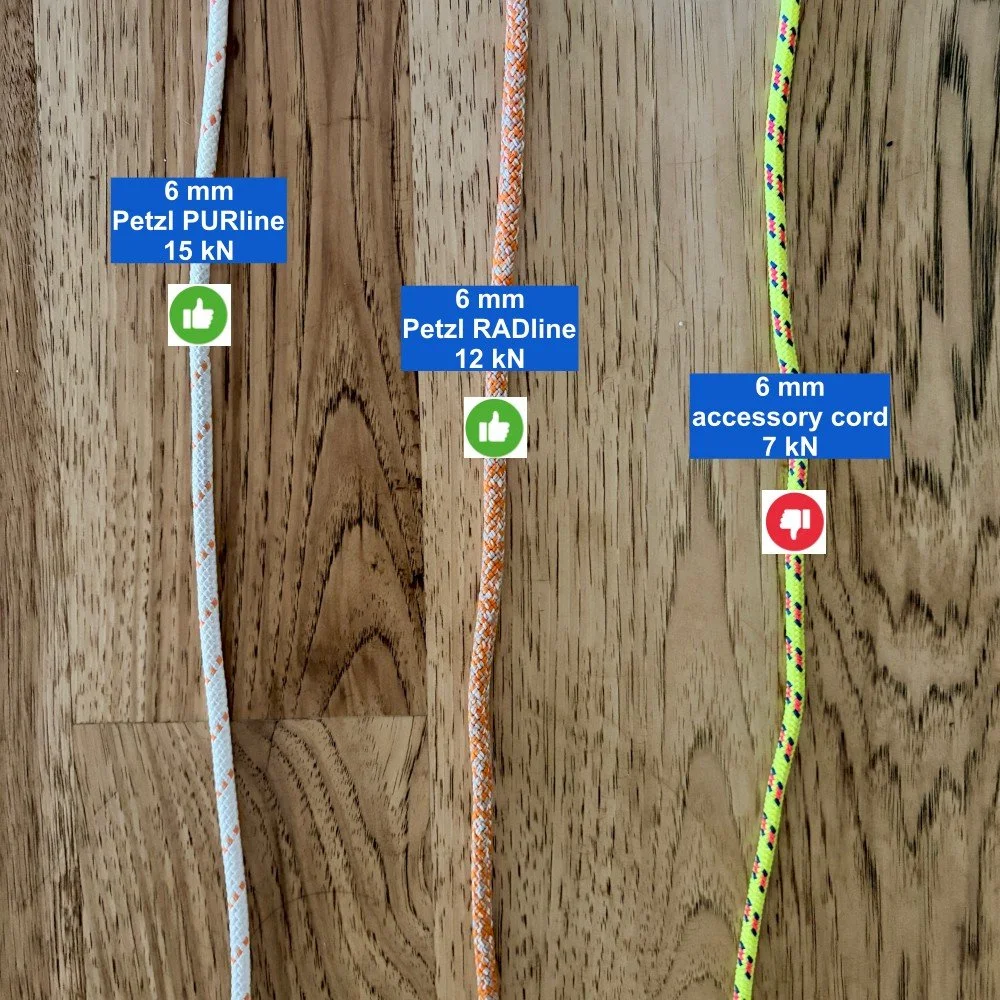
With the recent introduction of high tech, high strength rappel cords, such as Petzl PURline (15 kN), RADline (12 kn) or Edelrid Rap line (10 kN) that have a core of Dyneema or Kevlar, these fancy cords are strong enough for full bodyweight (even if the manufacturer may not be too excited about you using it that way.)
Compare that to standard 6 mm accessory cord, which is rated to about 7-8 kN.
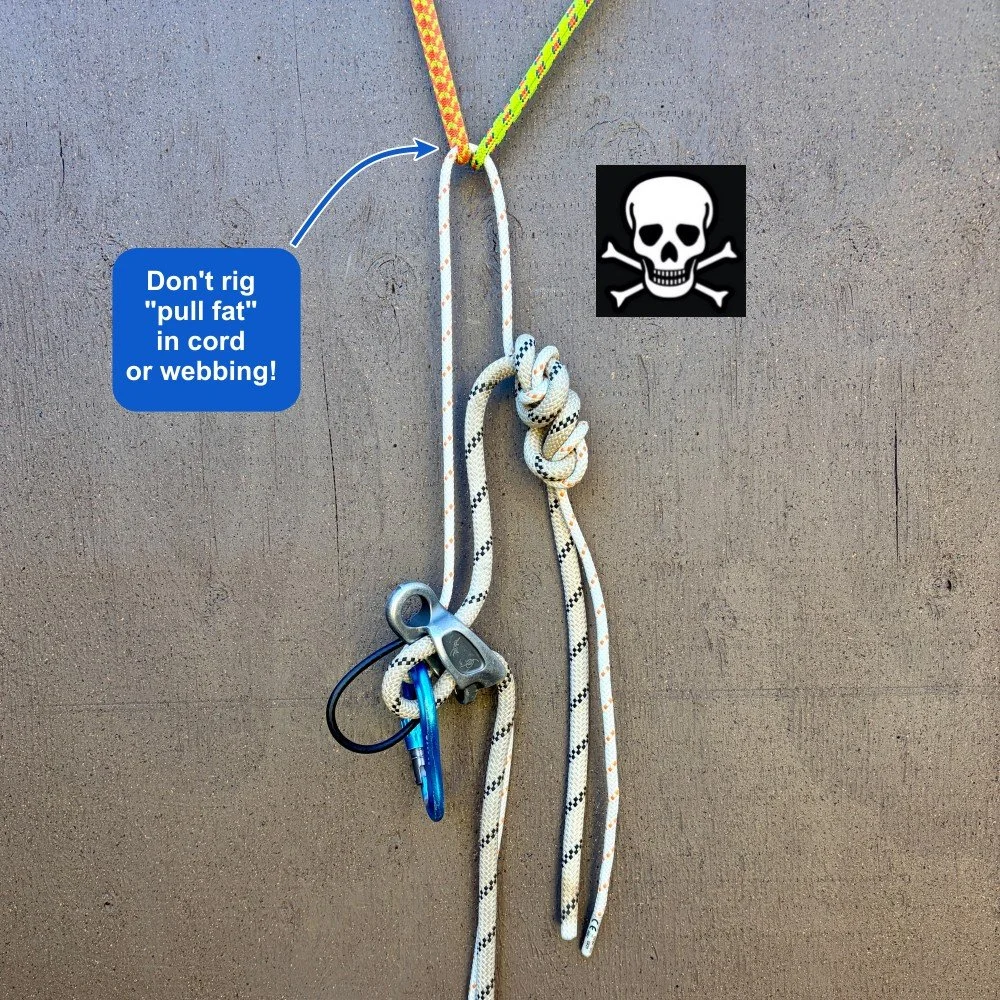
This could be a lethal mistake . . .
In climbing 101, you hopefully learned that you should never have a moving rope running through a static cord or piece of webbing. Under bodyweight and friction, the moving rope can easily cut the static material.
If you rigged a “pull fat” rappel through cord or webbing (which is something that could happen if you make a V thread anchor in ice, for example) and the knot starts to migrate, you could have this exact situation!
Avoid this by adding a quick link to an anchor that's made of cord or webbing.
One way to avoid the problem entirely: use double or twin ropes
Because the rope diameters are the same, knot migration isn't an issue. There are pros and cons to every different rope system, and I'm sure not gonna get into that here. However, it’s worth mentioning this as a big benefit to a double rope system. I'll leave it at that.
So, for you experts who are considering “pulling fat”, how can you address the problem of knot migration?
Here are two great resources from British climbing expert Andy Kirkpatrick.
A terrific overview of the issue and step-by-step walk-through of a hypothetical scenario where this could cause a big problem, posted September 2026 on Andy's Substack. Read it here.
In Andy’s Kirkpatrick outstanding book on descending mountains called “Down”, he covers knot migration, starting on page 329. (I think this book should be required reading for all climbers.) He covers at least six different ways to reduce knot migration. I'm not gonna cover all of them here, so buy his book and read it. =^)
Here are a few options to deal with knot migration.
For the first person descending, you can fix / tie off the rope(s) to the top anchor. You can do this in multiple ways; a simple one is clipping the fat strand to the anchor with locker and a butterfly knot, which is easy to untie after being loaded. Another option is the Stone hitch.
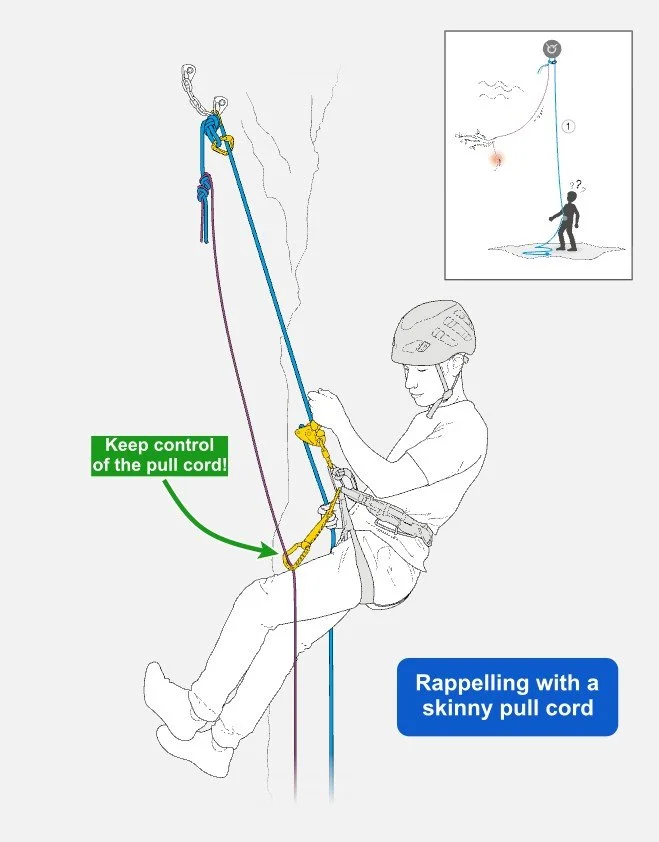
The fat rope is tied to the anchor, so the knot can’t move. The first person down rappels on the single “fat” strand.
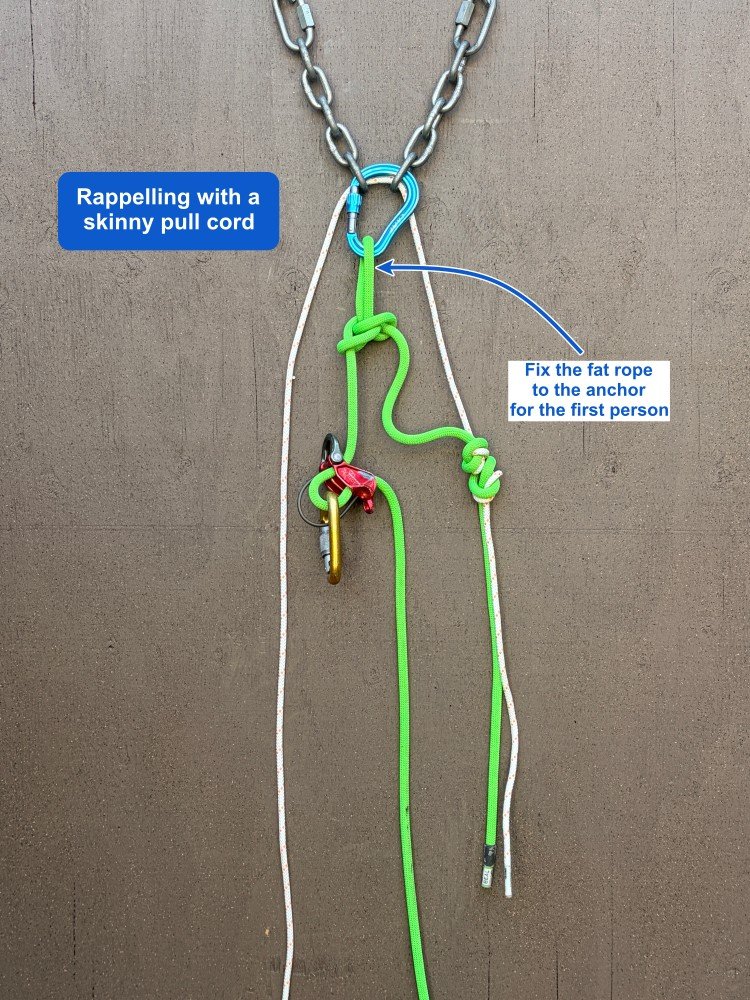
The first person down needs to always keep control of the skinny rope. They can clip it to their harness with a carabiner, or put it through the other slot in their tube style rappel device.
If you lose control of that skinny cord, it could swing or blow off to the side and cause a BIG problem if you can't reach it!
Another bonus, as you can see in the diagram below, this lets the first person down rap on a Grigri, which can have lots of advantages.
To prevent or reduce knot migration for the second person down, there are several solutions.
Experiment with different flavors and orientations of rappel devices. Sometimes it's as simple as flipping your device around so it's in LOW friction mode, so it doesn't grab the thick rope quite as much. (This might be counterintuitive; try it with your device and see how it works.) In my testing, having less friction causes the thicker rope to slide more easily, helping keep both ropes properly moving through the device.
Consider putting both ropes through the same slot in your device. Because the ropes strands are next to each other, this encourages them to pass through the device at the same rate.
How about that Munter hitch? With a Munter, the adjacent ropes tend to move at the same speed around your carabiner. And, if you use the proper technique, you can do it without twisting your rope. (Having said that, skinny 6 mm cords are already prone to tangling, and you could cause an EPIC mess if you get it really twisted, so keep that in mind.)
The first person down can tie both ends of the rope to the lower anchor. This is known as the J Loop. This had several benefits, one of them being that if one rope starts to creep upwards, it can only go a couple of meters. Granted, this might cause some problems for the next person coming down, but it's certainly better than rapping off the end of your rope.
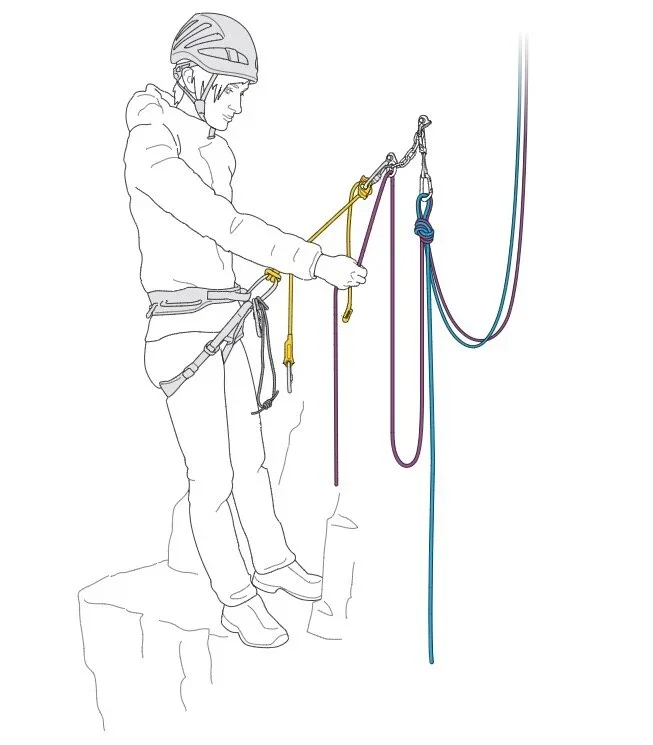
The second person down can clip the end of the skinny rope to their belay loop with a locking carabiner. This doesn’t prevent knot migration, but it does stop the potentially lethal mistake of rapping off the end of the skinny cord.
Andy Kirkpatrick covers several other methods to reduce risk for the second person in his book “Down”. Get it and study this section (pg 329).
What are three types of anchor hardware that you shouldn't use with a knot block?
What's the recommended knot to use to join a skinny pull cord and a fat climbing rope?
What's a make and model of a specific rappel device that can pretty much eliminate this problem?
Want to see a video from an expert climber who talks about this issue?
