You’ve finished a long multi pitch climb, using a single rope. From the top, you need to make some double rope rappels to get down.
You partner carried a lightweight 6 mm pull cord in her pack, and you now need to use it to make your long rappels. (You chose not to climb with double ropes, because the route was pretty much straight up, and you decided with your partner that the extra hassle/cluster factor of double ropes was not worth it.)
Before you head down the lines, you want to be mindful of a few things.
When rappelling on ropes of two different diameters, the skinny rope will usually slip through your belay device a little faster than the fat rope, which means the ends of the rope may not stay together.
This happens because there’s more friction on the fat rope side, so the fat rope has the potential to move with you a bit more as you are descending.
This leads to the possibility that the end of the skinny rope can lift off of the next anchor point, potentially leaving you with rope ends that are uneven. If you’re doing a full rope length rappel, this could be a problem.
(The degree to which this happens depends on a a few things, such as what kind of rappel device you’re using, or how slippery or grippy the rope sheath is, and whether the rope size difference is 1-2 mm, or maybe 3-4 mm.)
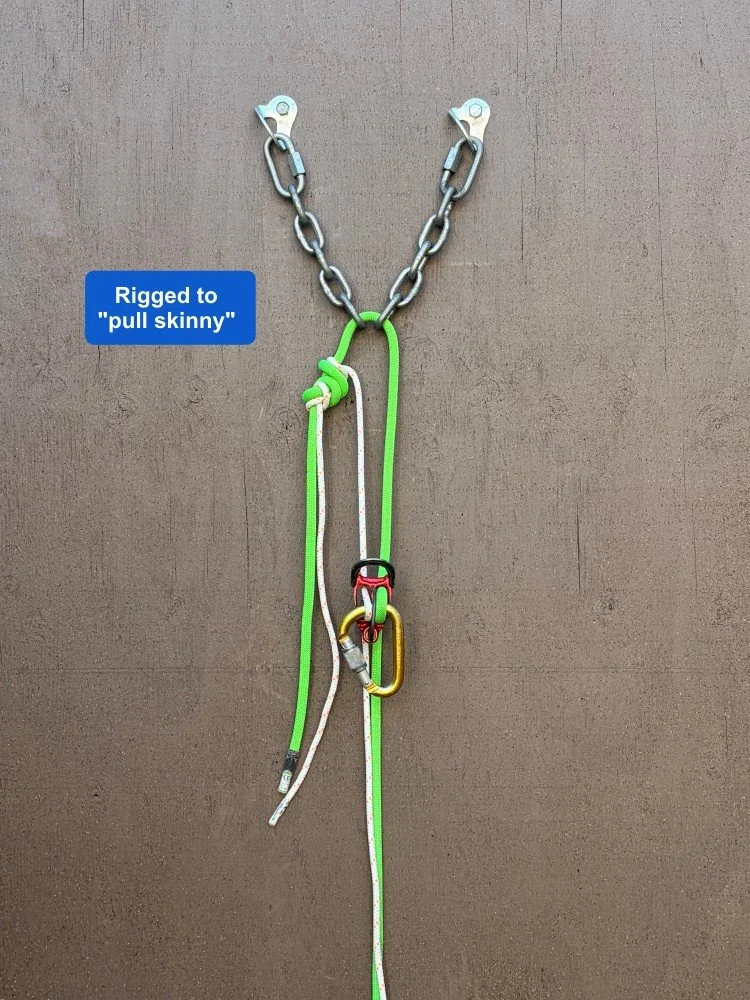
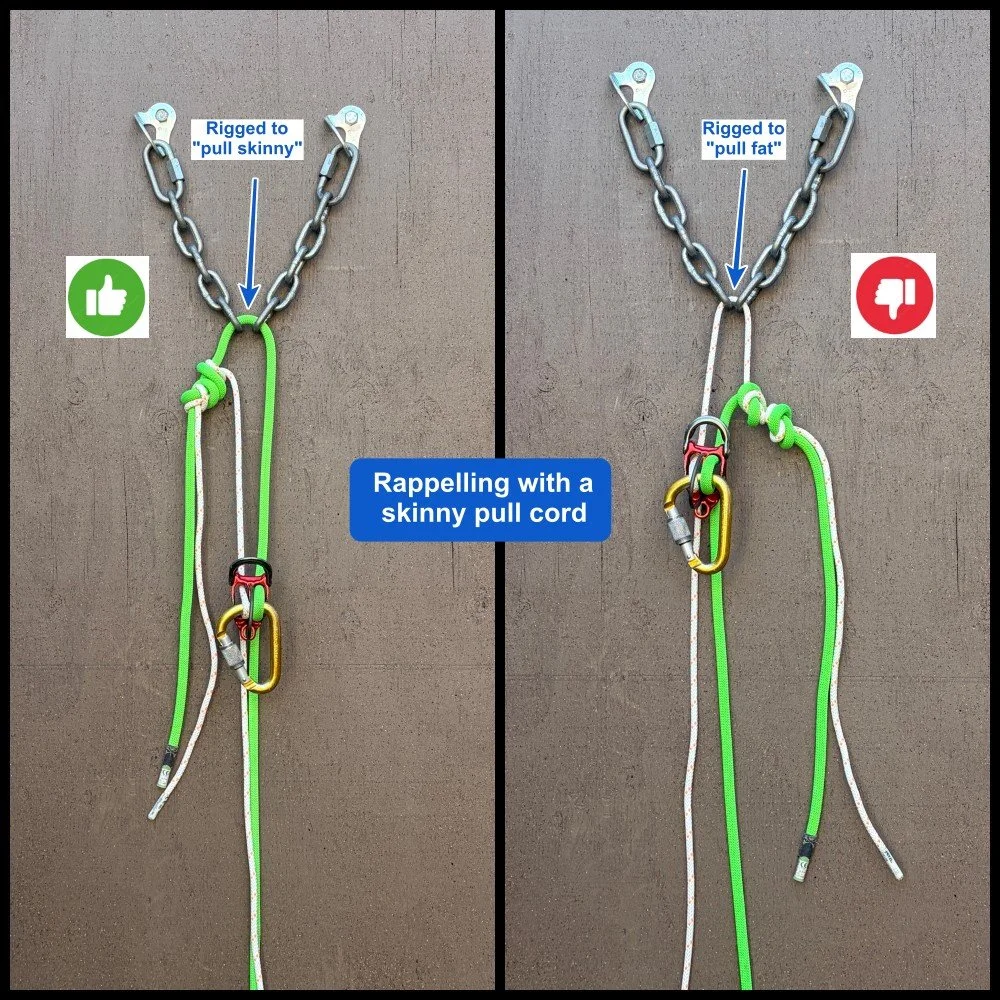
There’s a few ways to keep this from happening. One is to put the knot connecting your two rap ropes on the “skinny rope side” of the anchor. That way, if the thick rope starts to migrate, the knot will hopefully be stopped by the anchor master point, and keep the ends of the rope at the same length.
It helps if the master point of the rap anchor is a quicklink or some other small diameter hole, rather than a carabiner, which might allow the knot to migrate through it, making the rope pull difficult if not impossible.
Here's a pneumonic to help you remember a way to mitigate this: PS, or "Pull Skinny.”
That means when you're finished with your rappel, you always pull the skinny rope, which is the side with the knot.
Left: correct rigging. The knot is on the skinny rope side of the anchor. If the knot migrates, it'll stop at the chain link. "Pull Skinny", or "PS", means pull the white skinny rope to retrieve it.
Right: incorrect rigging. As the larger diameter green rope migrates, it'll pull the knot downwards.
Like most things and climbing, this is not an absolute black-and-white rule. There are some situations when rigging to pull fat might be helpful, like on a very big mountain with multiple rappels in complicated terrain.
This is a technique that I consider experts only, and I would encourage you to read Andy Kirkpatrick's excellent book “Down” for a good overview of the pros and cons. I think it's about page 386.
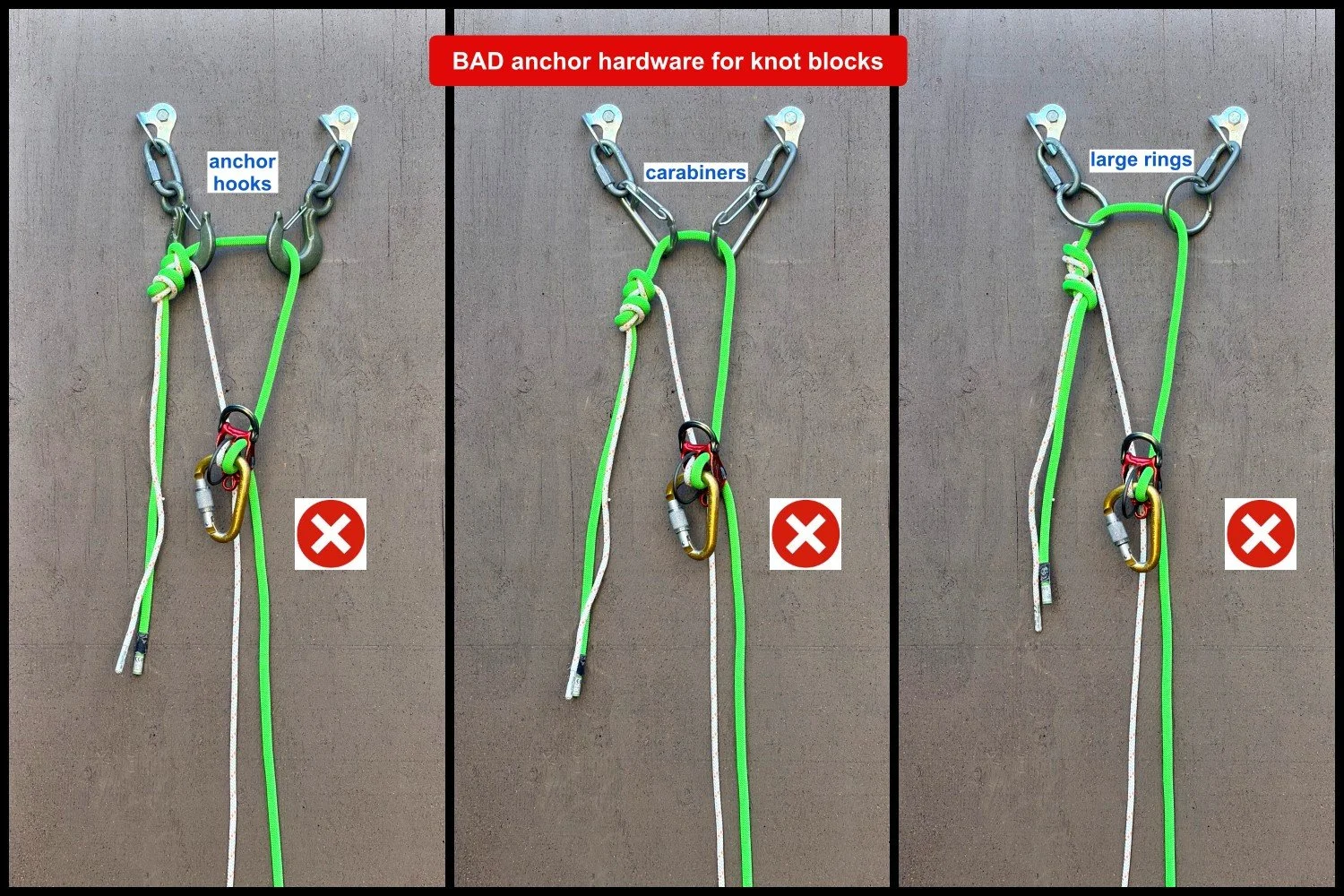
On a related note, it's ideal if the master point of your anchor is a small bit of metal, such as a chain link or quick link. With this hardware, it's pretty much impossible for the not to get jammed into it.
Anchor hardware that has a larger opening such as the photos below of anchor hooks, carabiners, or big rings, are problematic for this kind of rappelling because the knot could easily pass through the hardware.