
The CAMP Reel lanyard

Premium Members can read the entire article here:
Full disclosure: CAMP sent me this gear for free. That in no way biases my review; it’s a great product and I want to tell you about it. There are no ads, brand sponsorships, or paid product promotions on Alpinesavvy. In the rare cases when I get a free product like this, I’ll let you know.
This article may contain affiliate links to HowNOT2. If you purchase through them, Alpinesavvy may earn a small commission at no extra cost to you. Your support helps me improve this website, the world’s largest collection of climbing tips.
While an adjustable personal lanyard / tether isn’t a required piece of climbing gear, it can be very helpful in lots of different situations. That's probably why most major manufacturers now offer some version of it.
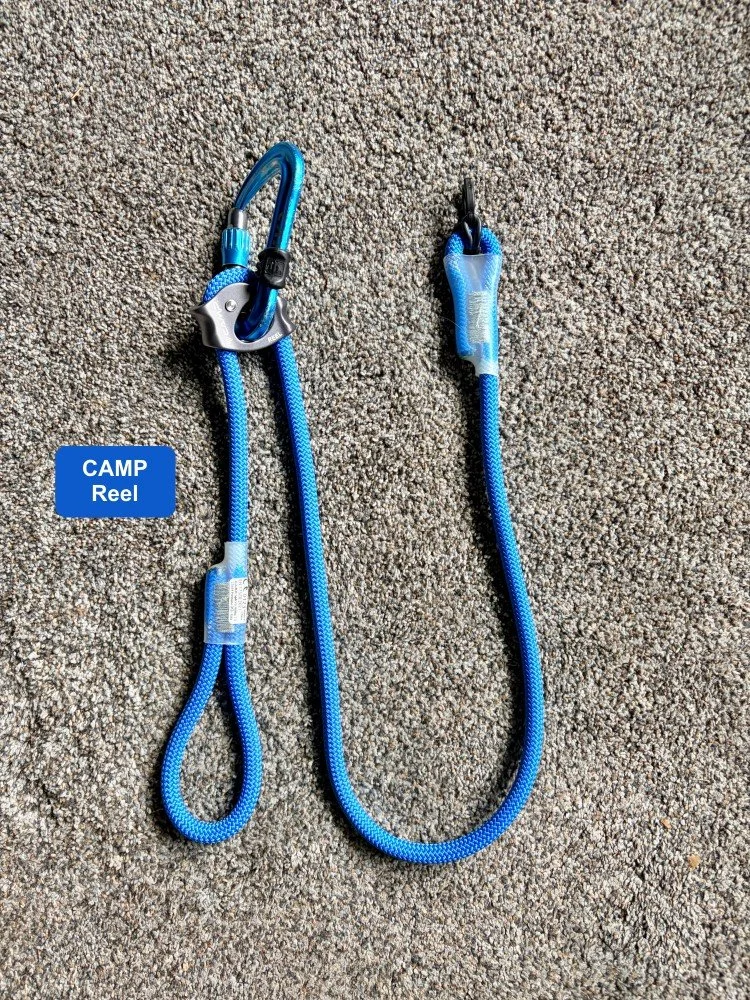
Here's a review of the latest from CAMP, called the Reel.
Before we get into that, here's a short Italian lesson . . .
Did you ever wonder why CAMP is capitalized? That's because it's an acronym, and it stands for “Costruzione Articoli Montagna Premana.”
Costruzione = construction/manufacturing
Articoli = articles/products
Montagna = mountain
Premana = the town in the Italian Alps where the company was founded in 1889.
There you go, we both learned something new today. =^)
The Reel is an upgrade from CAMP’s previous tether, which was called the Swing. The main changes:
Redesigned cam device, which allows for smoother adjustments, especially under load.
9.4 mm rope versus 9.7 mm rope
Slightly longer adjustable range
A little clippy thing CAMP calls the “Reel Snap” so you can easily stow away the extra tail. It’s actually quite useful.
There’s also a version with an section for an extended rappel, called the Reel Duo.
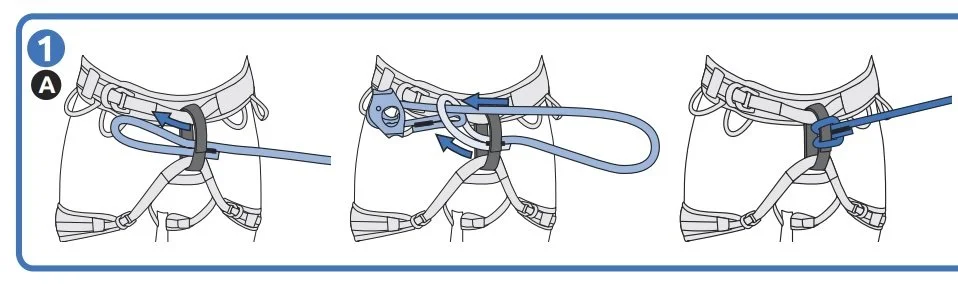
Connect the Reel to your harness with a girth hitch through your belay loop.
Let's start with what everybody wants to know: how does the Reel compare to Petzl Connect Adjust (CA)?
I think the Reel matches up well in several ways:
The sheath on the Reel rope seems more durable and grippy than the CA rope. The older style CA was a hassle to extend, and the rope was too thick. I think Petzl might've addressed the problem too effectively on the new version, because the new CA sometimes it seems a little bit too slick and smooth. The Reel hits a nice sweet spot in the middle, easy to extend and grippy when it needs to be.
This may seem like a minor thing, but the little rubber stopper thingie that keeps the carabiner properly positioned is quite a bit more secure on the Reel than on the CA. That's a good thing, this is something you don't want sliding around after it's properly positioned. Pro tip: you can get your carabiner wet, which lets you more easily slide the stopper thing into position, then when it dries, it's pretty well fixed in place.
You can release the Reel under a full load without any sort of a separate pull cord or a carabiner, which is kind of required with the CA. (See video demo below.)
The metal cam that pinches the rope is quite a bit smaller than the Reel than the CA. I think that’s good, because the sleeve of the locking carabiner that’s clipped to your gear can’t pass through the cam on the Reel, but it can on the CA. (I don't know if this is an intentional design feature from the clever Petzl engineers, but to me it feels like a potential problem.) See video below.
Overall, I think the CAMP Reel is an excellent choice for a personal tether.
Is it wildly better than the Connect Adjust? No, I don't think it is, The CA has a few features that I really like, as I cover in this review.
Either of these tethers would be a solid choice, and it's great that top manufacturers are offering choices like this (along with some hopefully friendly competition.)
Want to see that video of how the cam in the Reel can't go past the sleeve on the carabiner, and how that compares with the Connect Adjust?
Want to check out the cool version with the extension for a rappel, which I'll give away to one of my Premium Members in September 2026?
How about a video clip showing how to release the CAMP Reel under a full load?
