

Premium Members can read the entire article here:
I'll start with a story that a student shared with me awhile back in a self rescue class.
This person, climbing second, was traversing on a multi pitch route. They took a fall, swung into overhanging terrain, and found themselves hanging in space about 5 meters below the last bolt. All they needed to do was ascend the rope and keep on climbing. They had a cordelette and various slings, but didn’t know how to rig them as friction hitches to climb the rope. (There was too much friction in the rope for the leader to haul them up; plus the leader didn’t know how.)
This turned into a call to the local search and rescue team, and this unfortunate person had to wait almost 4 hours to get rescued, hanging there in their harness! Ouch!
A little knowledge of improvised friction hitches, and how to use them to ascend a fixed rope, would've solved the issue.
The humble friction hitch cord. Inexpensive, lightweight, and pretty much infinitely useful when it comes to #CraftyRopeTricks and self-rescue stuff.
Let's have a closer look at the hitch cord, the Swiss Army knife problem-solver of climbing gear.
Is a “hitch cord” the same as a “prusik loop”?
Terminology: I'm using the more general and accurate term of hitch cord. Why?
You can tie several different knots with a hitch cord, like an autoblock and Klemheist, not only a prusik.
It doesn't have to be a loop, it can be “eye to eye", with a small loop on each end. (More on that below.)
How do you make your own friction hitch loop?
To tie your own, a good starting point is 120 centimeters / 48 inches of 6 mm cord.
I’ve experimented a lot with the length. 106 cm / 42 inches (when tied) gives about the smallest usable loop. 120 cm gives you more wiggle room. Having a little extra length in your hitch cord is usually fine, but having one that's too short can be a problem. I suggest starting with 120 cm, tie different hitches on different diameter ropes (single and double strand) and then trim it down a bit if you want.
A common mistake is making a hitch cord that's too long. You only need it long enough to tie an effective hitch onto whatever diameter rope(s) you're using, and enough space to clip a carabiner. When you first cut the cord, it's probably gonna look too long. That double fisherman's knot, with nice long tails, takes up a lot more cord than you might think.
6 mm is a good diameter. It's small enough to be grabby on small diameter ropes, but big enough to inspire confidence when you're hanging from it way off the ground.
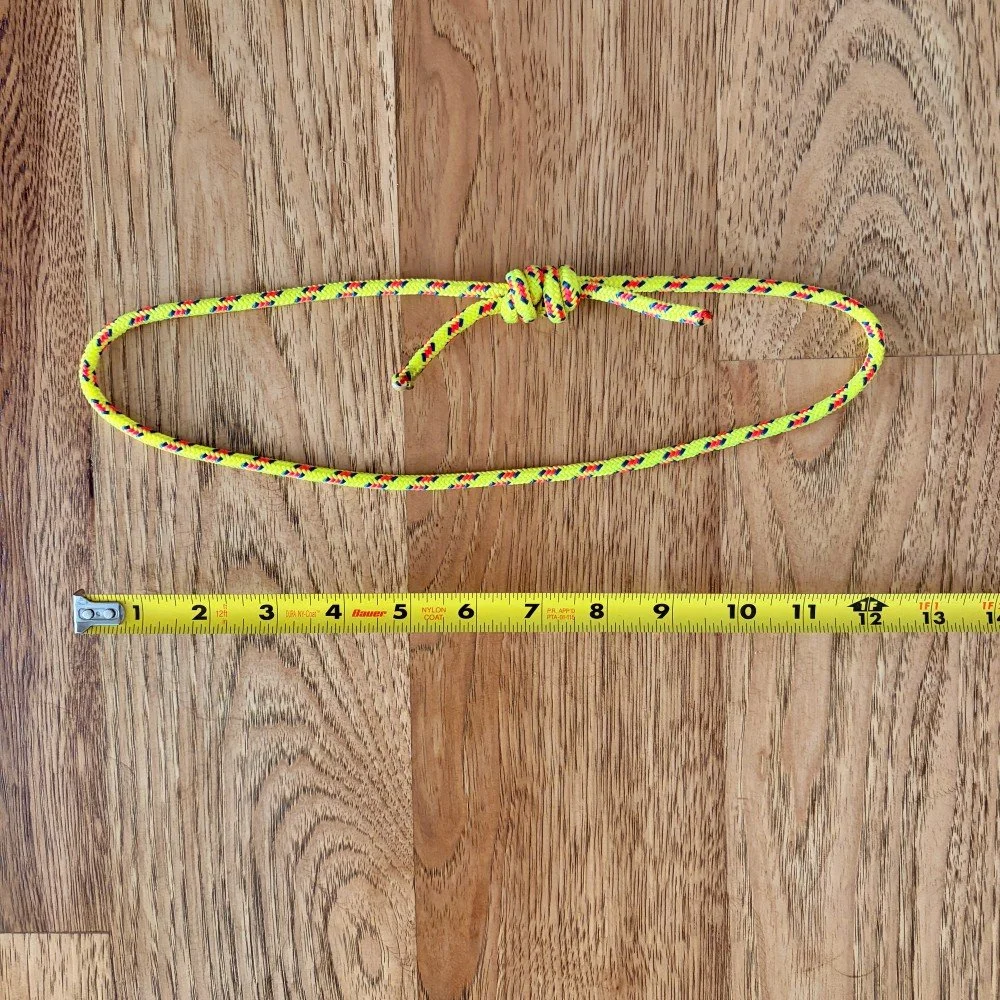
When you're done tying it, you want a loop that measures about 30-38 cm / 12-15 inches when you stretch it out. (The photo below shows a slightly smaller loop.)
Have the climb shop use their hot knife to seal the ends. If that's not an option, tape the cord where you want to cut it, slice it carefully with a sharp knife, and then put a few dabs of superglue on the end to seal it up. Here's my longer article on how to neatly cut a rope.
Different manufacturers make cord of various softness / stiffness. Cord that’s softer tends to work better for friction hitches, so if you have a choice, go for that.
Tie into a loop with a double fisherman's knot that's properly dressed, and really snug down the knot with tails of at least 5 cm / 2”. After you get the length dialed, you can get this knot wet and crank it tight by bouncing on it, because you're never going to untie it.
Test your rigging systems
It's good to have a go-to setup, especially for a rappel autoblock, that you use all the time. Test different flavors of hitch loops with the rope that you use most often, both double strand and single strand, to see, which works the best. This could be especially important with smaller diameter rope.
You don't want to find out in the middle of a rappel that your hitch cord has too much or not enough friction. Figure this out ahead of time in a controlled environment. Maybe start on a staircase, and then move to something vertical close to the ground.
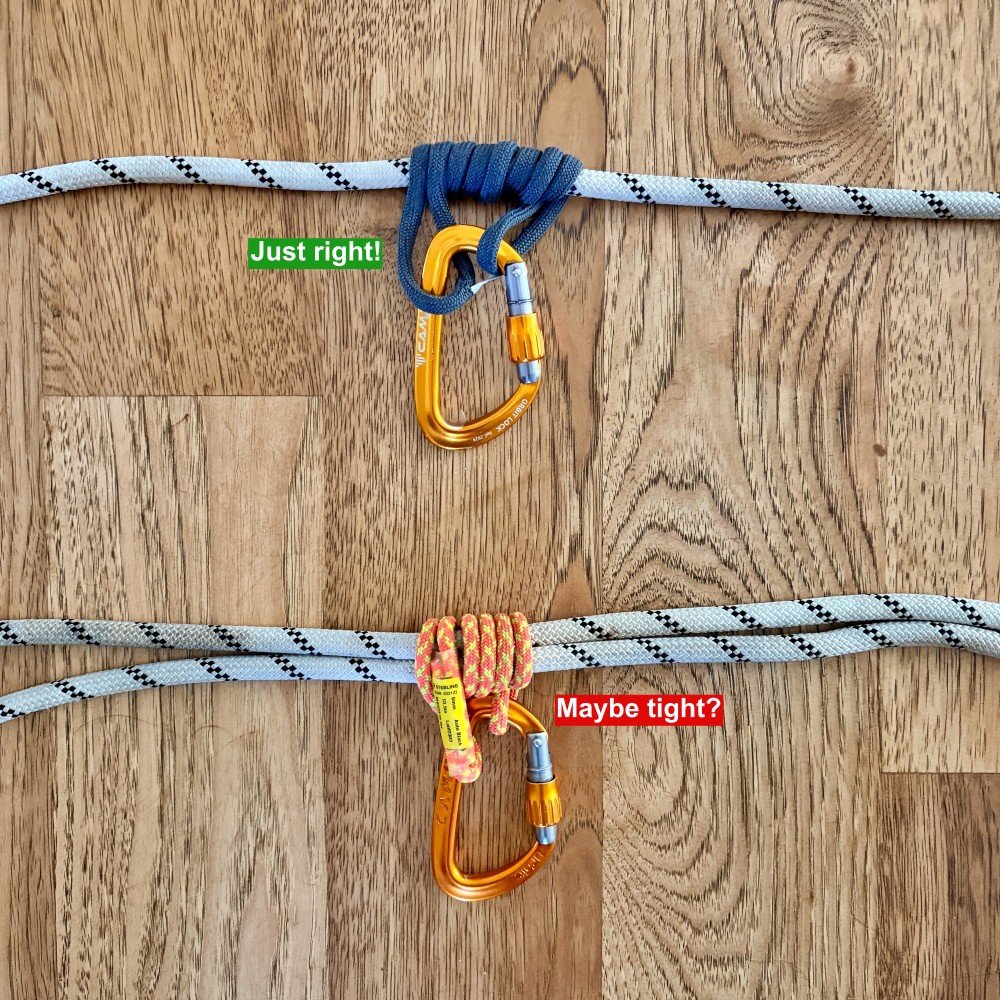
For example, in the photo below, the auto block hitch on the single strand of 10 mm rope looks great. However, the hitch cord on the double strand is just barely big enough.
How do you rack it? Do the twist
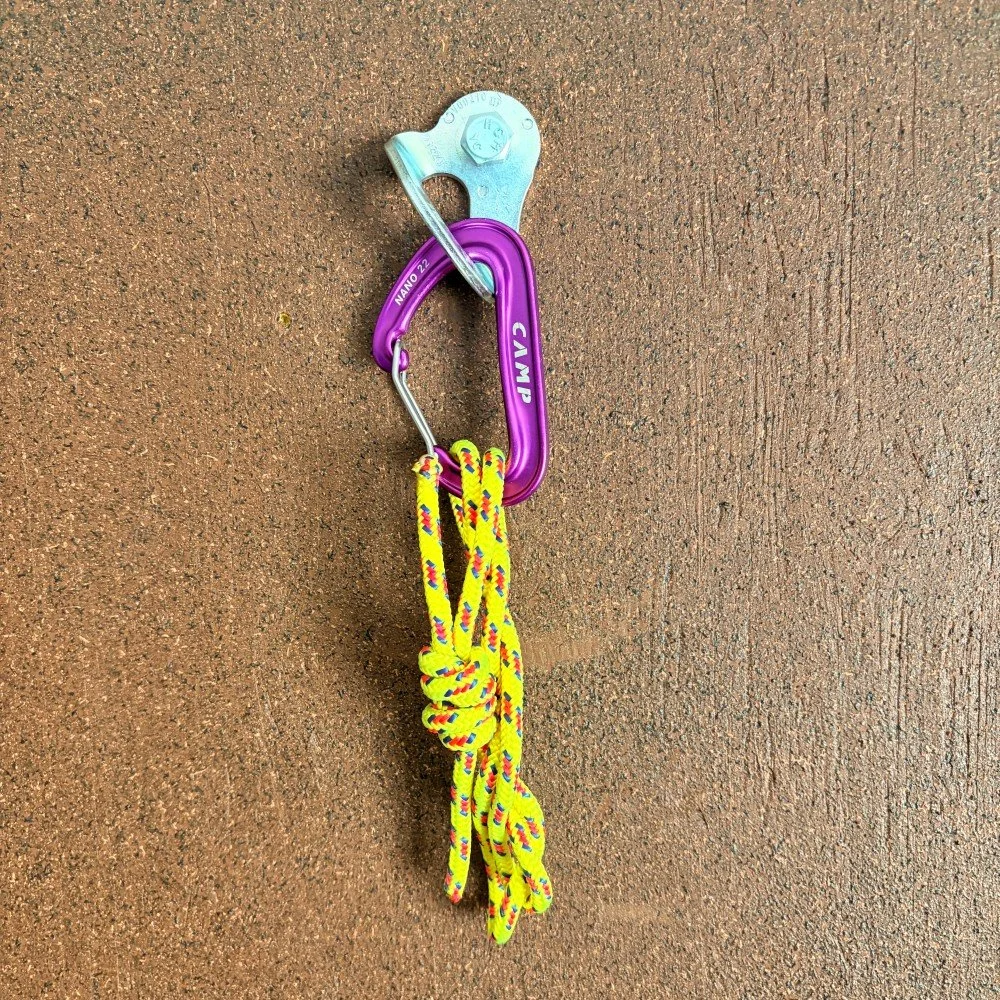
My favorite way: “do the twist”. Hold the loop by both hands, put a few twists in it, then clip it with a carabiner. The cord sort of does a little double helix thing, gives itself a hug, and makes a neat bundle for your harness. No need for fancy macramé projects. The twist is fast, simple, and works with cordage of any length.
How strong is that DIY hitch loop?
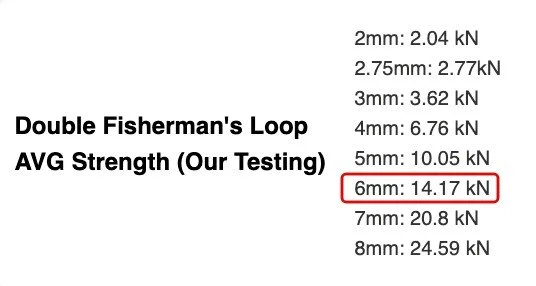
Great question. Our friends at HowNOT2 have these specs on their website. Sterling 6 mm accessory cord, tied into a loop with a double fisherman's knot, is around 14 kN.
Can I use a Dyneema sling to tie a friction hitch?
Yes, you can, but cord is usually better. Cord is typically more “grabby”, so you might have to make a few more wraps if you use Dyneema. But hey, if you're in some unexpected situation and you need a friction hitch, like the one described at the top of this article, then go for it.
It's best practice to NOT use a Dyneema sling as a third hand / rappel backup. Because Dyneema has a relatively low melting point, the heat generated from a fast rappel could potentially damage the sling.

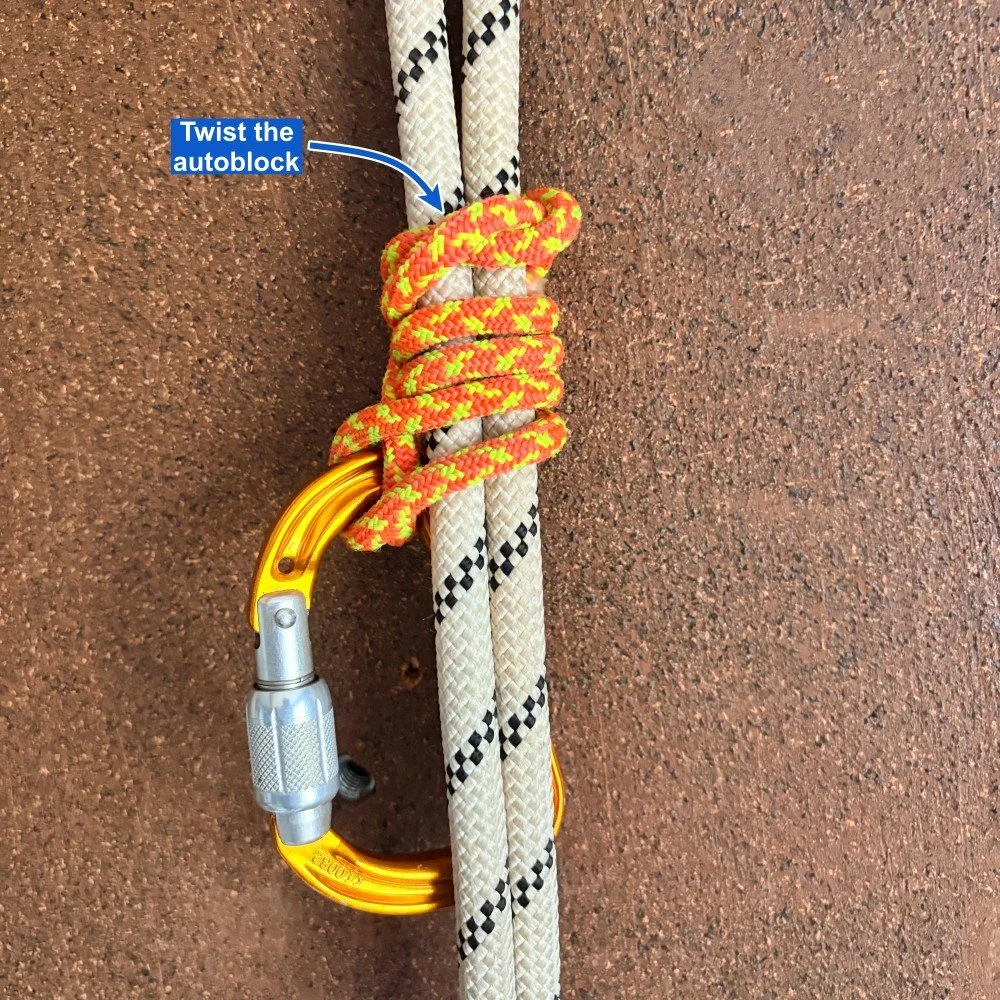
Autoblock tip: add a twist
Sometimes, your autoblock rappel backup might be too “grabby” with three wraps, or not grabby enough if you only use two wraps. Here's a trick that can help.
Instead of making the third wrap, instead twist the auto block sling a couple of times before you clip it to the carabiner. This effectively constricts the hitch onto the rope, which can often give you just the right amount of friction for a smooth rappel.
Here’s a bonus article on this topic (usually only available for my premium members) with a video from an IFMGA guide showing how it's done.
What about factory made hitch loops?
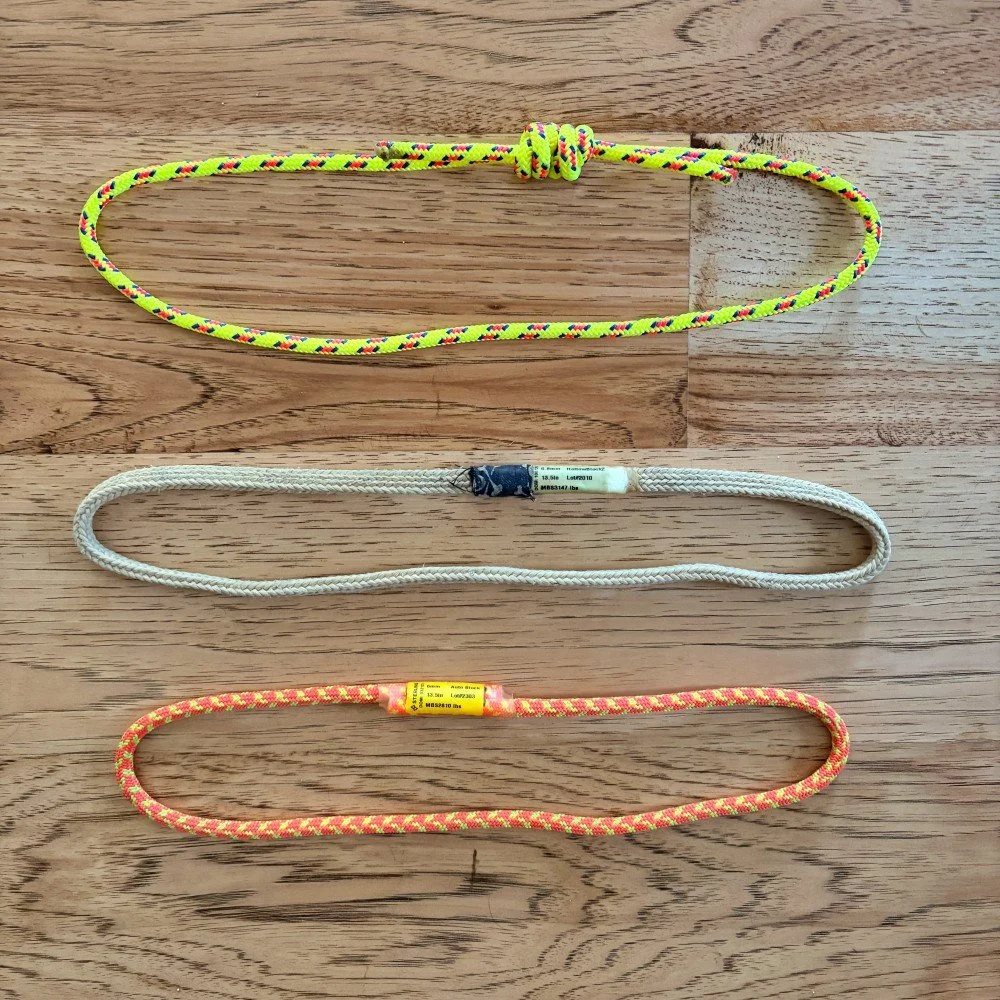
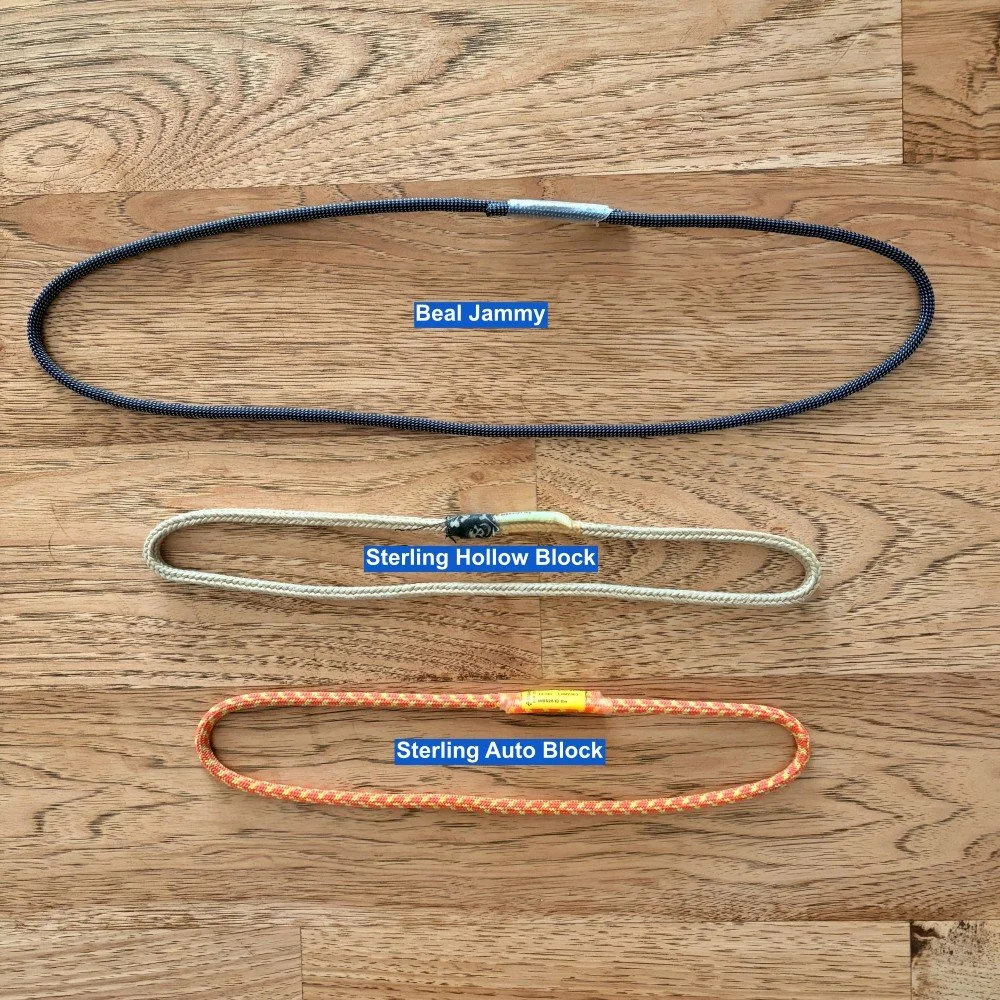
Most rope manufacturers offer some version of a sewn hitch loop. These are usually sewn, so they're a little less bulky and slightly easier to tie friction hitches. They're also more expensive than the DIY version.
When you're out with friends who have different flavors of these, give them a try and see what you think. Below are some that I have.
What about spliced hitch cords?
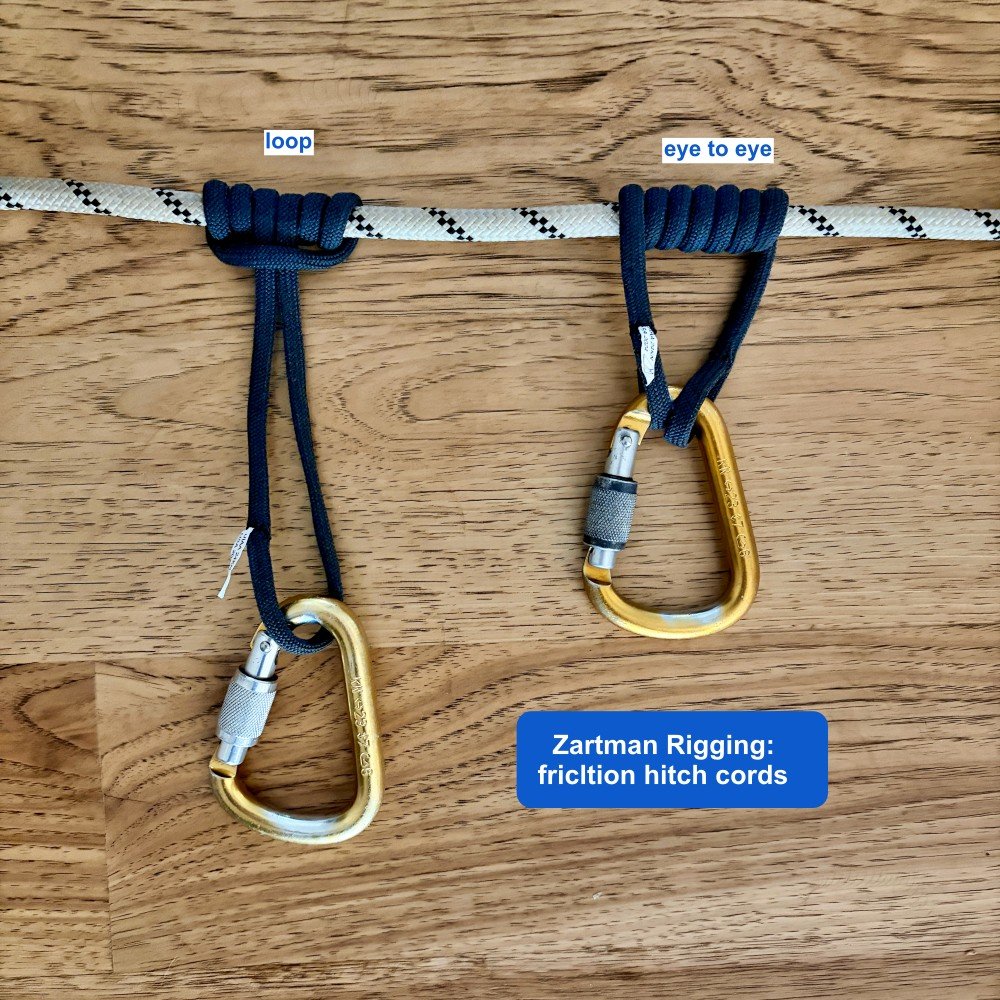
Zartman Rigging make some very interesting spliced soft goods for climbing, among them two flavors of hitch cord. One is a loop, the other is eye to eye.
Because of the splicing, there's no stitching. That makes it easier to tie a friction hitch.
Dyneema core with a Technora / Aramid sheath
UIAA rated to 24 kN
Very interesting products! Check out the Zartman Rigging catalog here.
Here's a link to my more detailed article about Zartman products.
More on the Sterling HollowBlock . . .
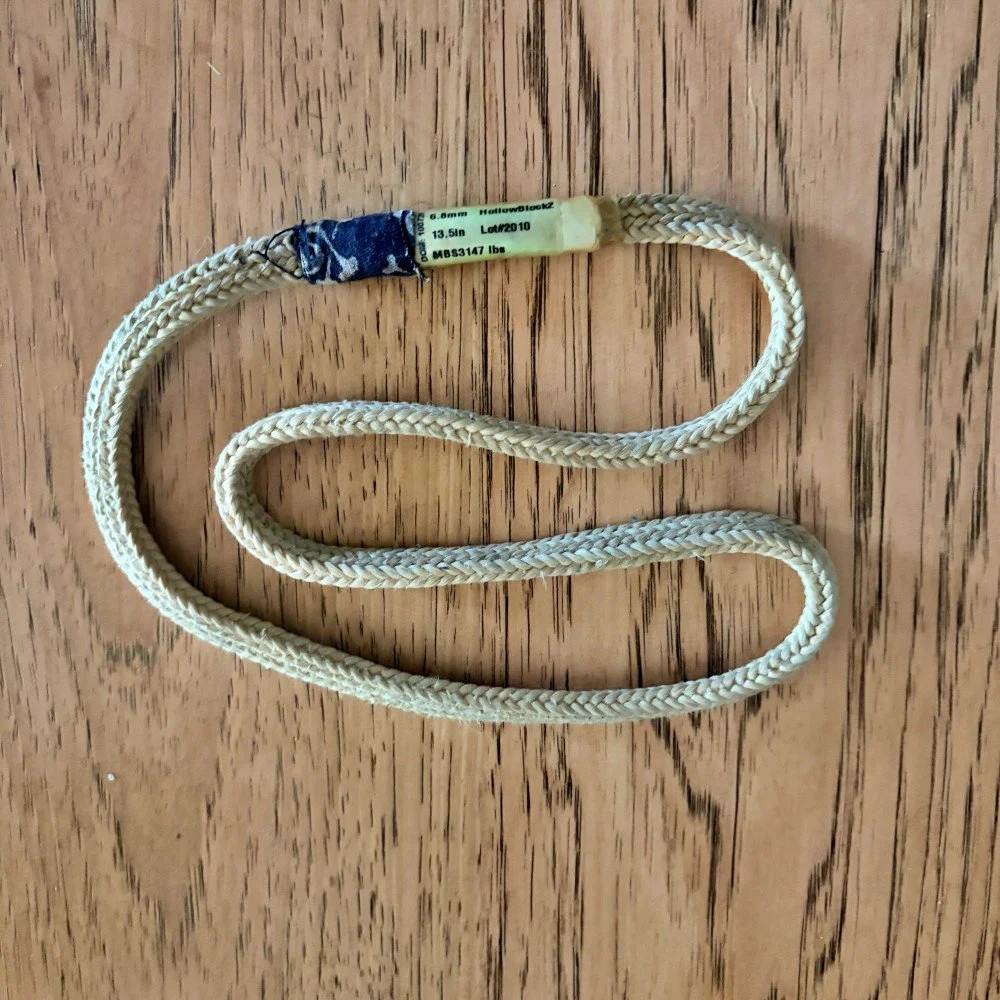
A common factory sewn hitch loop is the Sterling HollowBlock. This is made of Aramid/Kevlar, grabs quite predictably on ropes of various sizes, and is a popular choice as third hand back up for rappelling.
Because it doesn’t have a sheath, dirt/sand/gunk can get inside the cord and compromise its strength. As with all small diameter cord, replace if it starts looking the slightest bit worn out.
Here's a nice article from Sterling about when to retire a HollowBlock.
The current iteration of the HollowBlock is version 2, which Sterling says is made out of a stronger material. Get version 2.
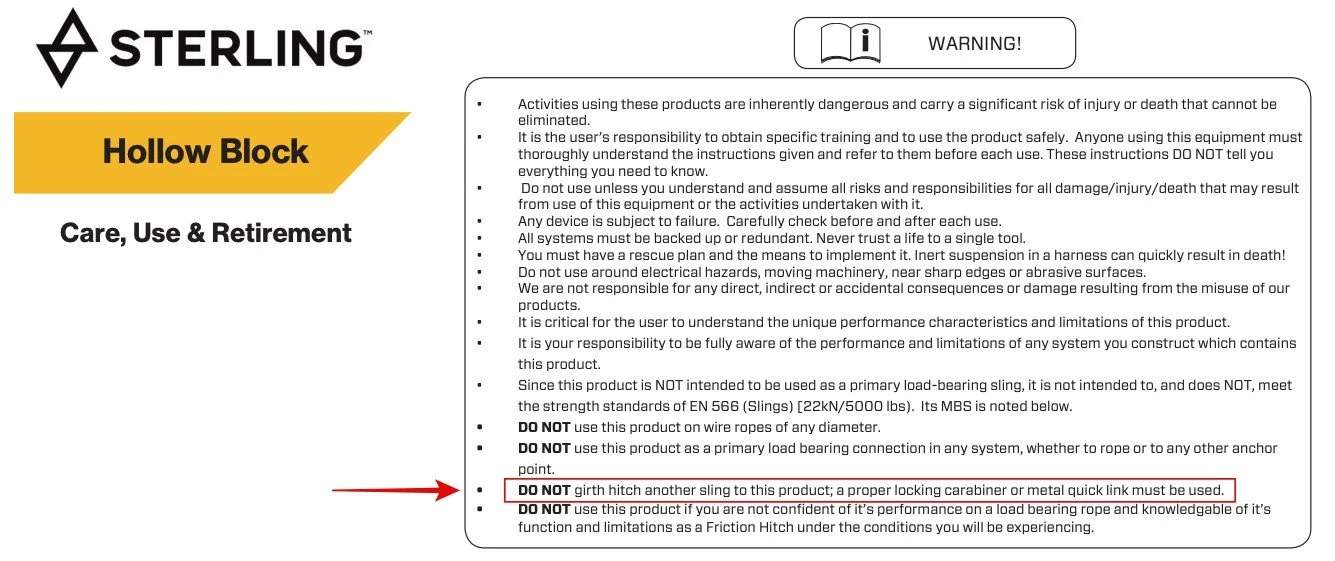
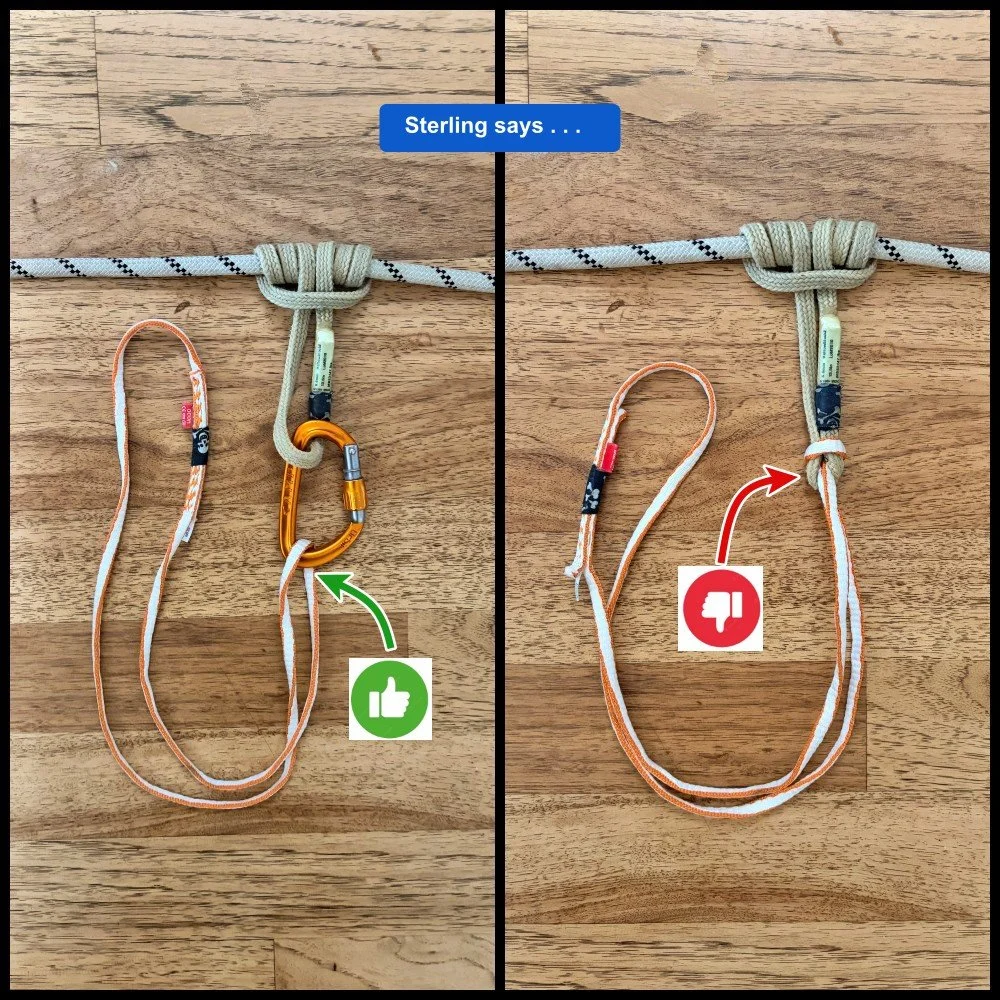
HollowBlock caution: no girth hitching
Sterling says on their website to avoid girth hitching another sling directly onto the HollowBlock. Instead, they recommend a carabiner to connect the slings.
I don't know if this notice is from the legal department or from the engineering department, but I wanted to pass it along.
(Personally, I've girth hitched slings directly on a HollowBlock for rope ascending practice quite a bit and haven't seen any damage; your mileage may vary.)
What about wet or icy ropes?
Friction hitches are usually less grabby if your rope is wet or iced up. Take additional wraps with the hitch around the rope to increase friction. This is a case when having a slightly longer friction hitch to make that extra wrap can be helpful. Test before use!
What about carrying a “waist” prusik and a “foot” prusik in case I need to ascend a rope?
Don't bother. Those are pretty much single use pieces of gear, and it's very old school to carry those. Instead, improvise with the gear you have.
With a short hitch loop attached to longer slings or cord, you can make just about any rope ascending system you need. Here's a link to my article on this.
Here’s a short hitch loop, with a 120 cm sling girth hitched to it. This becomes the “foot prusik” for ascending a rope.
What about an attachment for your waist? Attach a 60 cm sling to another short friction hitch loop.
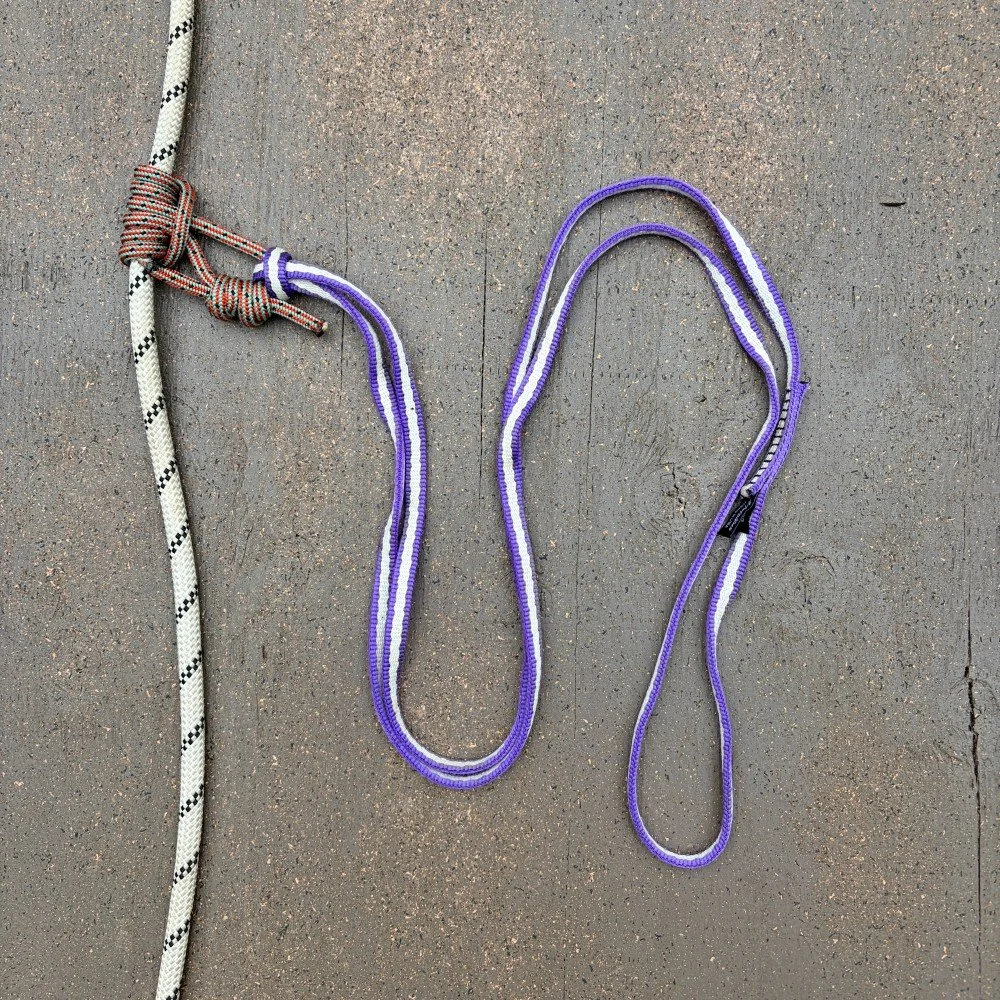
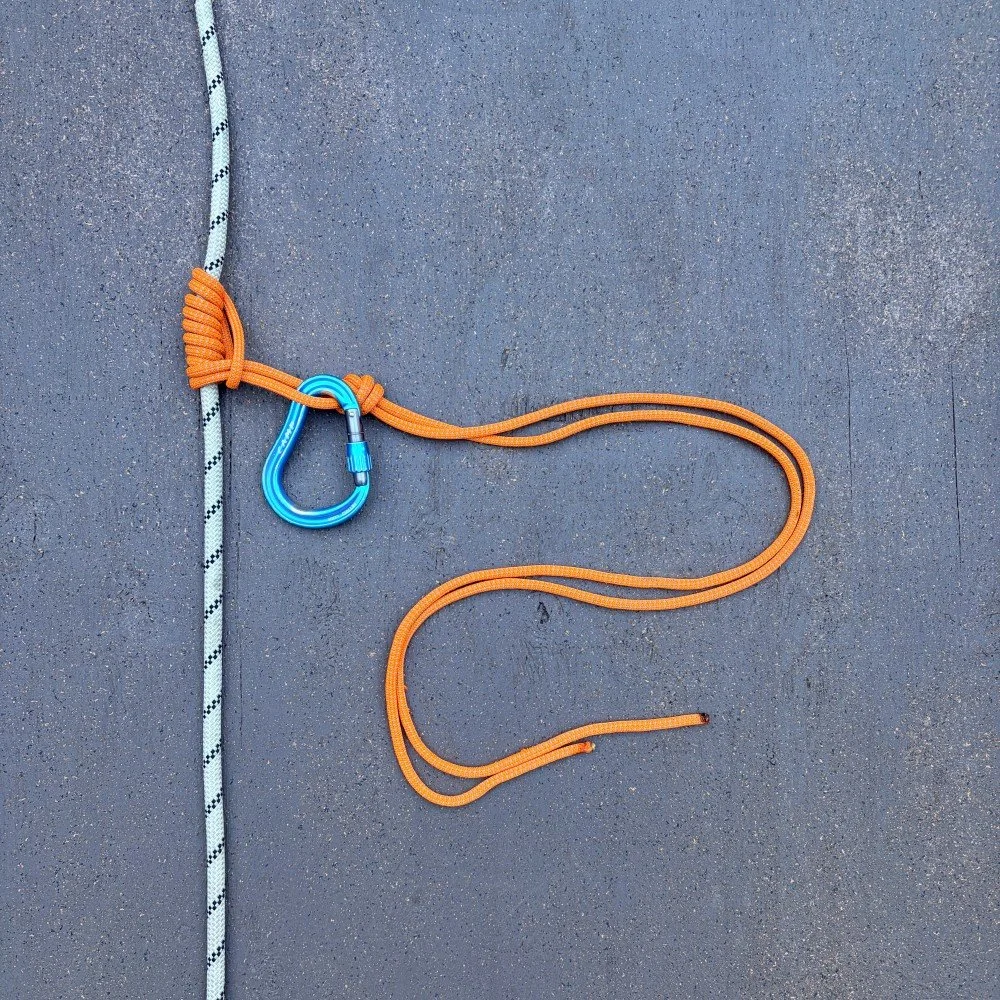
Here‘s a long 6 mm cordelette, tied with a Klemheist hitch to the rope. An overhand knot is tied close to the hitch, giving a convenient clipping point. A long cord can make a hitch loop of any length you need, nice!
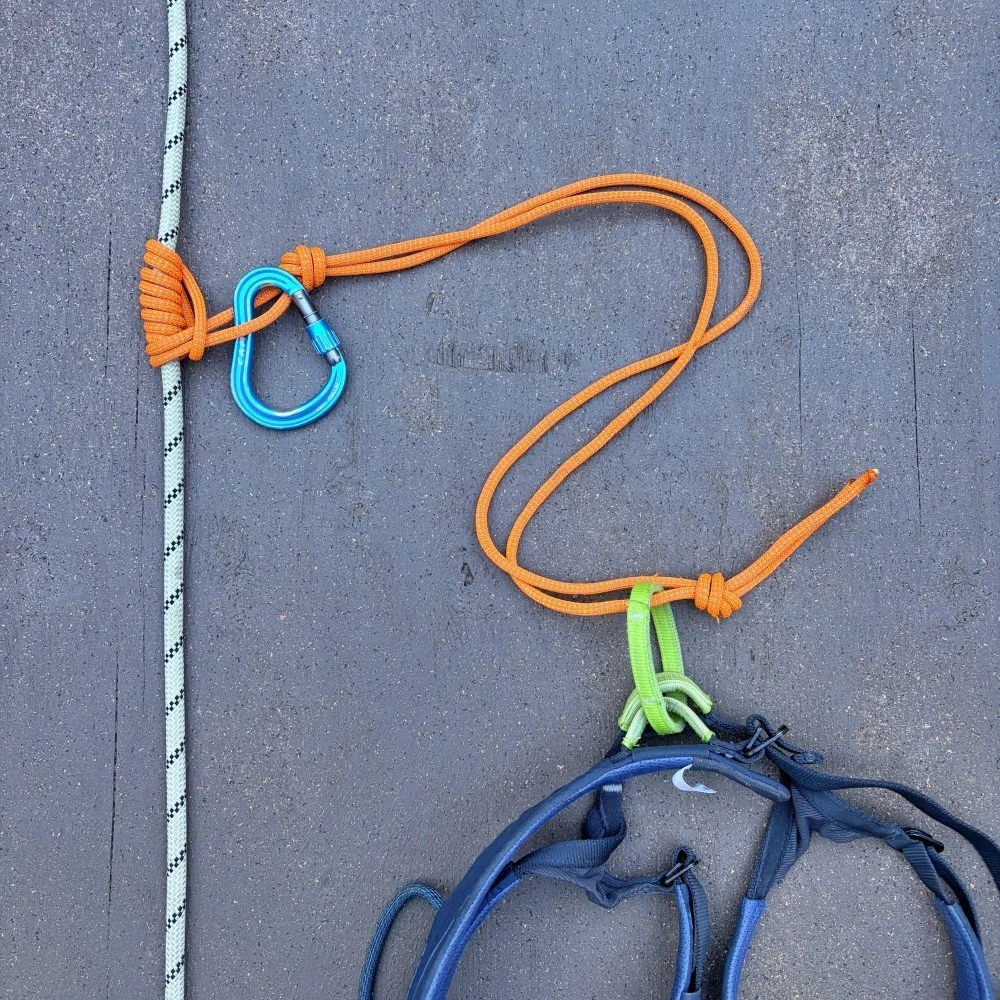
Taking the above example a step further, you can pass the cord through your harness, tie an overhand knot to connect yourself, and then clip the carabiner for hauling or other rescue operations to the short loop close to the friction hitch. This can be helpful for crevasse rescue; I cover more about this technique in this article.
(Related tip: when you're on a glacier, you generally don't need to have your friction hitch(s) already on the rope. Keep them at the ready on your harness, and add them to the rope if you need to.)
Here’s a nice diagram from Ortovox showing this method.
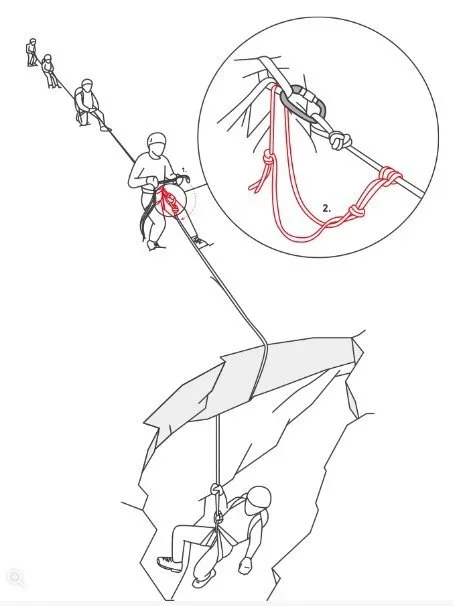
image: https://www.ortovox.com/uk/safety-academy-lab-ice/chapter-3/rescuing-a-companion
What type of hitch cord works on skinny 6 mm rope?
Usually, the diameter of the hitch cord needs to be at least a couple of millimeters smaller than the diameter of the rope it's going on. This makes it challenging to use hitch cords on 6 mm ropes like the Petzl RADline.
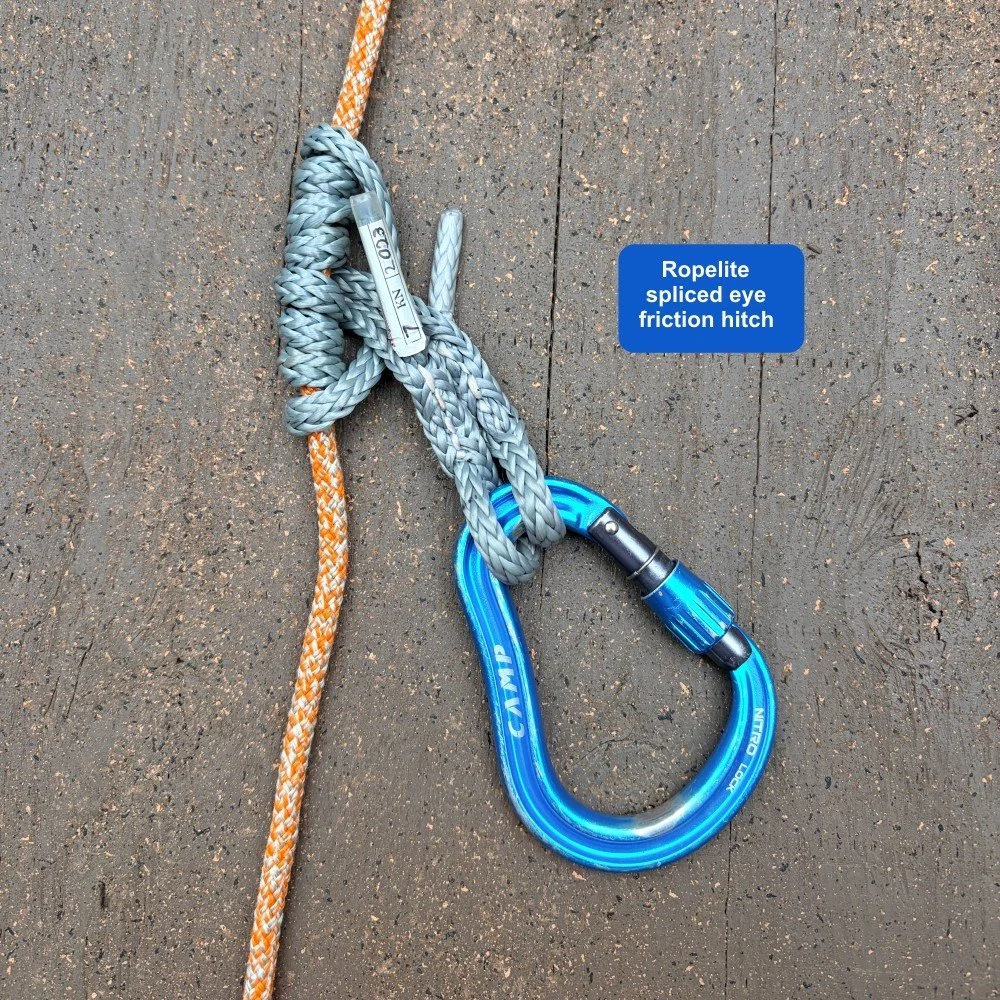
Here's what I have that works well; a spliced polyester 5 mm cord from Ropelite. Even though it's just 1 mm smaller than RADline, a four wrap prusik holds my bodyweight on a single strand.
Ropelite makes some other similar products from Vectran and Technora, as well as other creative, lightweight cordage. Check them out on my “Innovative Gear” page.
Does it matter where the bartack / stitching goes?
What about “eye to eye” hitch cords?
What’s a (small) caution on the Beal Jammy?
