
High tech climbing cordage from Zartman Rigging

Premium Members can read the entire article here:
Full disclosure: Zartman Rigging sent me some goodies for free. That in no way biases my review; they are great products and I want to tell you about them. There are no ads, affiliate marketing links, or paid product promotions on Alpinesavvy. In the rare cases when I get free products like this, I’ll always let you know.
A few of the specialized spliced goods from Zartman Rigging.
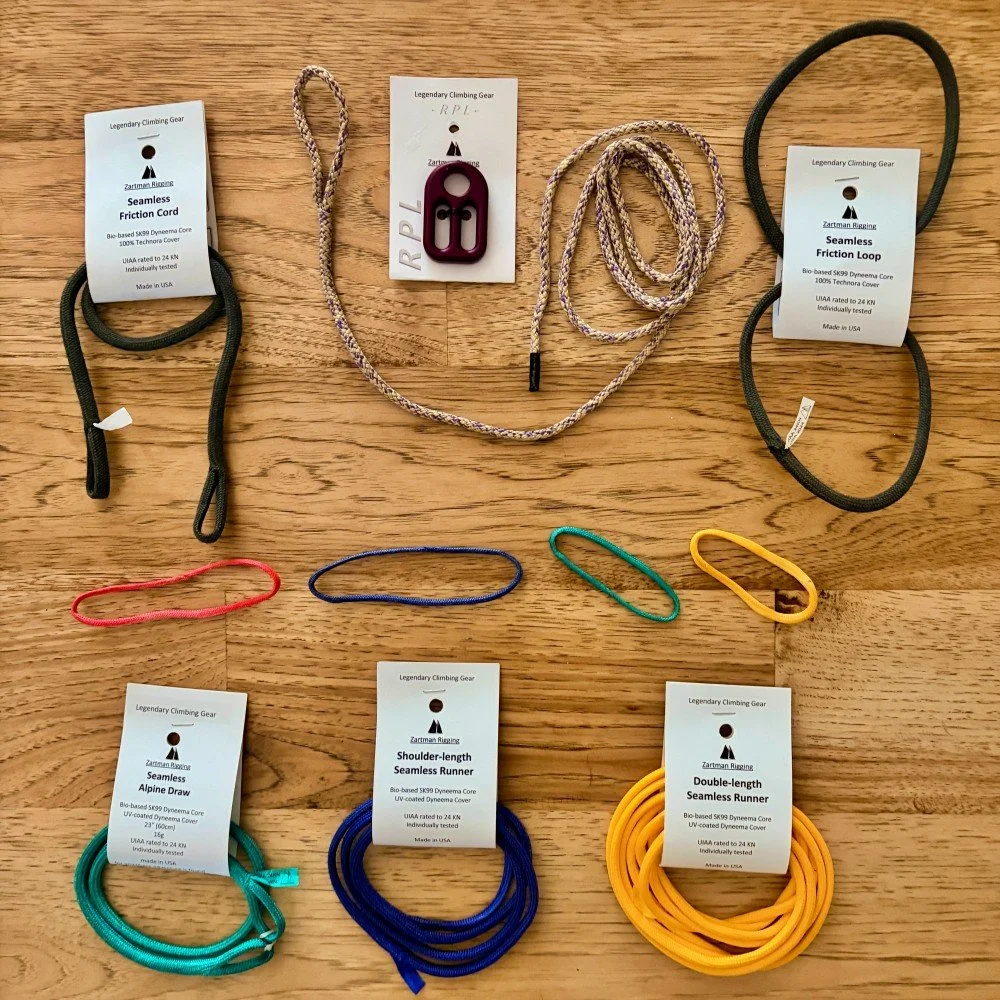
Zartman Rigging - website and PDF catalog
Ben Zartman, based in Rhode Island, is a sailor, climber, and expert one-man-band producer of made in USA, high-tech spliced cordage.
“Splicing”, if you're new to the term, is the permanent method of joining rope ends or forming loops by interweaving strands of the rope. While spliced ropes and cords have been used in the boating world for literally centuries, they’re relatively new to climbing.
The main advantage of splicing is that you can make a loop, or an eye loop on the end of a length of cord, without any sewing / bar tacks. This makes a strong, light, and less bulky product, and also lets you use very thin cordage that would be impossible to sew.
Here’s Ben’s more technical description of his methods.
Something I find impressive about Ben’s products is that many of them are UIAA rated, which for a small manufacturer is a fairly expensive and time-consuming process. Ben took this extra step to give users confidence in the tested strength of his products.
How strong? UIAA rated 24 kN!
And yeah, I’ll be honest, a confidence boost when weighting material that looks like parachute cord may be needed!
Yes, it may cost more than your standard sewn Dyneema sling. However, if you're looking for about the lightest possible weight, and the lowest bulk soft goods, it's pretty hard to beat this.
It's not all soft goods. Ben also sells the RPL (“rappel”, get it?) a cool micro belay plate designed for ultra skinny 6 mm ropes.
Let's have a closer look at some of the Zartman Rigging goodies.
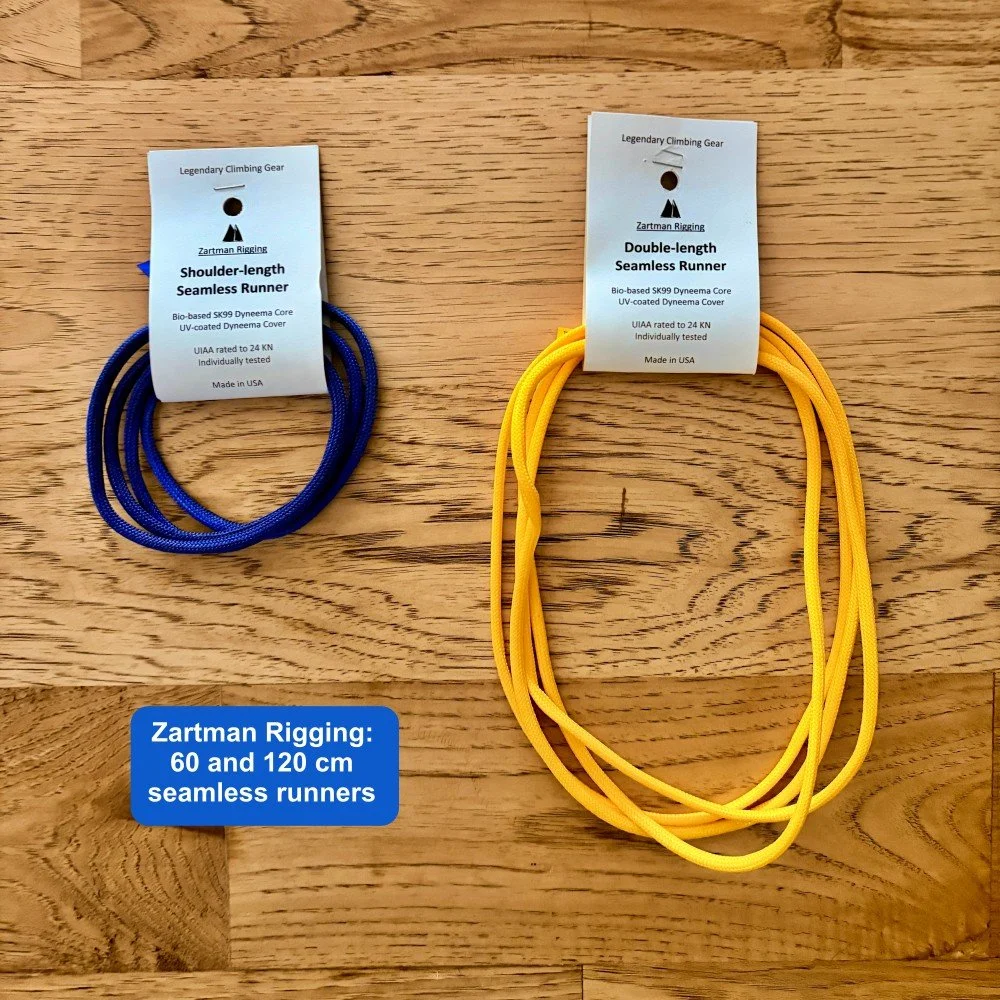
Let's start with something familiar to all climbers, single and double length loops.
These loops have a spliced Dyneema core, with an additional Dyneema sheath which protects against abrasion and UV light. These Zartman loops, which are 60 and 120 cm respectively, are about 30% lighter than the standard sewn slings of the same length. They also come in lengths of 20 and 180 cm.
These were the first UIAA certified slings (24 kN) to eliminate sewn seams.
Seamless alpine draw
This is made of similar material as the loops, but with a spliced eye on each end. This is 60 cm when extended, and is a featherweight 16 grams. You can clip it end to end to extend a placement, or shorten it up basket hitch style. UIAA rated 24 kN.
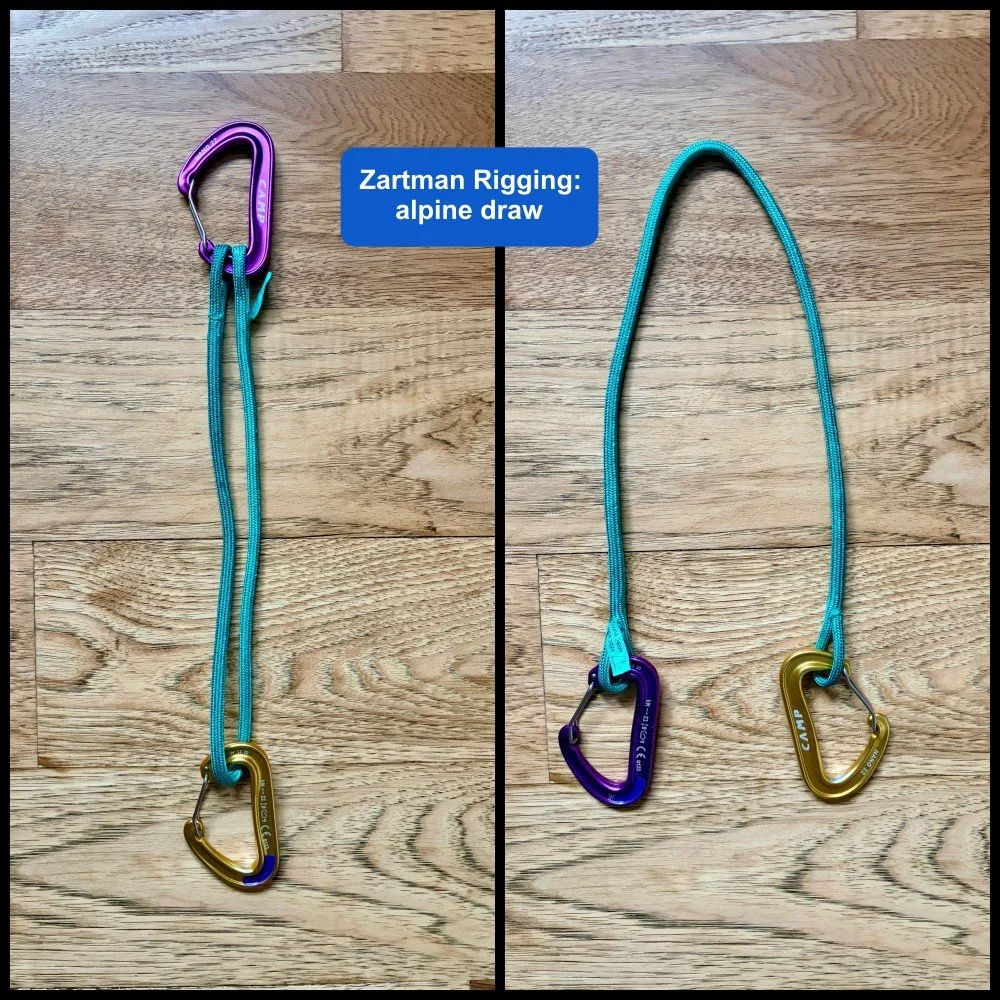
Here's a close-up of those spliced eyes, pretty cool!

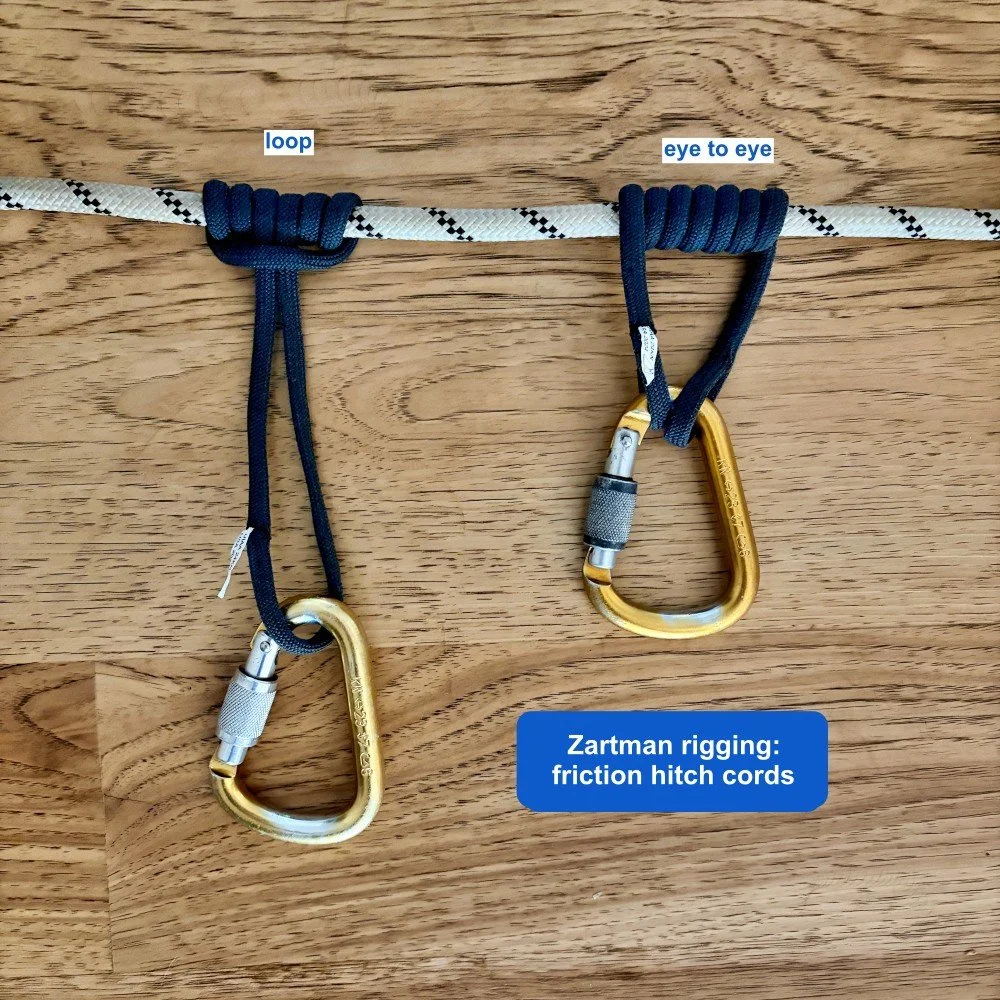
Friction hitch cords: loops and eye to eye
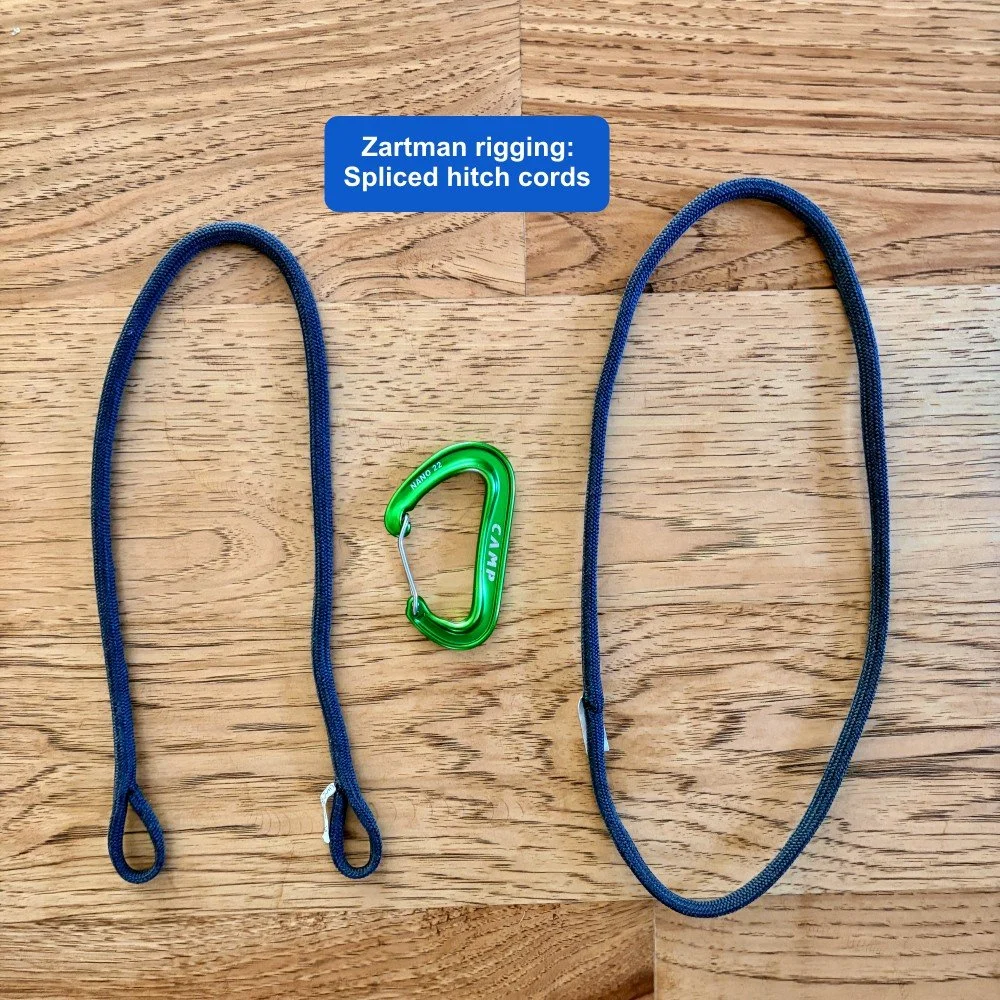
Carabiner for size comparison . . .
This is where the lack of a sewn connecting point really shines. Keeping the knot or the sewing out of the way when you're tying a friction hitch is always a bit of a hassle. Not a problem with these spliced cords. These are quite a bit thicker than the slings mentioned above.
Normally, you wouldn’t use a Dyneema sling as a rappelling autoblock, because the standard slings are not especially heat resistant. Ben uses a Technora (aka Kevlar) sheath over the Dyneema core, which makes these cords extra durable and heat resistant. Rappel backup, no problem. “Grabbiness” on the rope is excellent. UIAA rated 24 Kn.
I think my Sterling Hollowblock just got replaced . . .
Micro loops
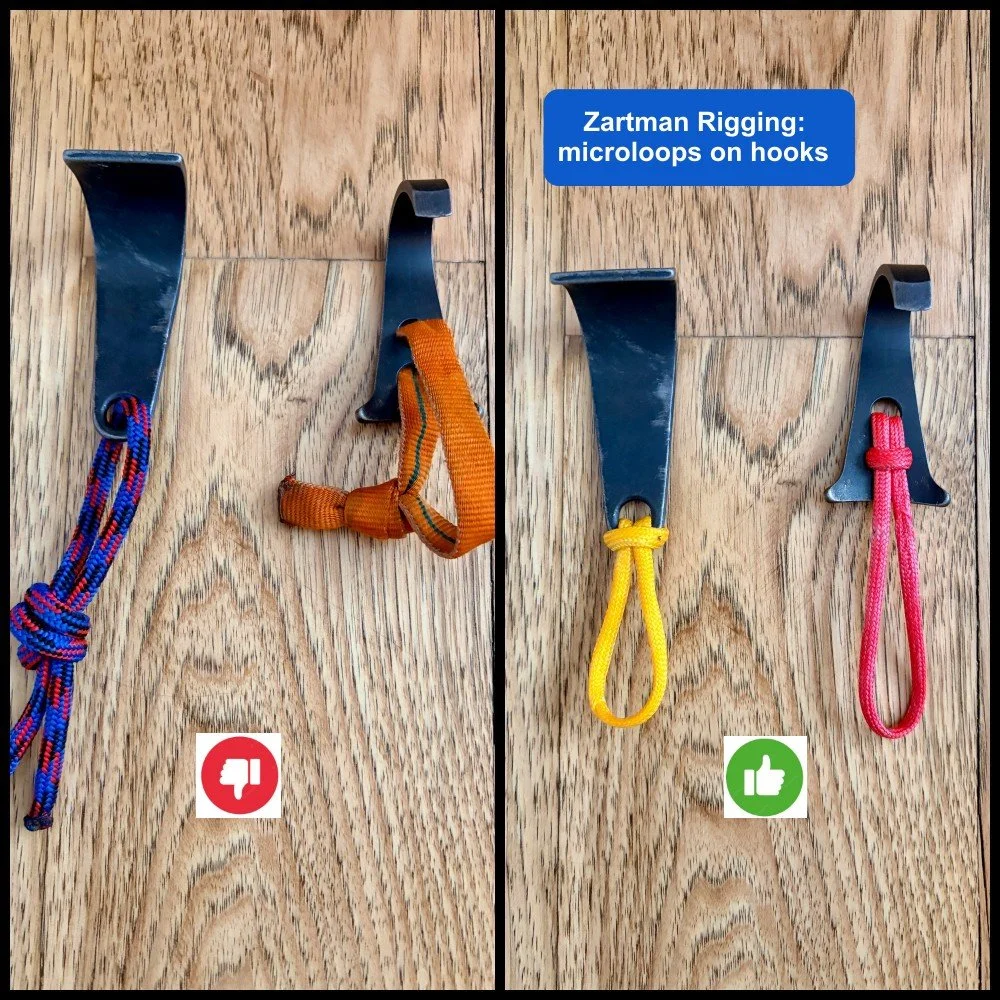
These loops, which come in two sizes, are very short spliced Dyneema loops that have a specialized application that may only be appreciated by aid climbers: they are perfect for girth hitching hooks. These loops break around 9 kN, and weigh a ridiculous 2.5 grams.
Attaching thick cord or webbing to hooks has always been a hassle. Up until now, the best option was to get loops custom sewn on your hooks from Skot’s Wall Gear.
Here's a before/after of two of my hooks: chunky cord and webbing on the left, micro loop on the other.
The shorter Micro loop (yellow in photo) works fine for a hook with one hole, like my cam hook.
The slightly longer “Mega” Micro loop (red in photo) fits hooks with two holes, such as the Black Diamond Cliffhanger on the right. The longer Micro loop can also be used to tie off a piton, or basket hitch to the eye of a piton, where a carabiner might sit at a bad angle.
Slight correction to photo below: on the far right, the hook with the red loop should have the loop on the other side of the hook. Doing this helps press it down and into the rock when it's loaded. Mea culpa . . .
The RPL micro friction plate
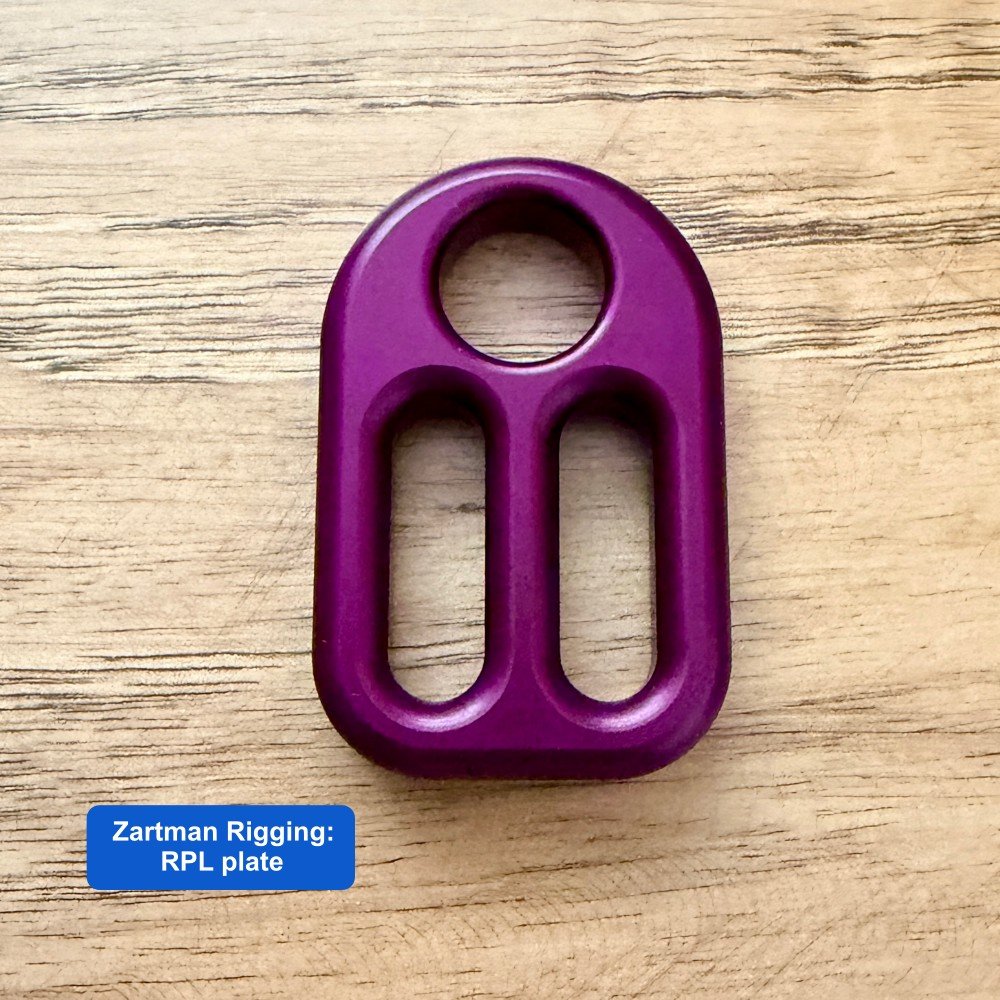
Rappelling and belaying on 6 mm ropes has become more of a thing in recent years. This is the only “metal” offering from Zartman Rigging, and it's designed for exactly this flavor of skinny cord. It has four separate functions:
rappelling on single or double strand 6 mm rope
personal adjustable tether / PAS, sort of like a much slimmer Kong Slyde
belaying in guide mode (behaves like the Kong Gigi)
rope ascending (I didn't try this)
Want to see my results about using the RPL on 6 mm cord?
Does the RPL work on a single strand of 6 mm?
How about Ben’s new offering that turns the RPL into a sweet adjustable, personal tether / PAS?
