
All about friction hitches - Part 1

Premium Members can read the entire article here:
The humble friction hitch loop. Inexpensive, lightweight, and pretty much infinitely useful when it comes to #CraftyRopeTricks and self-rescue stuff.
(Something I've noticed over the years: the more experienced the climber, the more likely they're gonna have a hitch loop or two on their harness. Unless you're in the gym; then you look like a dork.)
Let's have a closer look at friction hitches (Part 1) and hitch loops (Part 2, coming soon), the Swiss Army knife problem-solver of climbing gear.
What is a friction hitch, and how is it used?
A friction hitch is a type of knot that is usually tied with a short loop of cord, which from now on I’ll call a “hitch cord”.
When a friction hitch is tied onto a larger diameter rope, the hitch grabs the rope when it's weighted, and can slide when unweighted. You can tie a friction hitch on a single strand of rope, or on two strands.
This makes it helpful for many common climbing techniques, such as:
Ascending a fixed rope
Backing up a lower
Backing up a rappel
Rope grab (and progress capture) in mechanical advantage hauling systems
Safety on a fixed line when you're near a cliff top or crevasse edge
Can I clip my grandma to one friction hitch?
Short answer, no. A single loop of skinny cord should not be your only safety connection in any part of your climbing system, and that includes a friction hitch.
A hitch cord holding a human sized load should always be backed up in some way.
Typically, this backup is:
An additional rope grab or friction hitch
A backup knot
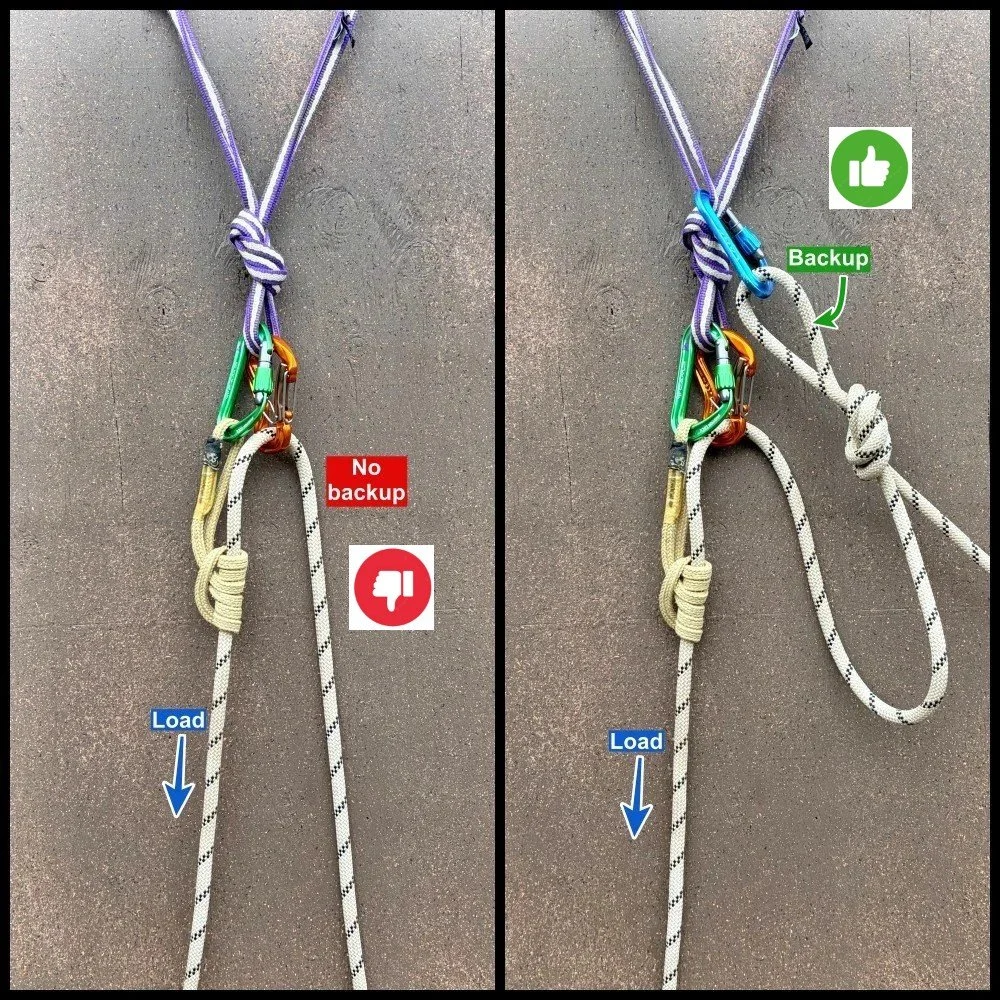
Below left: the load is held only by the friction hitch, and there's no backup. Not good.
Below right: if the friction hitch slips or fails, the load is caught by the backup knot clipped to the blue carabiner. Much better. As you pull more rope through your haul system, you can add additional backup knot(s).
Is a friction hitch the same as a prusik?
“Prusik” is one of the more confusing terms in climbing, because it's a verb, an adjective, a noun, and even a proper noun! It’s named after Karl Prusik, the Austrian mountaineer (and yes, Nazi) credited with its invention. (For this article, I'm using the more precise terms “friction hitch” and “hitch loop”.)
Short version: a prusik is a type of friction hitch, but not all friction hitches are prusiks. Without being too fussy about definitions, be aware that “prusik” is used casually by climbers to mean lots of different things:
“I'm going to prusik up that rope.” (verb)
“Did you bring your prusik loop?” (adjective)
“Good thing I brought my prusik” (noun)
How “grabby” does it need to be?
Sometimes grabby is good, other times not so good. This is why it's good to have a few different friction hitches in your toolbox, so you can use the right one for the task.
Sometimes you want a friction hitch that grabs tight and is hard to loosen up, like for a tractor on a mechanical advantage hauling system. For that application, a three wrap prusik or a klemheist with a lot of wraps might work best.
Other times you want to hitch that slides easily, like when you want to ascend a rope, or as a rappel backup. In that situation, an autoblock or a klemheist with less wraps could be a good choice.
A caution on the autoblock . . .
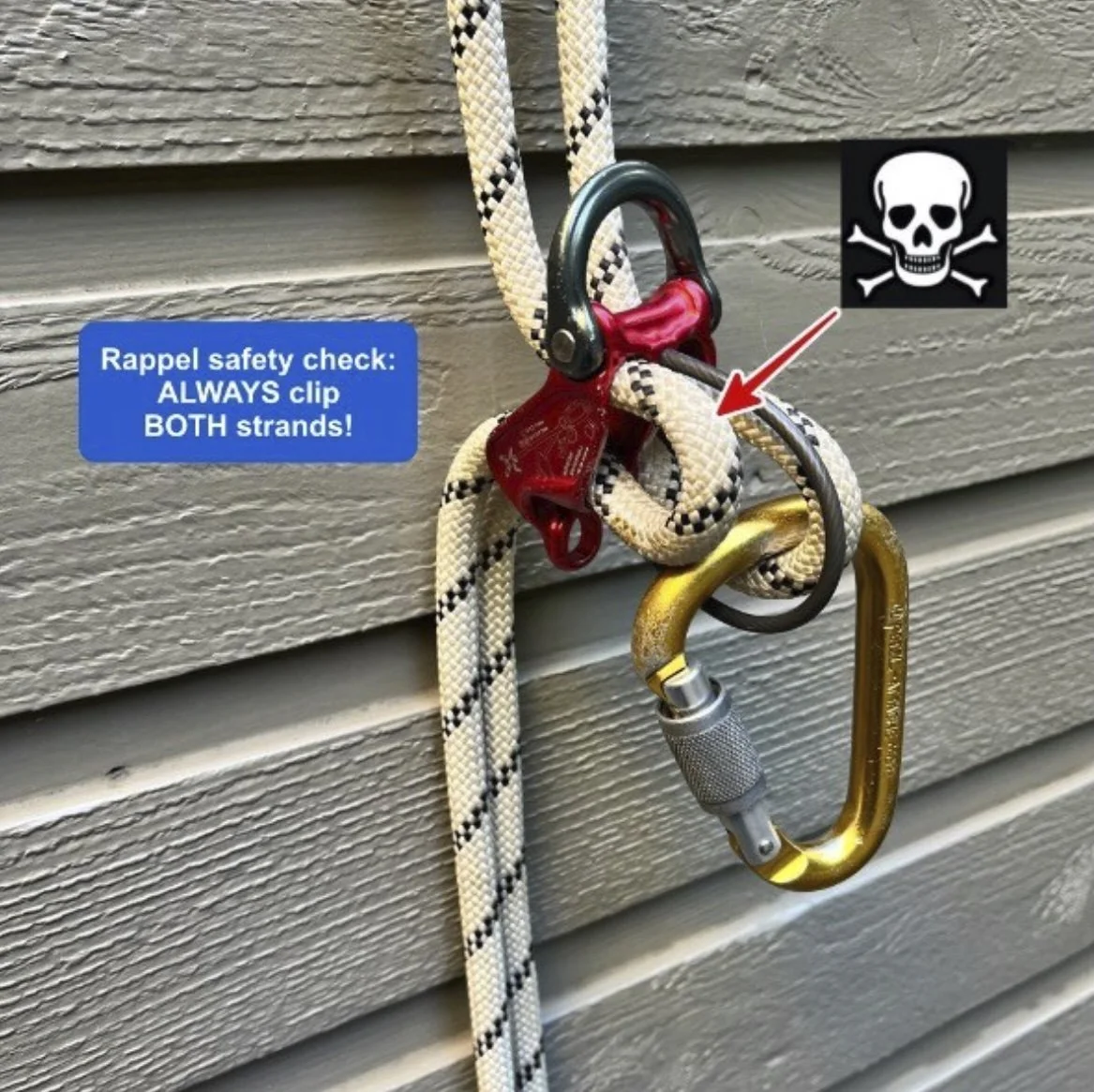
This is a quite common and potentially lethal mistake: clipping one, but not both, rope strands into your rappel carabiner.
Lots of people, myself included for a long time, thought that if you have an autoblock properly tied below your device, the autoblock would grab both rope strands (and keep you from dying) if you made this mistake.
Well, guess what, I was wrong!
If you tie your autoblock, but then clip only ONE strand as shown above, and then load the rope, the autoblock does NOT grab the rope as you might expect.
Instead, you start sliding down like the autoblock is almost not there! I tested this on fat ropes and skinny ropes, and with several different varieties of hitch cords. Pretty much the same outcome every time. It’s easy to test. Give it a try yourself.
(If you were to use the old school method of putting your friction hitch ABOVE your device, then it DOES catch you if you make this mistake. However, that comes with its own host of problems, it's an outdated technique in most situations, and I don't recommend it.)
The best way to reduce rigging errors like this: weight the rope with your tether still attached to the anchor before you commit to it.
Autoblocks are good practice for many reasons, but they don’t solve the problem of only clipping one strand. Do your partner safety checks as standard procedure. Don't be complacent, no matter how many rappels you've done in your life.
What are the main types of friction hitches?
There are MANY different friction hitches! Riggers, arborists and other rope pros have a quiver of exotically named and specialized hitches, often made with an eye to eye hitch cord (more on that below).
Climbers, on the other hand, usually don't carry this type of gear, and need to rely on a bit of improv with slings and cordage they are hopefully already carrying.
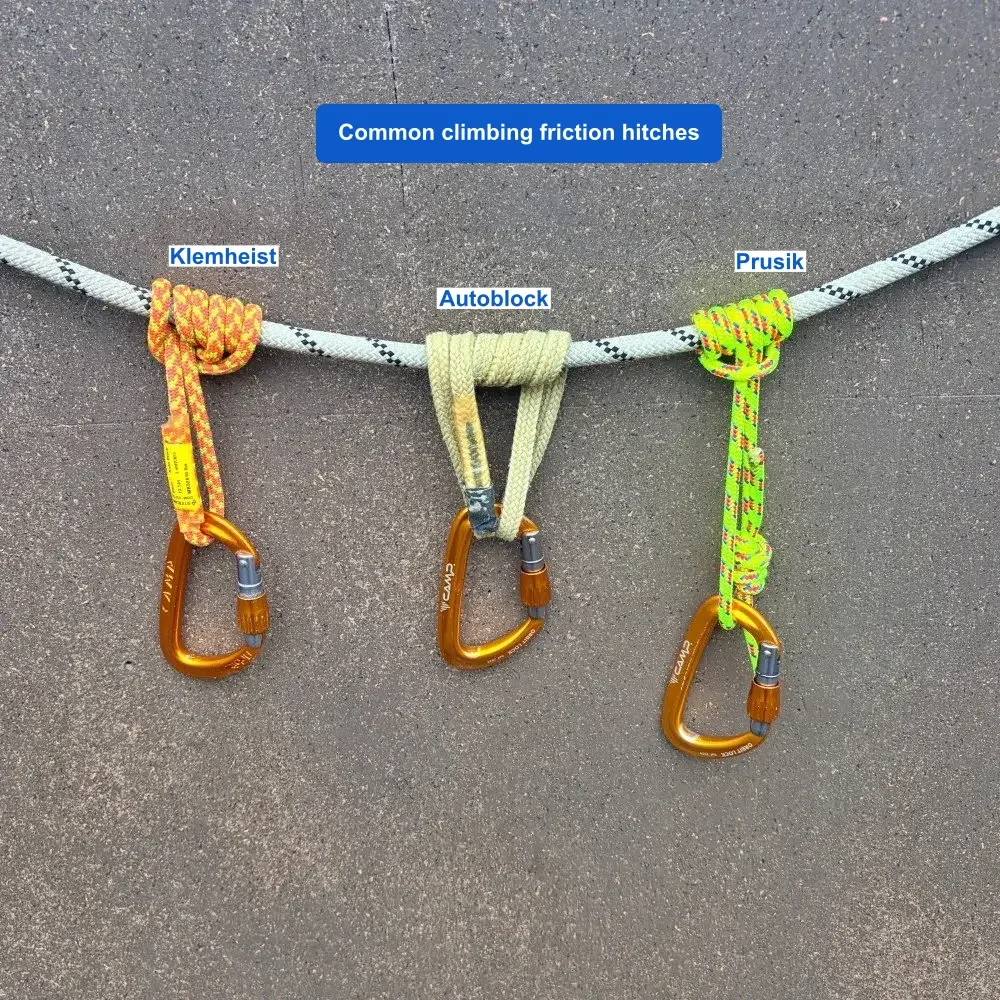
There are three common friction hitches in climbing:
autoblock
prusik
Klemheist
Autoblock
Has a few names: aka “French prusik” and “third hand”.
Has a fairly low level of grabbiness.
Most common use: rappel or lowering backup, hence the name “third hand.”
Can usually be released when it’s loaded.
Can be loaded in either direction.
Typically tied with cord (or a HollowBlock), not webbing.
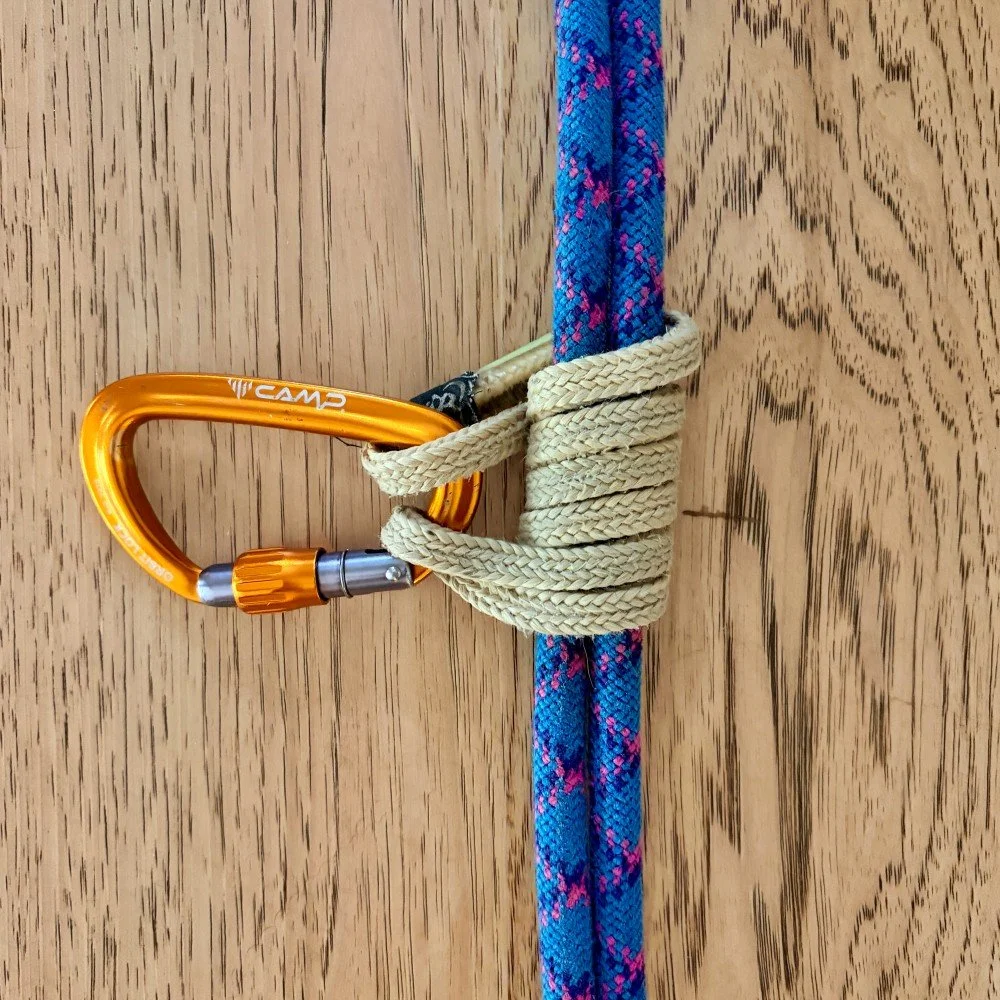
You can use as many wraps around the rope as needed until the autoblock properly grabs. (As a rappel back up, three wraps are commonly used.)
Tip on using the autoblock as a rappel backup: Best practice is to have your hand on the rope just above the autoblock when rappelling, not putting your entire hand / fist around the auto block.
One more autoblock tip: sometimes two wraps is too loose, and three wraps is too grabby. Start with two wraps, and then twist the hitch cord a few times before you clip it to your carabiner. This can add some extra tension to the knot, which might be the fine-tuning that you need. (Here's an Instagram video from IFMGA Guide Ian Nicholson that shows how to do it.)
Prusik
The “grabbiest” of the three common hitches.
Typical use: “tractor” or progress capture in a mechanical advantage hauling system and ascending a fixed rope.
Needs to be dressed perfectly to work correctly, so it's a little finicky.
Usually takes longer to tie, and is harder to tie with gloves or cold hands.
Typically tied with three wraps around the rope, but can use two or four wraps.
Can be loaded in either direction.
Needs to be tied with cord, not webbing.
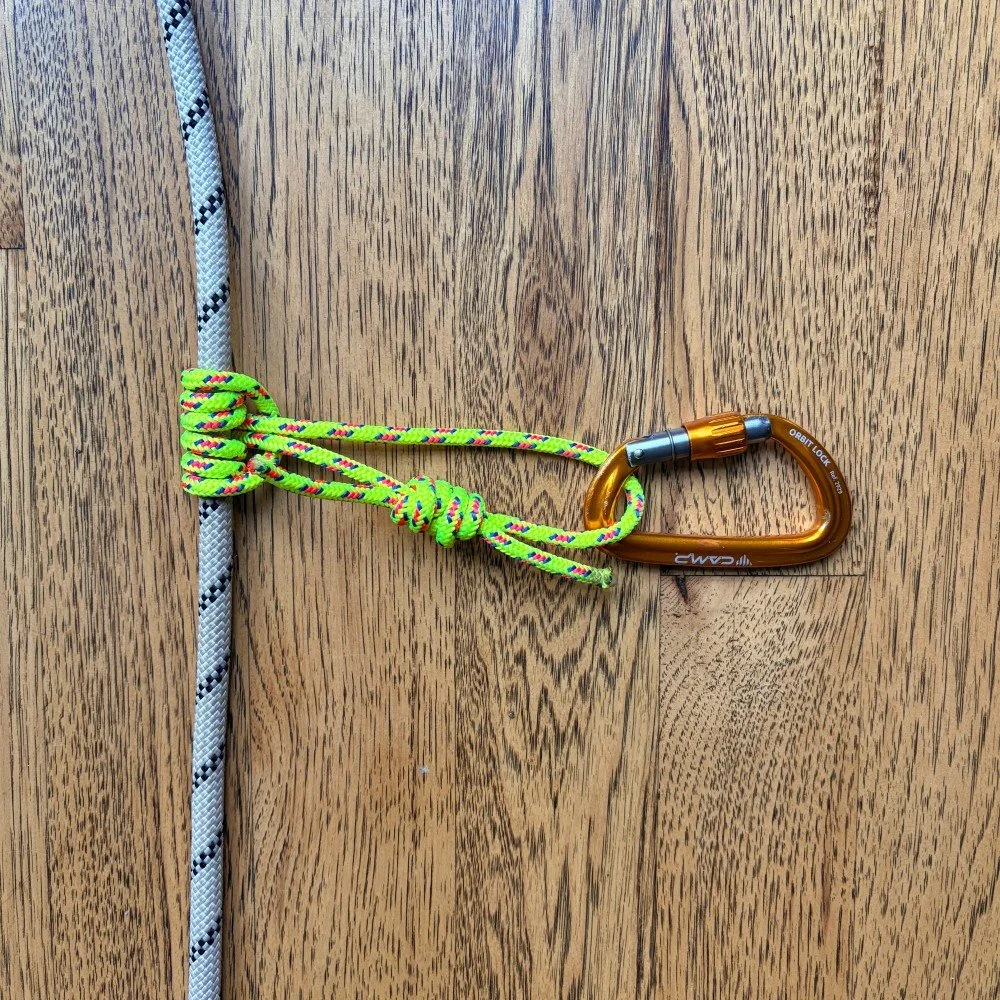
Klemheist
Has a medium level of grabbiness.
Can be tied with either cord or webbing.
Can add or removes wraps adjust the grabbiness.
Generally works best when loaded in one direction.
Works without being perfectly tidy / dressed, which is nice when you need to do it fast and maybe have gloves on.
The Klemheist is a good choice when you’re tying it with something very long, like a cordelette. It's faster to tie because you don't need to pass the ends through the knot with every wrap, only once at the end.
You can tie a Klemheist hitch with a sling/webbing or cord.
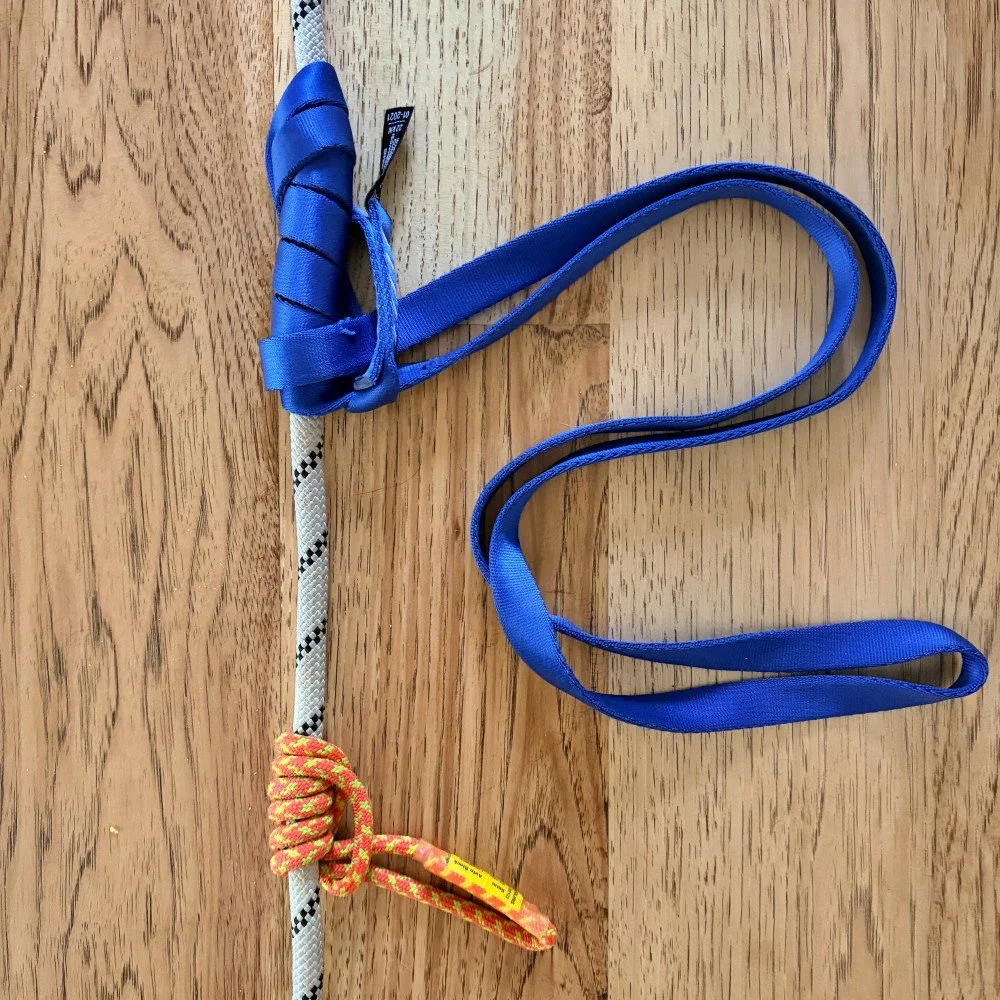
Here’s a Klemheist hitch tied with a 60 cm Dyneema sling. Lots of wraps, very grabby!
Note: because Dyneema has a relatively low melting point, it's not a good idea to use a Dyneema sling for any sort of a rappel backup. A fast rappel could potentially damage the sling.
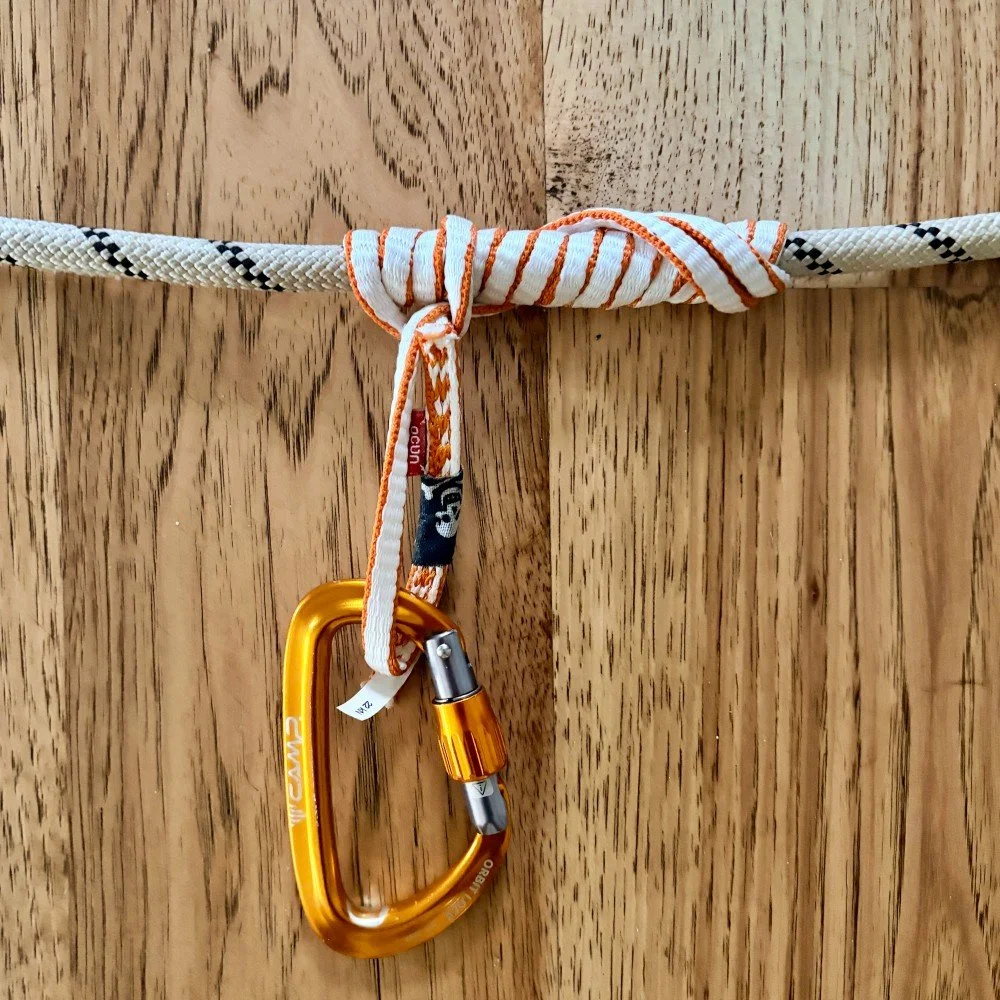
How do you tie a “cowboy” Klemheist (with a video demo)?
Does it matter where the bartack / stitching goes on a friction hitch?
What's the real world force where these hitches start to slip or break (with video of the testing?
