
Premium Members can read the entire article here:
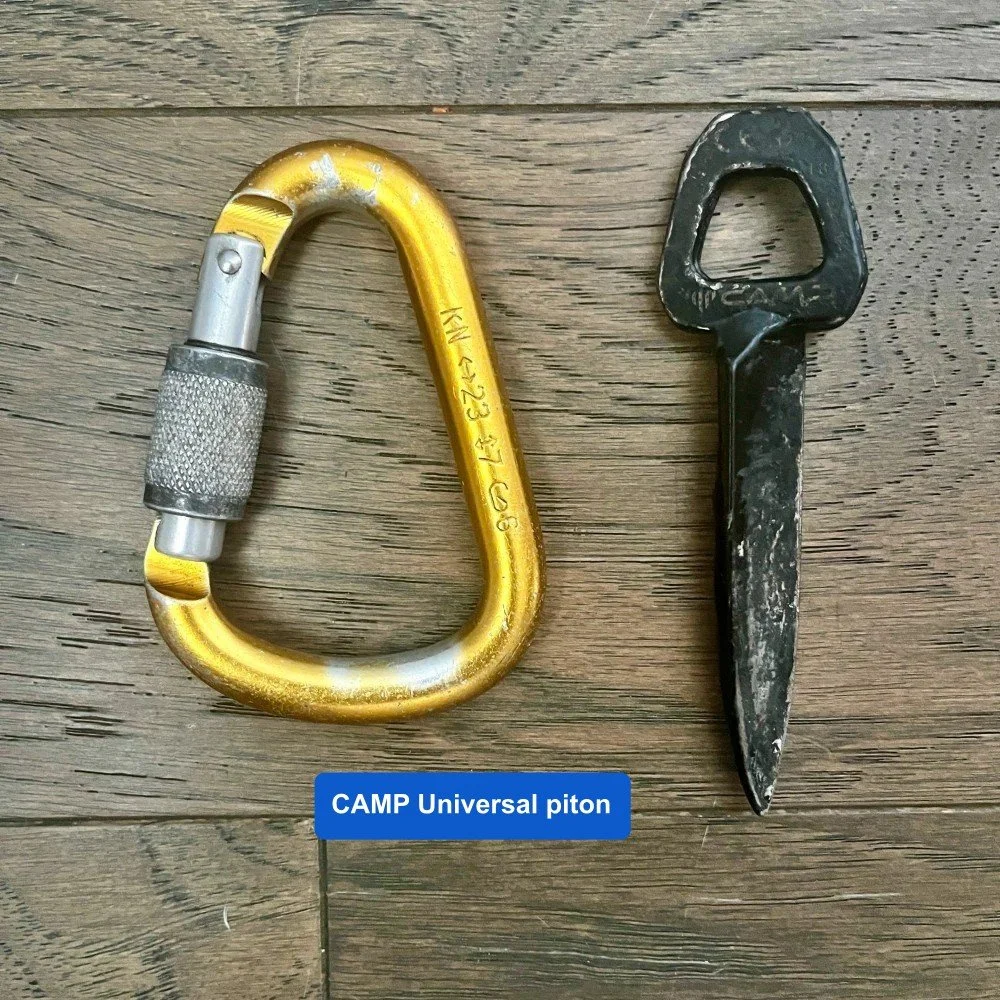
CAMP universal piton (with carabiner for size comparison)
I get it - hammerless / clean climbing started about 50 years ago. These days, pitons are used mostly on hard big walls.
However, for certain alpine climbing applications, especially making rappel anchors, sometimes a piton is just the ticket.
You’ll be pretty glad you have one if you're staring at a crack that's smaller than your smallest stopper!
The universal piton (like this one made by CAMP) is a clever design.
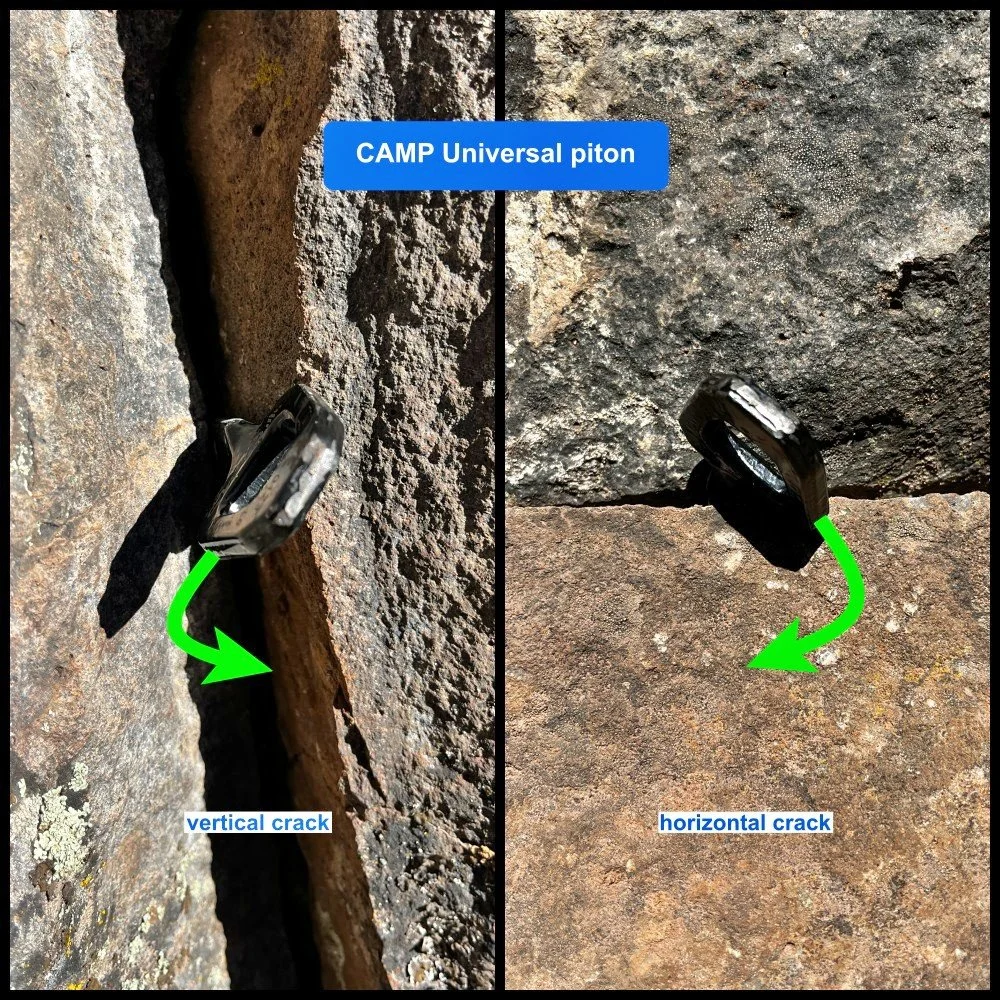
Similar in shape to a Lost Arrow piton, the blade is offset about 45 degrees from the head. This makes the piton rotate / cam into a (hopefully) more secure placement when loaded, whether it's a vertical or horizontal crack.
They come in hard steel (black) and softer steel (silver). The hard steel is better in most cases.
Universal pitons seem to be sort of a European thing. I don't think any American company (including the largest piton maker, Black Diamond) makes them.
You can get all different flavors of pitons, including the Universal, from HowNot2.
Because of the head is offset about 45 degrees from the blade, a universal piton rotates / cams into place when loaded in both a vertical and horizontal crack.
What are the downsides of universal pitons?
If you're doing hard big wall climbs, they don't replace standard pitons. (Get some beaks / Tomahawks instead.)
If you're placing them in a roof, or where the sides of the crack are at different depths (sort of like the left photo above) you may not be able to hammer it all the way in.
Some are made of soft metal, which may not hold up so well long-term.
They’re a bit heavy.
They’re a bit expensive, about $30 (spring 2026)
You need something to whack ‘em into place. (Don't have a hammer? You might get away with going caveman on it, with a baseball sized rock.)
Do you want to carry one on every climb? No. However, on a route where you need to maybe make rappel anchors, and especially if you have a hammer with you, you might want to consider it.
PS - don't leave it dangling on your harness at the rock gym . . .
Plus, whacking in pitons is just fun! (When you're practicing, be sure to do it in an area of rock where nobody is ever gonna climb.)
Because of the offset shape, a universal piton usually plays well with most shapes of carabiners, no matter how you clip it.
This makes it a bit easier to use than a more classic angle piton (below), where you usually want to clip it with the gate facing away from rather than toward the piton.
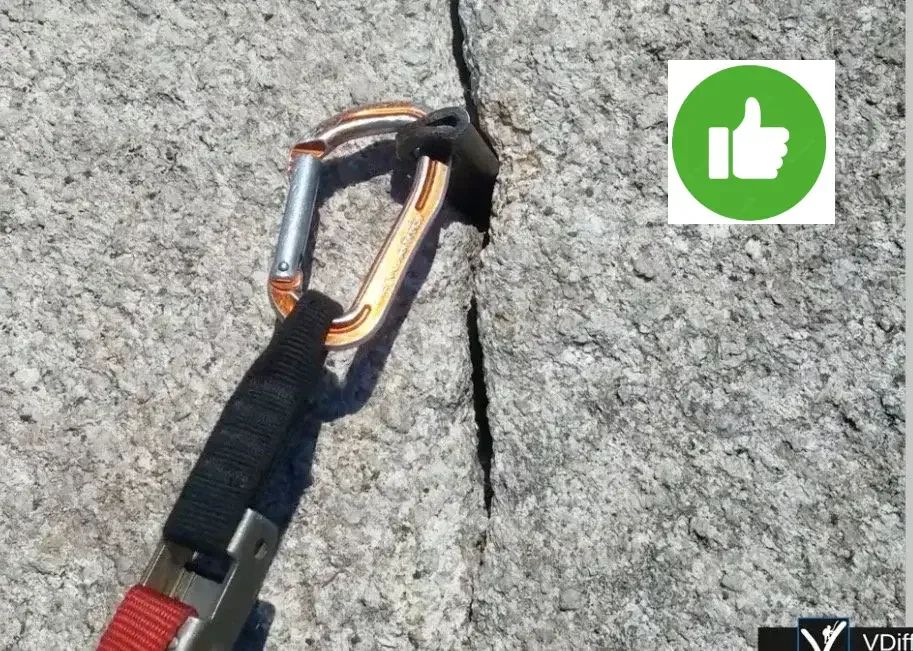
image: vDiff climbing, shared with permission
This is not a great way to clip an angle piton. The carabiner can get torqued and loaded in some strange ways; avoid this.
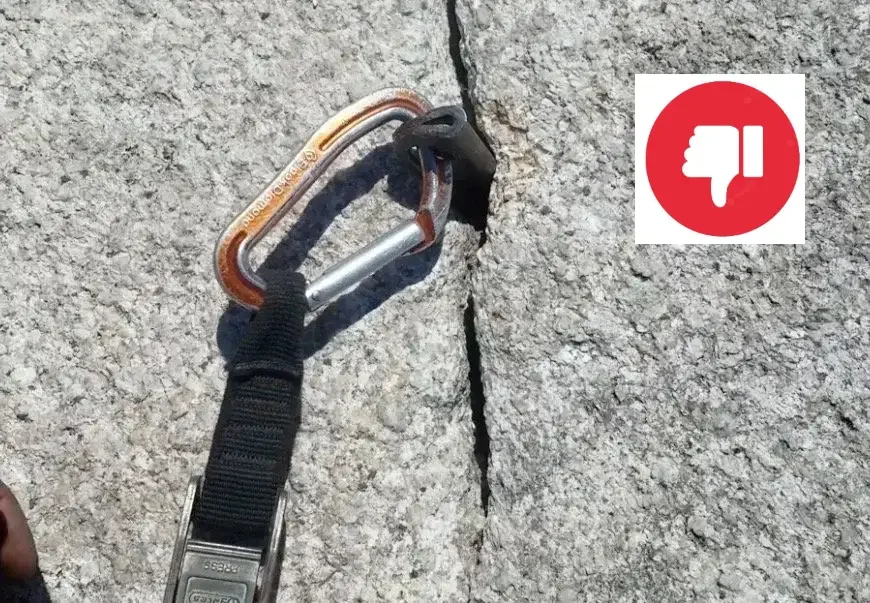
image: vDiff climbing, shared with permission
Want to see an example of using a universal piton for a rappel anchor?
What’s another size and style of piton that can be extra helpful for alpine climbing?
What are three different types of hammers that you can use to whack a piton?
