

Premium Members can read the entire article here:
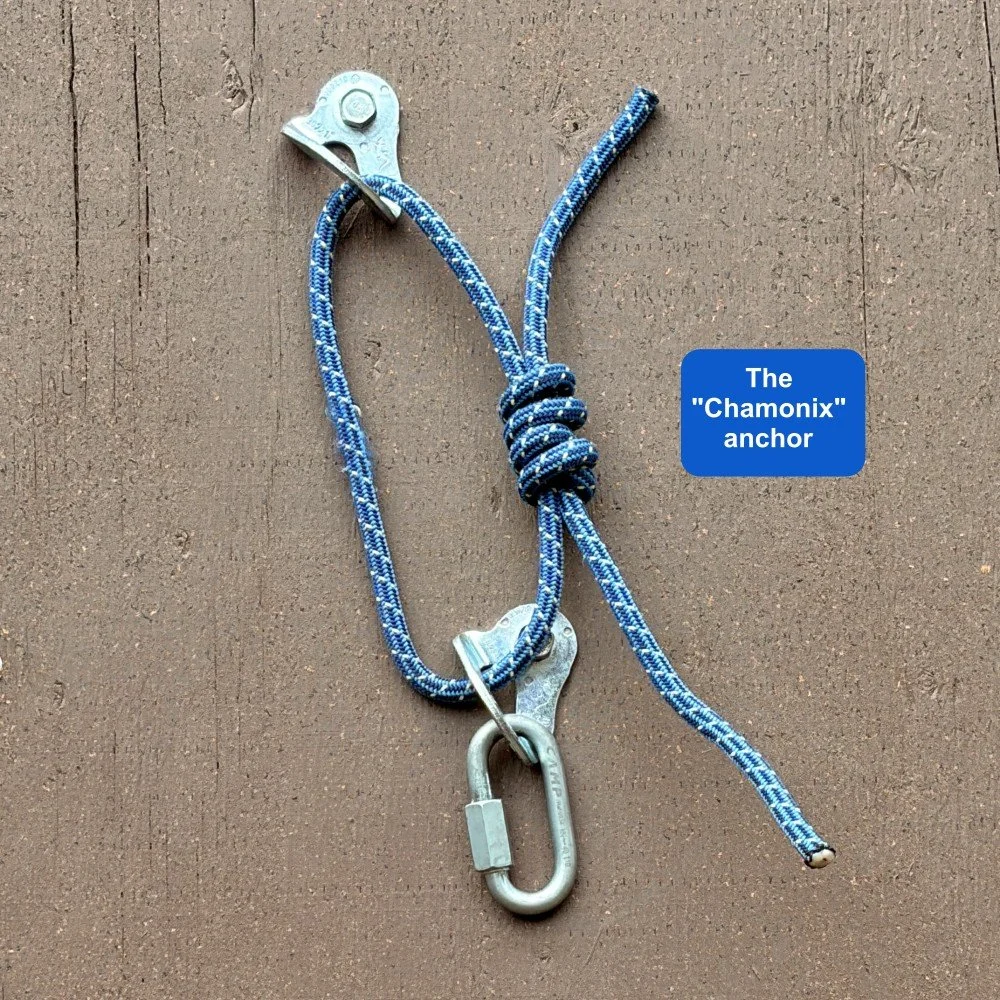
Here’s a flavor of series anchor that is apparently quite popular around Chamonix, and at some other European climbing areas. If you encounter one in the wild, it's good to know how to best use it.
(If you're new to vertical anchors, check out my detailed article here.)
The Chamonix anchor is two vertical bolts connected with a tied loop of cord. The bottom bolt has a quick link for rappelling. (Adding a second quicklink or ring to the bottom bolt that would hang perpendicular to the rock would give an easier pull of the rappel rope, but that’s a minor quibble.)
The cord and the top bolt back up the bottom bolt, in the highly unlikely event that the bottom bolt fails. The anchor is redundant, but not equalized.
What do you think? Sketchy as Donald Trump's tax returns, or elegant Euro anchor minimalism?
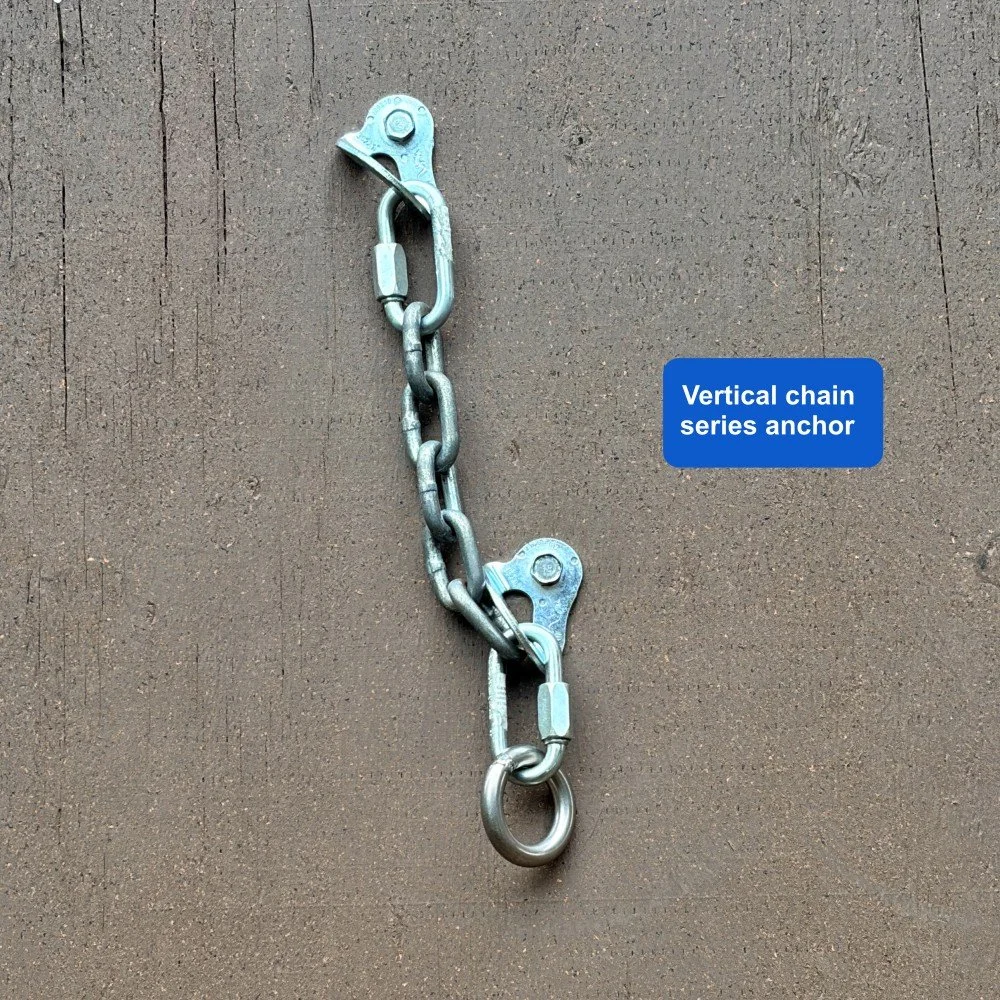
It's basically the same design as a vertical series chain anchor (below), but with cord connecting the bolts instead of chain. (In my opinion, this is the best anchor design for a multi pitch route.)
Is this chain anchor obviously stronger and longer lasting? Yes!
Is it also heavier, more expensive, and perhaps not as versatile? Also yes!
More on the pros and cons below.
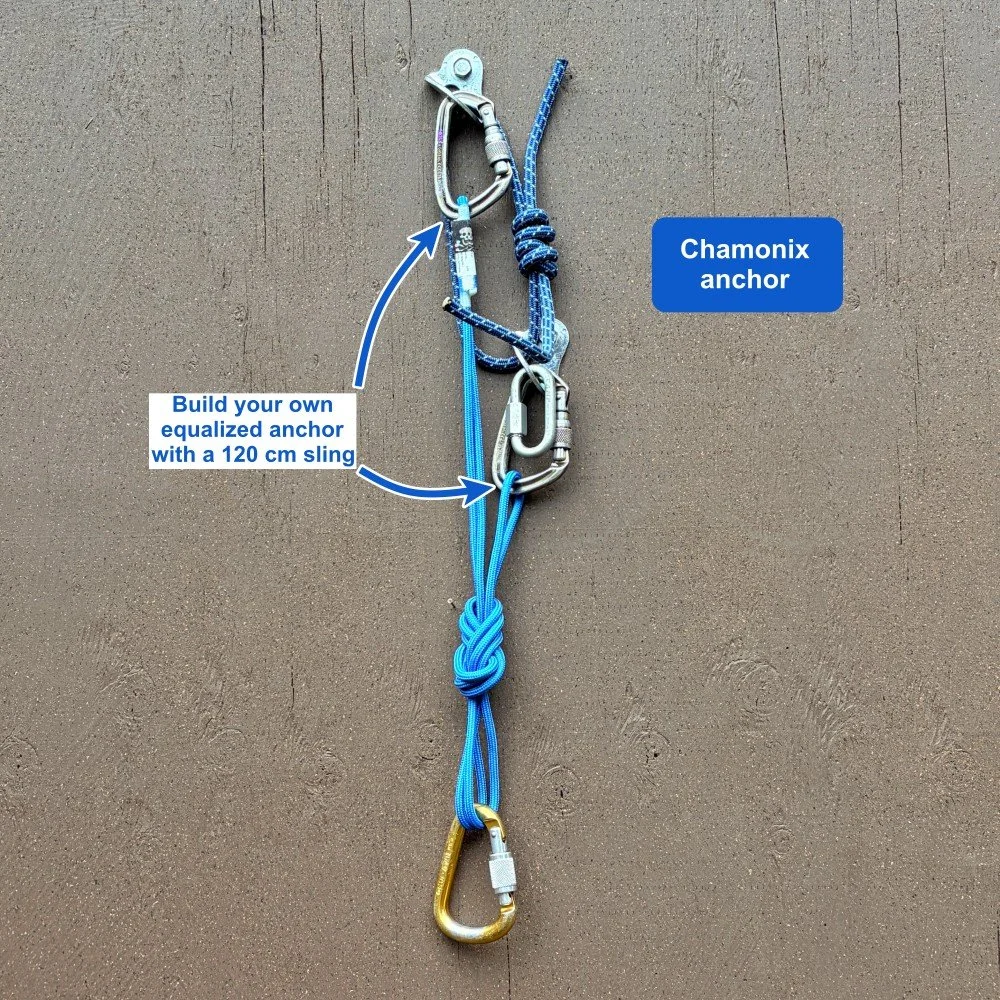
For a multipitch anchor when ascending, equalize the two bolts with a sling.
Would you want to use the Chamonix anchor in a high-use sport climbing area? No; better to use all metal hardware that will last longer.
Where might the Chamonix anchor be suitable?
In a more remote alpine area on routes that don’t get a lot of use.
Where you want to save weight and cost establishing a long multi pitch route.
Hopefully, where the local ethic is that you carry spare cord (and a knife) in the bottom of your pack and replace old ratty anchors as needed.
Keep in mind, there are probably thousands of anchors like this throughout the Alps. Are we hearing reports about them failing? I wonder if a failure of the bottom bolt AND the cord has ever actually happened in real life? I don't know. If you do, send me an email and tell me about it.
It's easy to say, “Always use metal anchor hardware” and never soft goods like this. However, learning from the incredibly wide range of anchors in the climbing world, there might be some cases when the Chamonix anchor makes sense.
On this website, I strive to share information and ideas, and not offer advice or (usually) share my opinion.
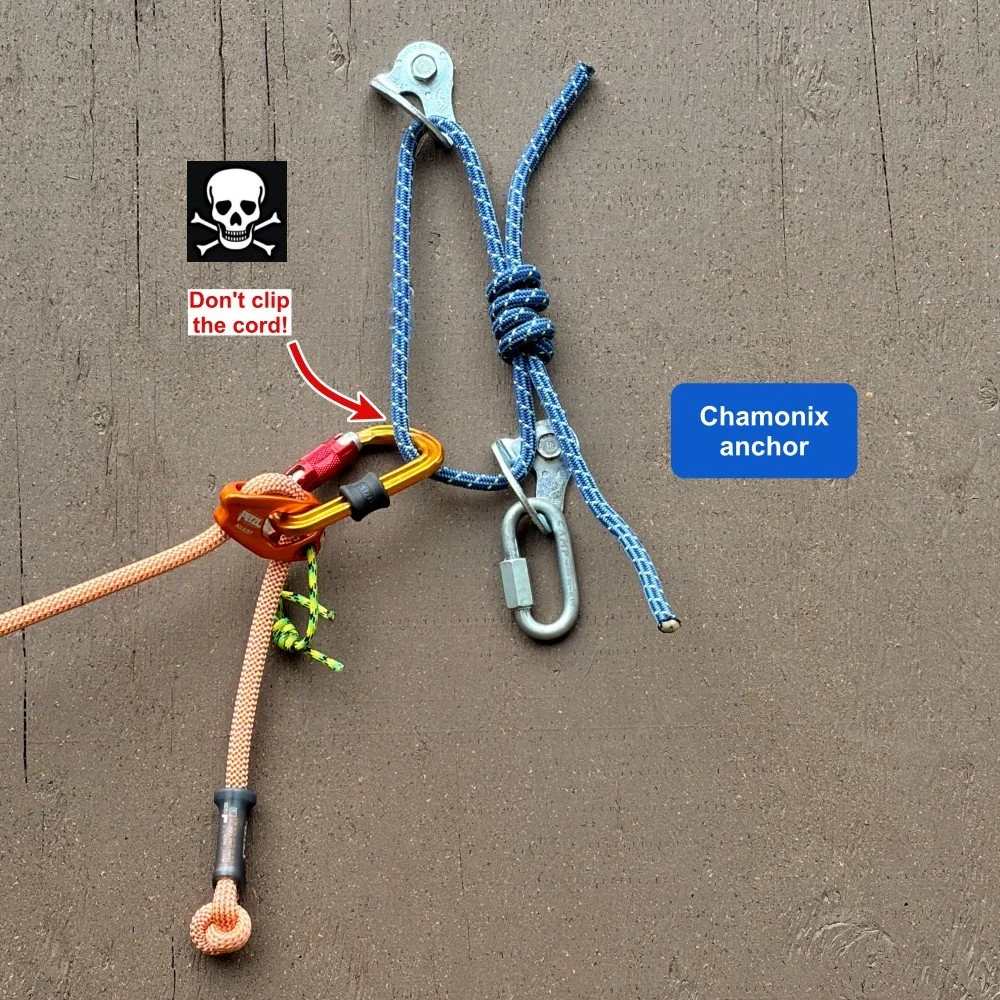
Chamonix anchor: Don’t clip the cord
One big potential problem: clipping the single loop of cord, and not building your own anchor or using the bottom quick link. That obviously is not redundant! If the cord is old and crusty, it could break under a modest load, and then you have a complete anchor failure, yikes!
Pros and cons of the Chamonix anchor. . .
Pros:
Low cost
1 meter of 8 mm cord, @ $2, AND one 8 mm quicklink @ $5, total about $7, VS
Four links of stainless steel chain, @ $8, AND two 8 mm stainless steel quick links, @ $5 each, total about $18
Cord is about 2.5x less expensive
Lightweight
40 grams for 1 meter of 8 mm cord, AND 75 grams for one 8 mm quicklink, total 115 grams, VS
190 grams for 15 cm of chain links, AND 150 grams for two 8 mm quick links, total 340 grams
Cord is about 3x lighter
Strong enough - provided the cord is newish and replaced as needed. (See strength test results below.) A good bolt should be good for at least 20 Kn+ each. The 8 mm quick link is rated to 30 kN. The weak link is clearly the cord.
Easier to place bolts in an ideal position in the rock, because you can adjust the length of the cord between them, as opposed to drilling in the spot that's dictated by the lengths of chain that you have with you.
Cons:
Not nearly as strong or long lasting as chain and quick links connecting the two bolts. Soft materials like cord, and especially webbing, can degrade quickly when exposed to the elements, especially sunlight.
Relies on climbers to carry cord with them to replace the old ratty stuff.
As mentioned above, not good to clip the cord, which some people are still gonna do.
Want to see the break test results (with video) for this anchor?
What are some simple ways to increase the strength and security of this anchor?
What about using a hanger with cord-friendly rounded edges?
How about an IFMGA Guide approved alternative to this, that uses no cord?
