
How can you safely lower from a crap anchor?

Premium Members can read the entire article here:
In spring 2026, there was a tragic and fatal accident in Kalymnos, Greece. Short version: a climber reached the top of a route, lowered from a two bolt anchor, both anchor bolts failed, and the climber took a long fall.
Pretty much every climber's worst nightmare, not being able to rely on redundant fixed hardware!
(Yes, the bolts were apparently weakened by the rust and corrosion at this coastal area, and in a perfect world all hardware near the ocean would be corrosion-proof titanium. But that doesn't always happen, and it’s a separate issue.)
Here’s a simple way to test a bolt, rather than just looking at it and hoping.
If you need to lower off an anchor (or a bolt mid-pitch) that looks extremely dodgy, what can you do to reduce your risk?
Here's one method that might, repeat MIGHT, work.
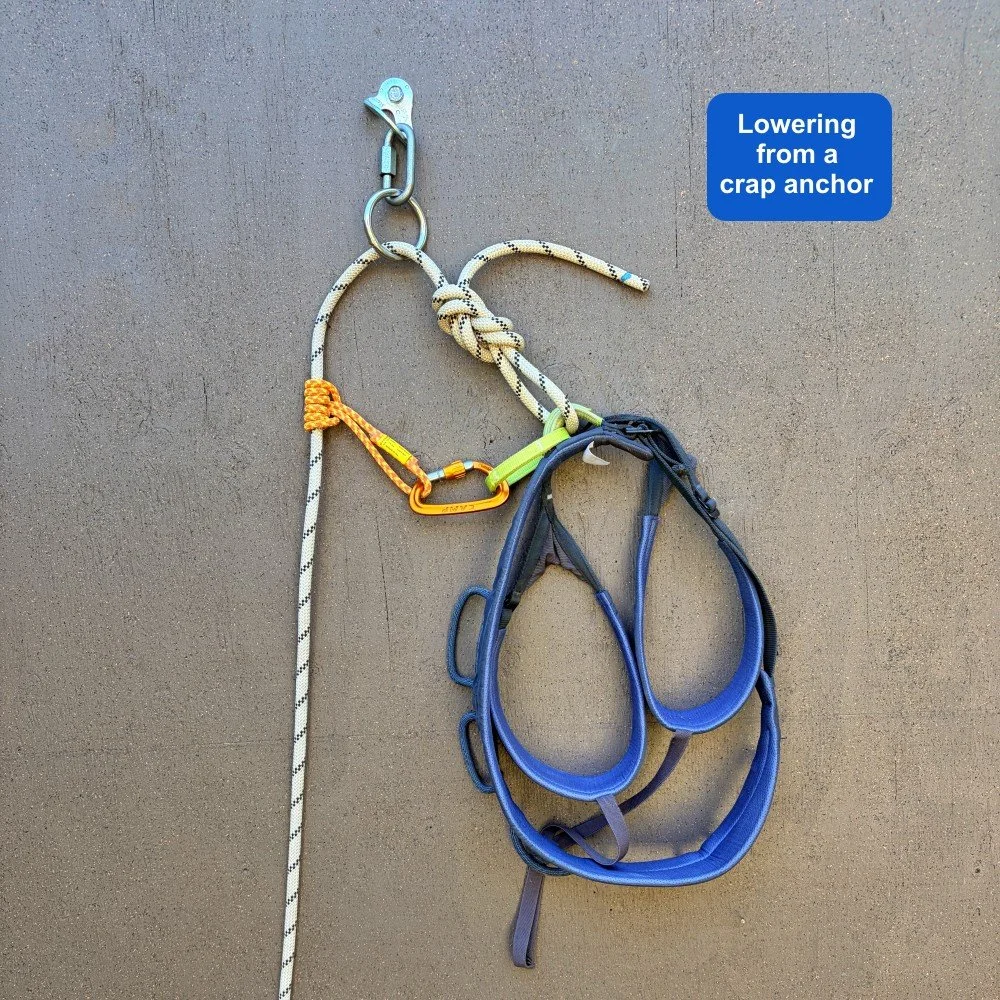
Rig the rope to lower from the anchor as normal.
Tie a friction hitch, probably a three wrap prusik with cord, to the strand of the rope that is going from the anchor down to your belayer.
Clip the friction hitch with a locker to your belay loop.
Call for “take and lower” from your partner below.
As you lower off the anchor, rest one hand above the friction hitch, and slide it down the rope strand. (Gloves are a good idea here, hint, hint.) Clean the gear as you’re lowered.
Now, if the anchor were to completely fail, you should only take a fall down to the next piece/bolt below you, because the prusik isolates the increasingly larger loop of rope that’s being created as you descend. One more reason to carry a prusik when you lead.
(If you did not have the friction hitch, and you have cleaned more than 1/3 of the route, and then the anchor fails, you would fall to the ground.)
Would a fall on this be terrifying? Yes!
Might the prusik melt and damage your rope? Possibly yes!
Are these better than the alternative? Yes!
What are some possible problems with this method?
This best works if you have gear placements below you. If there’s no gear below you, and the anchor fails on a single pitch, you will hit the ground.
If there's no gear below you on a multi pitch, you will take a factor 2 fall. If the anchor fails right after you load it, you'll take a very long factor 2. If it fails close to your partner down below, it will be a short factor 2. (See diagram below.) Either way, it's gonna suck.
You are relying on a thin (5 or 6 mm?) friction hitch cord to reliably grab onto the rope in a significant fall. Could it melt or damage the rope? Maybe.
You need to be guiding the friction hitch down the rope with your hand above the hitch pushing it down, rather than your hand grabbing onto the hitch, which may cause it to not grab the rope properly.
This method pretty much requires the anchors to be vertically in line with each other. If they're not, you’ll probably end up stuck on the rope between the anchor and the belayer. This can also increase the force on the top anchor because the rope is now being tensioned off to the side, which is not ideal.
Want to see a diagram that illustrates this problem of a diagonal route?
How about a video that shows this entire process, including what happens when the anchor fails?
Would a step-by-step diagram from Petzl showing this process, along with testing results, be interesting?
