

Is gate loading an HMS carabiner bad?
Yes, Petzl has a warning about it, and yes, it weakens the carabiner. But, is it something you should worry about? Get the break test results here.

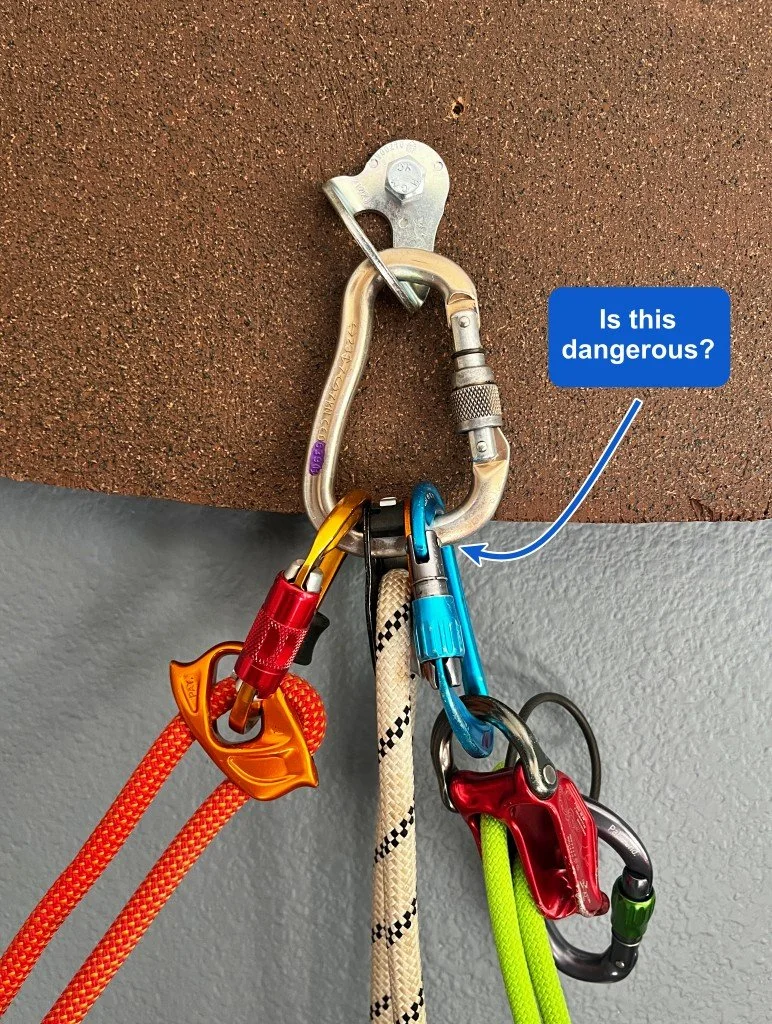
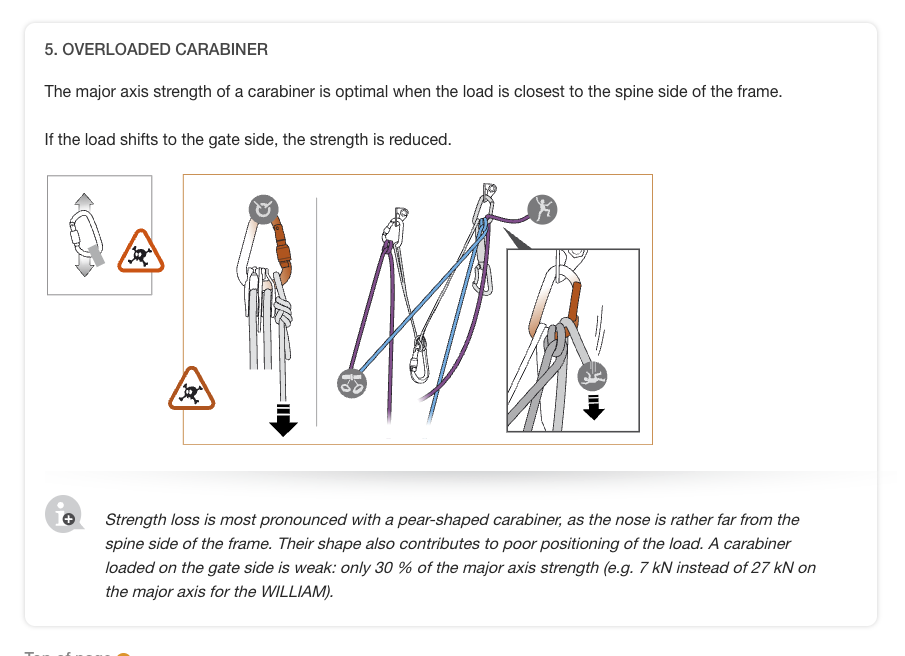
Petzl seems to have a pretty clear warning and not to do this on their website. The skull and crossbones usually gets my attention.
But here on their website, they say it's apparently fine to connect multiple items to a HMS carabiner . . .
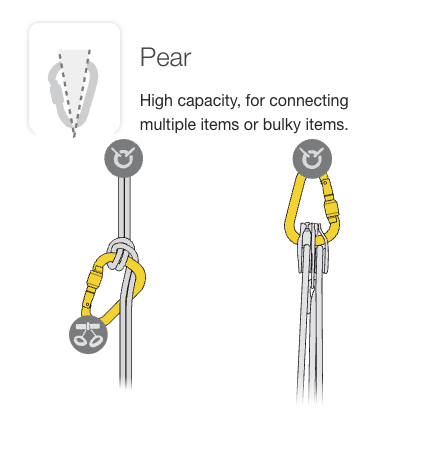
So . . . clipping two items is OK, but clipping three isn’t?
We all know that you get maximum strength from a carabiner by aligning the force along the spine and not necessarily the gate. Petzl says the “strength is reduced”.
By how much? Is it really a concern for recreational climbing?
HowNOT2 did a break test on this. With a limited sample size of 1, an HMS carabiner loaded up with several things clipped to it broke around 15 kN.
Is this significantly weaker than the rated strength of the carabiner? Yes.
Given that the largest possible force in recreational climbing is somewhere around 9 kN (and that's for a crazy factor 2 fall directly onto the anchor that 99.9% of climbers will never experience in their life) am I concerned about putting a load near the gate instead of upon the spine? No.
I want to share this as more of an “FYI, carabiners can be weaker than the rated strength if you load them like this”, rather than “OMG, if you do this, Yer Gonna Die.”
Modern climbing gear is incredibly strong and very rarely breaks under normal usage. There's lots of ways to get the whack when you climb. This isn’t one of them.

Stuck rappel rope? Try the “rubber band” trick
Yep, stuck rap ropes suck. The “rubber band” is a #CraftyRopeTrick to (hopefully) get your rope down.
You start to pull the rap rope, but can’t get it moving. Try this.
You and your partner grab opposite ends of the ropes and pull, hard. One of you keeps the “pull” pressure on, while the other suddenly releases their end. The “rubber band” effect of one end of your dynamic rope “springing” upwards often will get a stubborn rope moving.
You can do this with a Grigri or similar belay device; this might let you apply a bit more force to the rope instead of just pulling with your hands.

How much is a kilonewton? A great visual
Next time you're feeling less than thrilled about hanging off of that single sling, here's a good visual reminder of how strong it actually is. It. (Hint: it’ll hold 22 people who probably weigh more than you do. )

You see it on the labels of your carabiners, slings, rock, and rock protection: “Rated by the CE/UIAA to 22 kN”.
If you stayed awake in physics class, you might know that a kilonewton is a metric unit of force, equal to the weight of about 100 kg, or 225 pounds.
But even that gets a little dry.
You have a skinny 8 mm Dyneema sling in your hand.
It says it's rated to 22 kN . . .
But you still doesn't have a real sense of how much that is.
It turns out 100 kg is about the average weight of one NFL (American) football player.
So, imagine this: A skinny 8 mm Dyneema sling, rated for 22 kN, could hold about 22 football players all hanging from it at the same time!

Isn’t that’s kinda crazy to think about! Yes, most all climbing gear is impressively strong!
Next time you or your partner is concerned about that skinny sling breaking under your body weight, or maybe rappelling off of a single quick link that's rated to more than 40 kN, think of a whole pile of football players hanging off of your gear instead just you.
Hopefully you'll feel better. =^)
Fun facts about that gear label . . .
The “N” is capitalized in “kN” because it refers to the last name of Sir Isaac Newton.
There are only three countries in the world that don’t use the metric system: Liberia, Myanmar, and ‘Merica. Metric measurements are the international standard of pretty much everything, especially climbing, and that's what this ‘Merican is using.
What about that CE rating, what’s that? CE is an acronym from the French, "Conformité Européenne," which is French for “European Conformity”. Basically, it means that the gear meets certain safety regulations established by the EU.
How about the UIAA rating? UIAA stands for “Union Internationale des Associations d'Alpinisme”, which translates to International Climbing and Mountaineering Federation. They developed globally recognized standards for climbing and mountaineering equipment. The UIAA label means it’s been tested by an accredited third party and meets the UIAA requirements.