
5 differences: old and new Petzl Connect Adjust

Premium Members can read the entire article here:
Affiliate Disclosure: This article may contain affiliate links to HowNOT2. If you purchase through them, Alpinesavvy may earn a small commission at no extra cost to you. Your purchase helps support the largest and most comprehensive collection of climbing tips available anywhere.
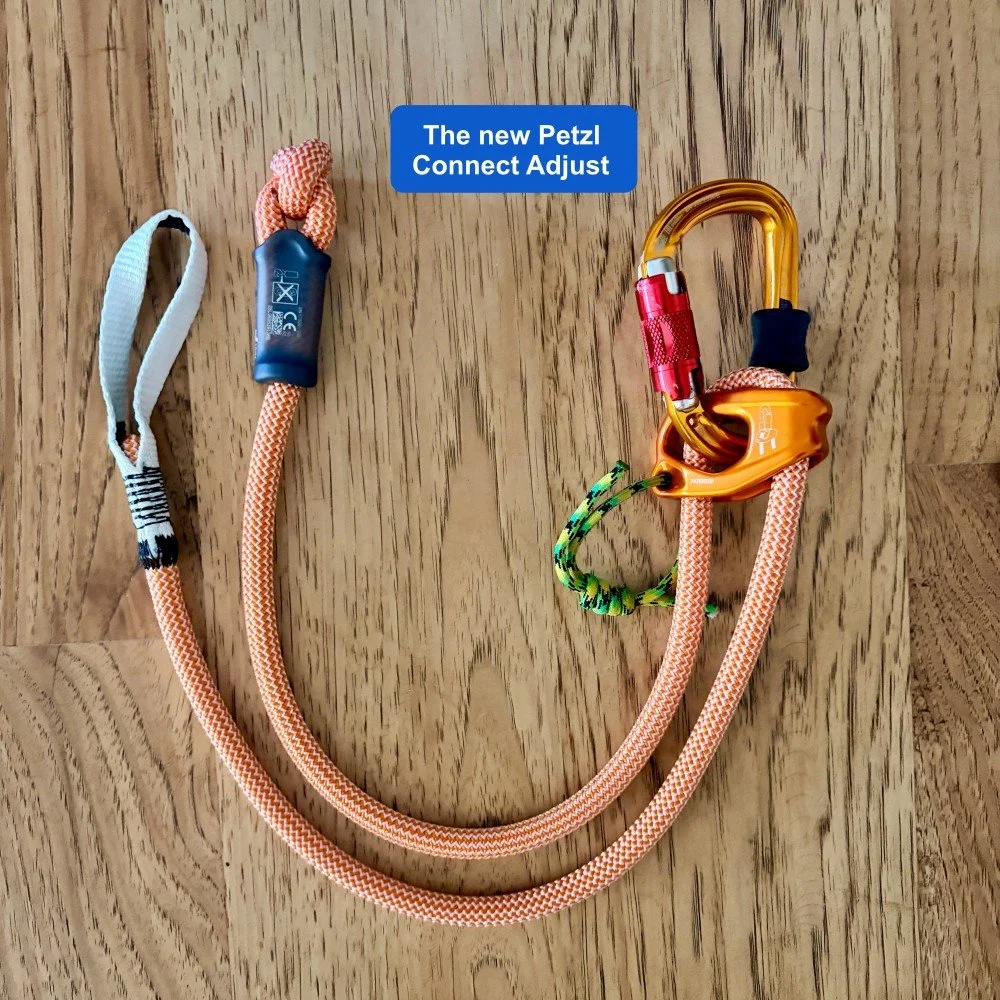
Petzl introduced the Connect Adjust tether / lanyard in 2015. It was an innovative product (and popular enough that most major manufacturers have since copied it.)
In 2025, Petzl introduced Connect Adjust 2.0, so let's check it out.
First off, why use a tether in the first place?
Whether it's DIY from a sling or a ready-made one like this, a tether is needed primarily when you need to clip yourself to something, and the rope is either under tension or unavailable to use.
Here are a few reasons (off the top of my head, I'm sure I'm missing a few.)
Clipping an anchor when transitioning to setting up a top rope or a rappel - Yes, you can do this with other tools, but the Connect Adjust is simple, solid, stretchy, easily adjustable and distinctly different from anything else you're carrying. This can make it easier to use, especially for beginners.
Route setting and route development - Clipping yourself to ascenders, bolts, fixed lines, etc., while you place holds, drill holes, remove old bolts, etc.
Hangdogging a sport route - While you can chain together a few quick draws to rest on a bolt, it’s usually easier to clip in direct with a tether.
Aid climbing - The Petzl “Dual Evolv Adjust” is like the Connect Adjust, except it's longer and it comes in a matched pair. This is the modern standard for an aid tether. It’s extremely handy for leading and following overhangs, roofs, traverses, redundant clipping to anchors, rope ascending, easing onto a delicate hook placement, and other big wall dark arts.
Search and rescue teams - All kinds of uses like securing yourself near the door of a helicopter, attaching yourself to a litter with a patient, etc. (or so I’m told; I don't do that kind of stuff. =^)
Climbing in moderate terrain in a larger group - You may be moving along a fixed rope with a friction hitch or two, sort of like a via ferrata. You need a tether to connect to the anchors and possibly to your friction hitches.
Skiing on a glacier - In the Alps, it's common practice to ski unroped, but have a tether attached to your harness and clipped to the top of a backpack strap. If you unfortunately fall into a crevasse, get wedged in it, and can’t access your harness, someone can hopefully drop a rope to you, you can clip it to the tether, and you get pulled out via that. Certainly hope you're never in this situation!
A lot of people like to poop on designated tethers / PAS’s like this, so here’s a word for them.
To be clear, I'm not saying it’s a required piece of gear. Many climbers get along fine using a 120 cm sling for the occasional multi pitch rappel, chaining together a couple of quick draws to clean an anchor, and other minimalist approaches.
However, consider this situation:
Say you're on a multipitch sport climbing route where you need to rappel to get back down. You must have a tether to descend. “Don't bring a Connect Adjust, it's a single use item”, they say.
Well, what kind of tether ARE you gonna use? Probably a 120 cm sling. Guess what? You’re sport climbing, remember? On the way up, that sling is a “single use item” that's not being used for anything. Just sitting there on your harness with a locking carabiner, not helping you at all.
You have to bring something to secure yourself to the anchors on the way down. Why not bring the tool that works the best?
Main changes to the new Connect Adjust:
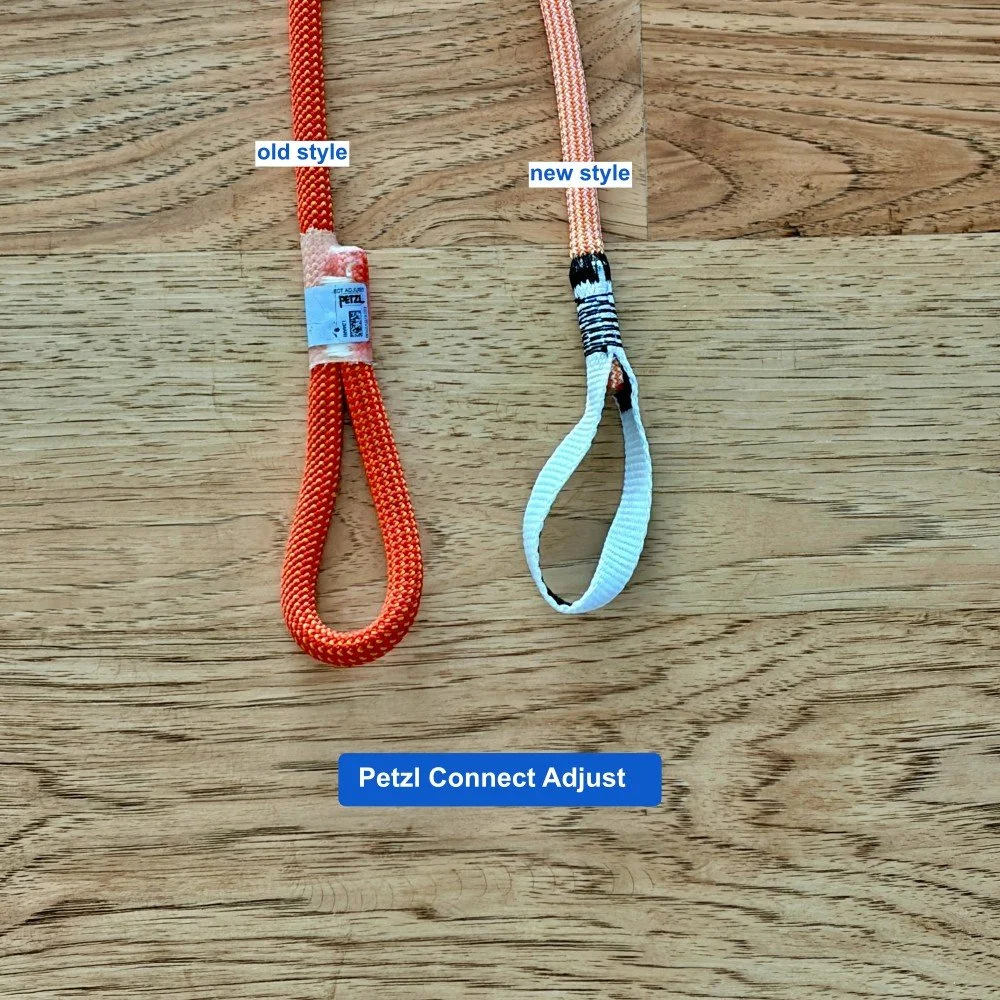
Added a Dyneema sling for harness attachment, less bulk
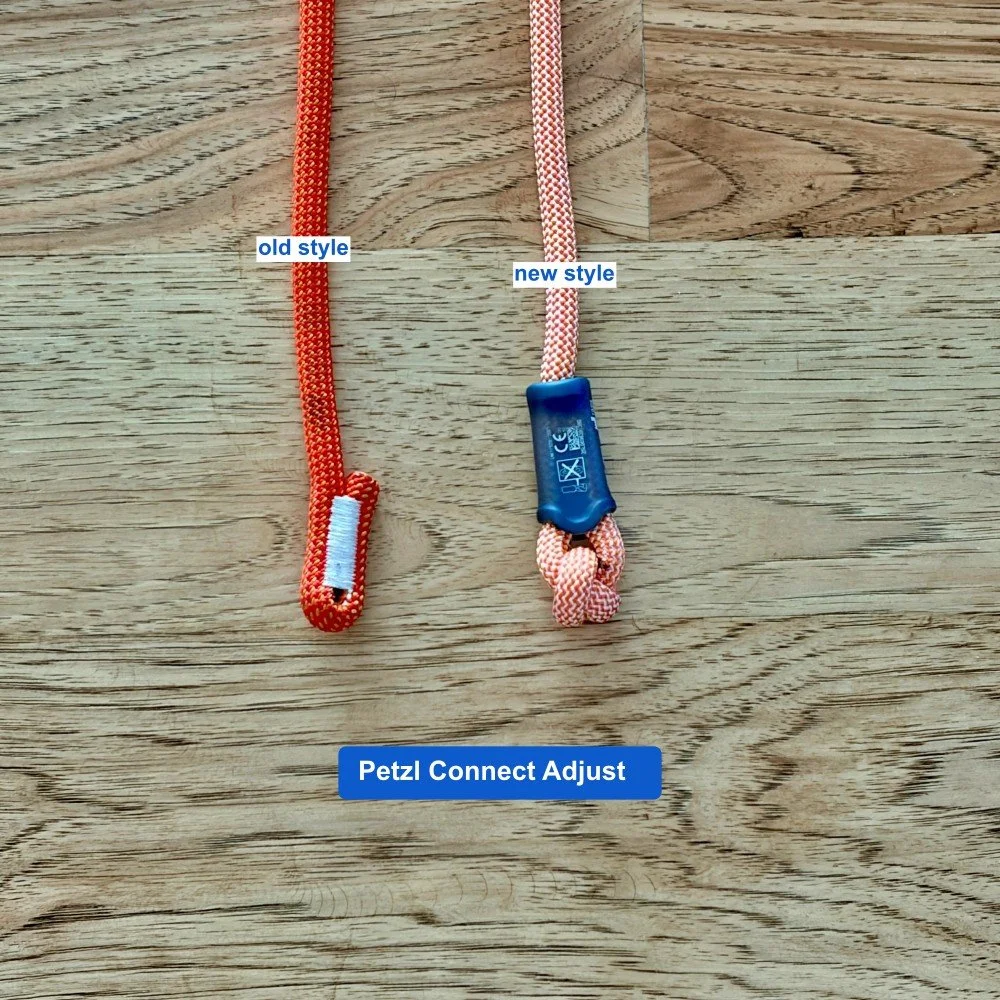
Changed the stopper system in the end, more elegant and ergonomic
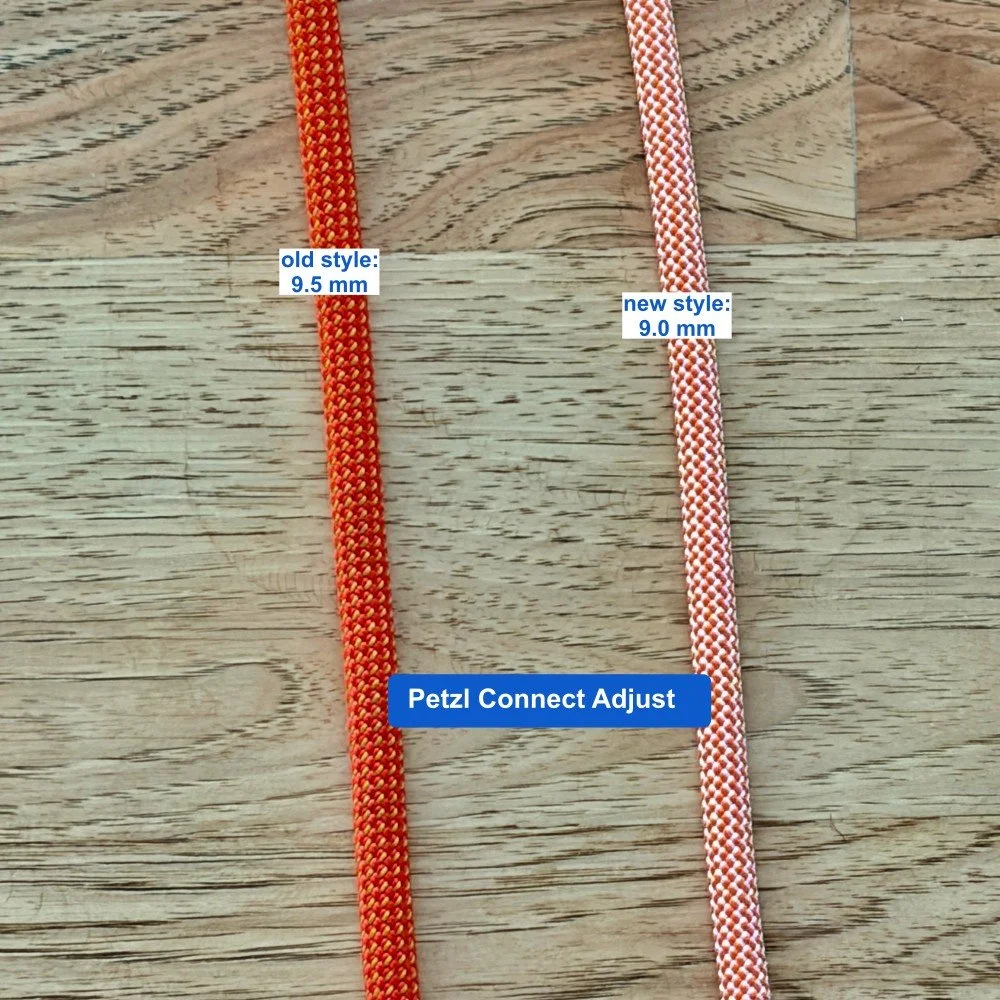
Went from 9.5 to 9.0 mm rope Petzl Volta, MUCH easier rope feeding
Small change of the angles in the metal part, so it's easier to feed the rope through
Added a “release hole”; if you want, you can tie some cord and carefully pull it so it's releasable under load
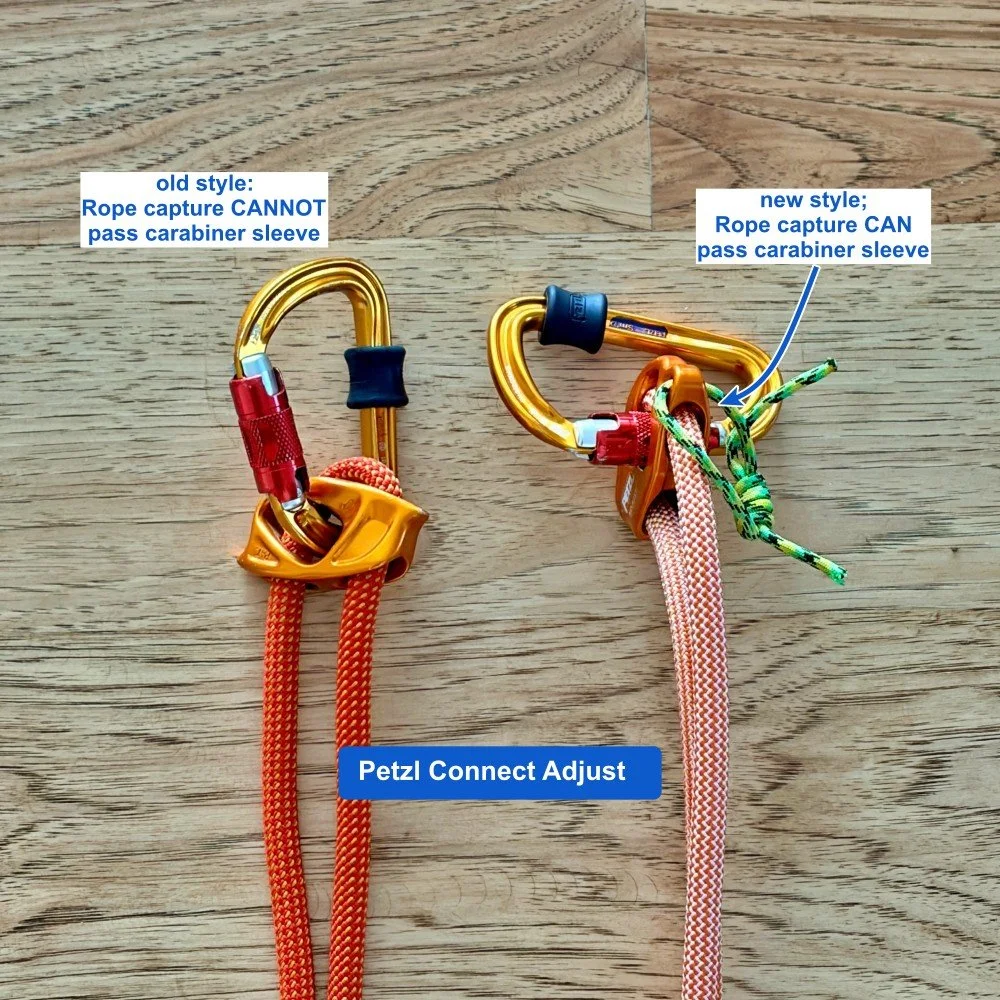
Don't know if this was intentional, but the barrel of the carabiner can pass through the metal part, whereas before that couldn’t happen (depending on the carabiner, more below.)
Old style: chunky but serviceable. New style: short bit of Dyneema webbing to connect with a girth hitch to your belay loop, which is lower profile and more compact.
The older version had a functional, but not very attractive chunk of sewn rope as a stopper on the end. The new style has a better looking and slightly more ergonomic rope stopper.
Note that in both of these designs, it's impossible to clip a carabiner to the end. This is good, because you should never do that!
One of the biggest differences in ease-of-use is a slightly smaller diameter rope (Petzl Volta) in the new version: 9.0 mm vs. 9.5. Lots of people cut out the rope on version 1 and replacing it with various flavors of rope, from 8.5 to around 9. (I think Petzl got the hint.) You may not think that half a millimeter can make much difference, but it really does.
Another big change is the addition of a small hole in the new style, through which you can tie some cord. This allows you to release the tether when it's under full body weight, which you couldn’t do in version 1. This does take a bit of practice in a controlled environment, because it tends to go from fully locked up to fully unlocked very quickly, but it's doable.
Another change, that you can't really see it from the photo: the geometry of the aluminum part has been slightly changed to allow much easier feeding of the rope. Between this and the smaller diameter rope, the biggest headache with version 1.0 (hard to feed rope) is solved.
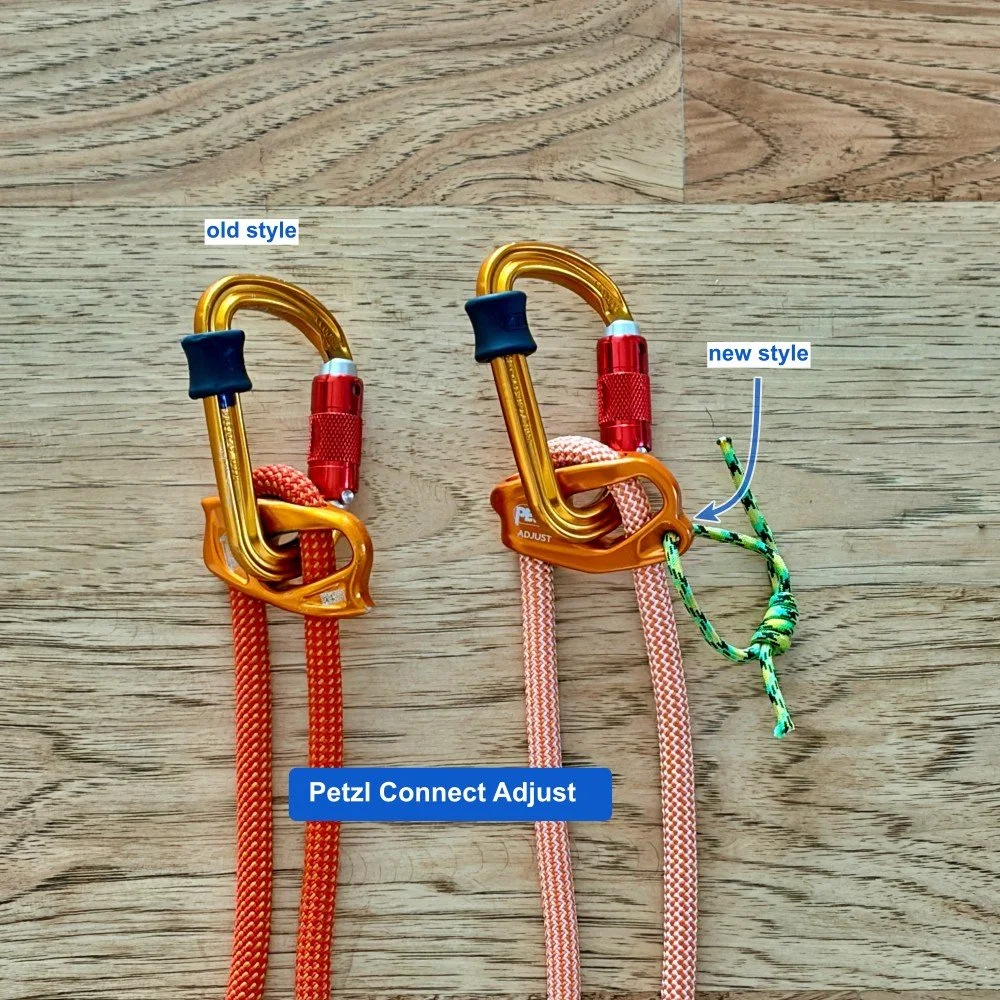
This last one is a head scratcher for me . . .
Using the recommended carabiner, the twist lock Petzl Sm’D, with the old version, it was impossible to pass the Connect Adjust over the locking sleeve of the carabiner. Combining this with the little rubber stopper thing (called a Tanga, more than that below), it was impossible to cross load the device, and so it always was situated happily in the bottom of the carabiner. Seemed like a solid design, good job.
However, I was surprised to discover with version 2.0, with the same carabiner, you CAN pass the Connect Adjust onto and beyond the sleeve of the carabiner. This creates some potential for cross loading, removes the device from optimal position in the bottom of the carabiner, and in my mind seems kind of . . . wrong?
However, I'm sure the clever Petzl Design Gnomes, who are undoubtedly smarter than I am, did this for a reason. If you know why, please email me so I can be unconfused.
How do I attach the Connect Adjust to my harness?
What carabiner is best for the Connect Adjust?
What's the little rubber stopper thing that comes with the Connect Adjust?
