
What’s the “Low Impact Style” of ice climbing?

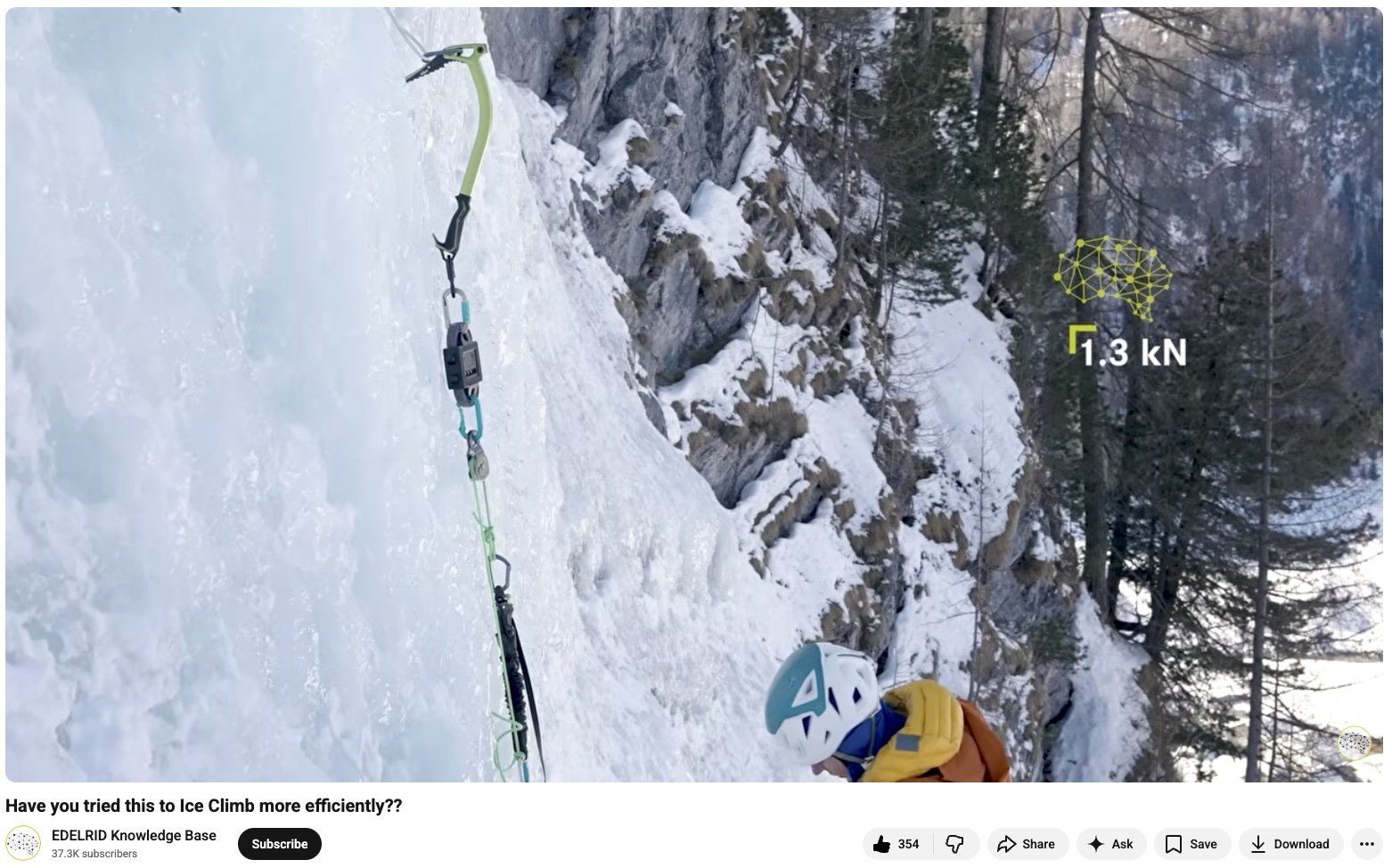
Check out this great video (link at bottom of page) from the always useful “Edelrid Knowledge Base” series on YouTube (a very underrated place to learn tech tips, in my opinion.)
While most beginners might think otherwise, ice climbing doesn’t have to be a battle of big swings and exploding ice.
This video from the (always useful!) Edelrid Knowledge Base introduces what they call the low-impact style of ice climbing, a technique that lets you climb harder routes with reduced risk, more refined movements, and with much less energy.
Beginners often hack away with full-body tool swings from hip, shoulder, elbow, and wrist. (I know I sure did when I started, because I was kinda scared!) Instead, the low impact style calls for reading the ice more like rock.
The core ideas are simple:
Look for natural features that accept the pick with minimal force.
If you don't have a natural feature, repeatedly tap lightly and precisely to make a pick placement instead of strenuous bashing.
Place the pick only 2–4 cm into good ice.
Primarily swing / tap with your wrist, rather than the whole body.
This reduces shattered ice, falling debris on you and your belayer, and preserves delicate features.
It wouldn’t be an Edelrid video without some creative experiments, would it?
They ran a series of tests on different pick placements in real ice, using a load cell and pulley system to measure how much force different placements can hold.
A “standard” deep, half-pick placement in good ice easily withstands forces above 3 kN, far more than the ~0.7 kN typically generated when the climber loads a tool with body weight during normal movement.
Shallower placements of around 3 cm still hold roughly 1.7 kN.
Even a seemingly sketchy 1 cm placement in good ice can sustain 0.5–0.7 kN—enough for controlled climbing when you’re not shock-loading the tool.
The same mindset applies to footwork. Look for precise front-pointing on features instead of hacking deep steps, which preserves ice integrity and gives more options as the route steepens.
This is more of an intermediate to advanced technique, because if your pick is just barely in the ice, and you shift the pick angle as you move up on it (a common beginner mistake) it's likely to pop out. However, if you're practicing this on top rope, which you should be, it can certainly reinforce good technique.
The takeaway:
Be a woodpecker, not a wood chopper.
Refined tapping can give you shallow but solid placements.
These shallow placements are usually strong enough and significantly more efficient.
The “low impact style” saves a lot of energy, preserves delicate features, and reduces dangerous falling ice for you and your partner.
Check out the whole video below.