
The “reverse stack pull down” rappel

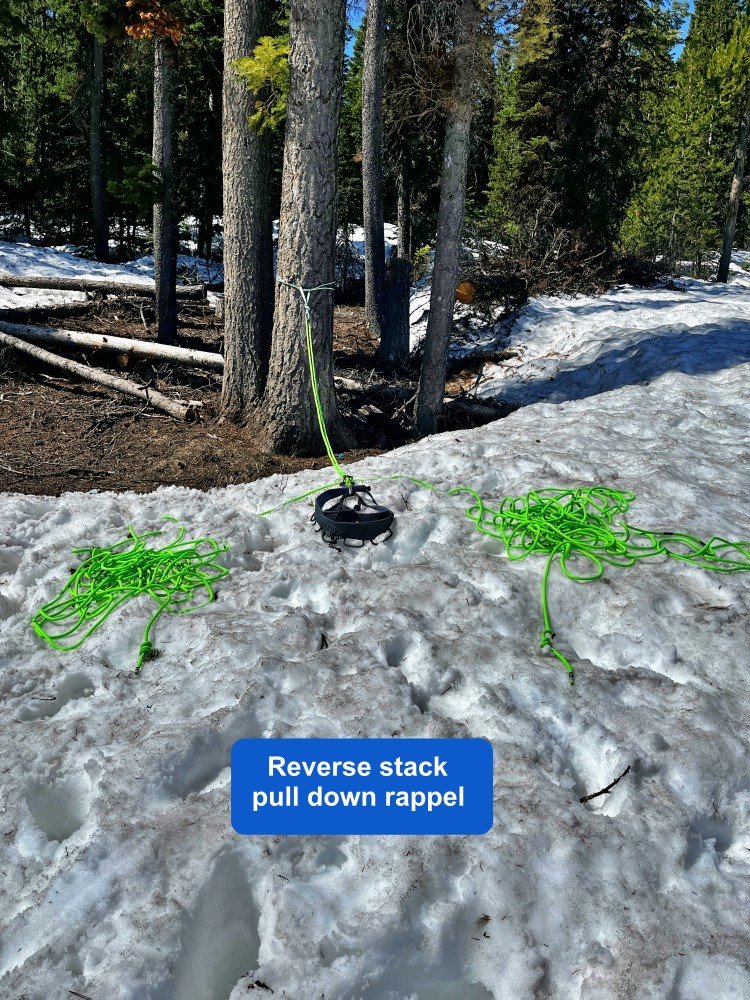
You don't always have to throw your rappel ropes down.
With the “reverse stack pull down”, you keep the ends at the top and pull them down with you as you descend.
Scenario:
You need to rappel down a low angle rock slab or fairly steep snowfield.
Maybe you have a double rope rappel. Making two separate tosses of 60 meters each will be a hassle, because the terrain below you isn’t steep enough to make a clean rope throw.
Might be time for the reverse stack pull down method; a fancy name for a simple idea.
Flake each half of the rope into two separate stacks, starting with the ends of the rope on the bottom. (That's the “reverse stack” part; typically, you flake the rope so the ends are on the top.)
Tie a stopper knot in each end to close the system.
Try to keep the rope piles well separated from each other so there's no chance they can tangle together.
Start rappelling, and the ropes are “pulled down” as you go.
This is breaking one of the main rules of rappelling, which is never descend past the ends of the rope. That way if the rope end is snagged on anything, you can detangle it on your way down.
You can break this rule in this situation because you have a smooth rock slab or a snowfield. This means there aren’t any terrain features that could grab your rope above you, or loose rock that you could pull down on top of you.
I’ve used this on a few high angle snow rappels, and it works great!
Keep it in your toolbox of #CraftyRopeTricks to break out in the right situation.
Here’s a nice Instagram video from IFMGA Certified Guide Dale Remsberg showing how it's done.
https://www.instagram.com/reel/DGncVxtuKNa/?igsh=ZTB5bnR5eGVhYW15