

Note - This post discusses techniques and methods used in vertical rope work. If you do them wrong, you could die. Always practice vertical rope techniques under the supervision of a qualified instructor, and ideally in a progression: from flat ground, to staircase, to vertical close to the ground before you ever try them in a real climbing situation.
Rare situation, but possible: you need to descend a loaded rope.
Maybe your partner rappelled first, got stuck or incapacitated, and you need to go down and sort it out. The problem is, because the rope is loaded, you can’t install your typical rappel device.
Here is one way to do it, using gear that you probably already have with you and without tying any exotic knots.
Put two friction hitch loops onto the loaded rope. (This can be a short hitch cord attached to a 60 cm sling, or as shown below, a single 60 cm sling, probably tied with a Klemheist friction hitch.)
Clip the top friction hitch/sling to your belay loop with a locker. (If you have an adjustable tether of some kind, use that in place of the 60 cm sling for better adjustment.) Depending how tall you are, you may need to adjust the length of this connection.
Girth hitch a 60 cm sling to your belay loop. Clip this to the bottom friction hitch with a locker.
Clip a third 60 cm sling to the locker on the bottom friction hitch. This will be your foot loop. You can tie a clove hitch or a girth hitch in the sling to secure it around your foot.
Remember the primary rule of rope ascending, which in this case is rope descending: you always have two separate connections to the rope.
Now, it's time to inchworm your way down the rope. Load the top friction hitch. Slide the bottom friction hitch down. Step in the foot loop, which should give you slack on your top friction hitch. Release this top hitch and slide it down. Load the top friction hitch, and repeat. It’s slow, but relatively low risk.
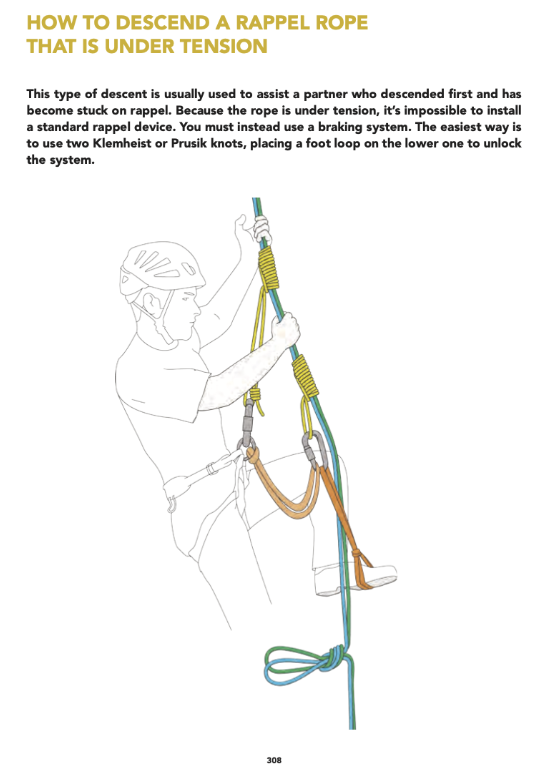
image: UIAA Alpine Summer Skills Handbook
There is one more method I know of to actually rappel on a loaded rope. It was shared with me by an IFMGA guide, who learned it at ENSA (the French National Mountain Guide School).
It involves putting a locking carabiner on each strand, passing one carabiner through the other, and then rappelling on that.
In my brief experimenting with this, it seems quite easy to lose tension on the whole system, and have a rather dramatic failure. For that reason, I'm not gonna teach that.
If you're curious, ask a French guide. =^)