
Alpine Tips

Decluster your anchor: Put lap coils on a sling
At a hanging belay or small stance, keeping your rope tidy and giving a smooth belay to the leader is a lot easier if you move the coiled rope away from your tie in connection and attach it to some part of the anchor.
This tip is from AMGA Certified Rock Guide Cody Bradford. While sadly Cody is no longer with us, his Instagram continues to stay up and is a great source of tips like this, check it out.
On a multi pitch climb, rope management is a key skill to staying cluster free and moving efficiently. The basic question is, ledge, or no ledge?
If you have any sort of a ledge, you can often (neatly) pile the rope at your feet.
If you're at a small stance or full hanging belay, the typical approach is to make lap coils over your tie in connection.
However, these lap coils can be cumbersome, especially when belaying a leader.
Below is the standard approach of the rope draped over your tie in connection. Do you think this might be awkward when you try to belay your leader from your belay loop? (Answer, yes.)

image: Cody Bradford, https://www.instagram.com/p/BsZCqrpBXpu/
Solution: hang the coils from a sling on the anchor. The rope stays tidy AND out of your way. Much easier to belay your leader on the next pitch.

image: Cody Bradford, https://www.instagram.com/p/BsZCqrpBXpu/
Here's a short video by Cody Bradford that demonstrates this simple and effective technique. (He's doing it on ice, but it works fine for rock climbing as well.)

Remove rope twists with an ATC
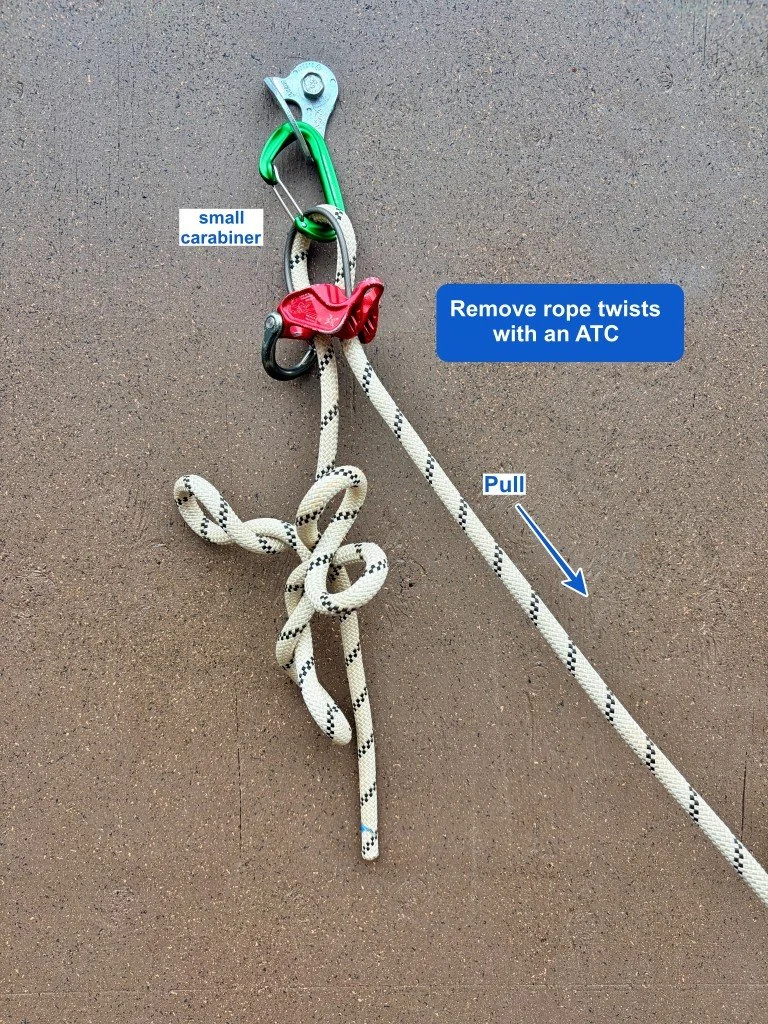
Got some serious twists in your rope? Ugh, you need to get ‘em out. Here’s a fast way to do it with an ATC style belay device.
Twists (aka pigtails) in your rope are a hassle, and you need to get ‘em out.
The source of pigtails is often a mystery. Some possible causes might be:
Munter hitch rappel or lower with poor technique
Lowering off an anchor with quicklinks lying flat against the rock
Unwrap a new rope in a hurry
Or just some random rope weirdness!
Here's a simple and fast way to decluster your spaghetti pile.
Clip a carabiner and a tube style belay device (here the DMM Pivot, my fave) to a bolt, some rock pro, tree branch, whatever, about head high. A small carabiner can work better than larger one.
Flake the rope onto the ground.
If you have the space, try to stretch the rope out to most of its full length. (A grassy field or park works well for this.)
Why stretch out the rope? Because as you pull the rope through your device, the twists start migrating toward the end. If the rope is all stretched out, these twists can more easily work themselves out the end of the rope instead of making a gigantic tangle as will probably happen if you flake the rope into a pile. (Ask me how I know about this . . . )
Feed the rope through the belay device and carabiner, and pull the rope through. When you get to the twists, continue pulling through the device, giving a few shakes and shimmies as needed. Having a friend to assist you can be nice.
As the rope is pulled through the small diameter of the belay device, the twists move to the end of the rope and should work themselves out. If your rope is REALLY messed up, you might need to repeat this.
Pigtails in your rope can be more than a minor annoyance. It’s especially important to remove them when you're pulling a rappel rope.
If you don't, the strands can twist together or cause other weirdness, making your rope difficult or impossible to pull. Check out this description (translated from Italian) and photo from @aledallo91.
“. . . a crunch created during the recovery of a rope on a broken descent on two anchors that forced me to abandon it, as it was impossible to recover from the intermediate stop. Then I went back up to save my baby. ❤️
This ball was formed by itself in recovering the rope, due to the twisting of the last meters of the same.
Experience that teaches the importance of checking that the rope is always well stretched and free of slots and twists before attempting the retrieve.”


National Park Service technical rescue manual - free PDF
The search and rescue (SAR) experts in the National Park Service, with techniques developed over decades of experience, have a technical rescue manual. It's available online as a free PDF download. If you have more than a passing interest in self rescue, this is a good place to take a deep dive.
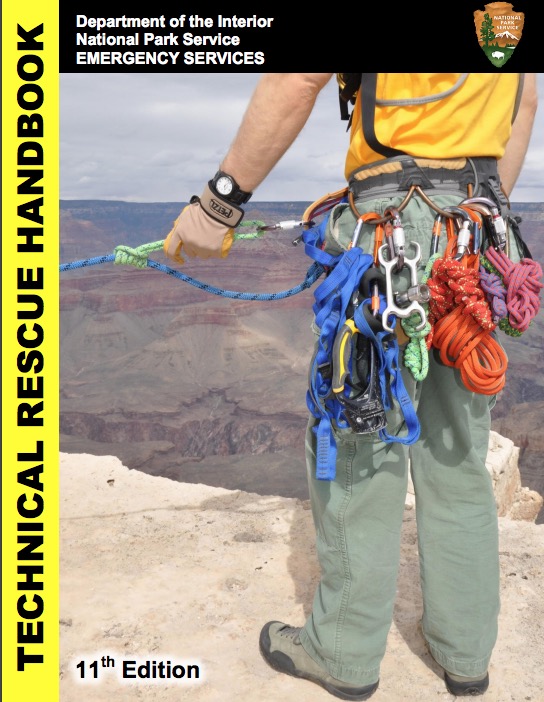
image: Department of interior National Park Service
National Park Service SAR (Search and Rescue) professionals, with skills honed over decades at parks such as Yosemite, Grand Teton, and Grand Canyon, have a technical rescue manual. It’s online as a free PDF file, hosted on the Mountain Rescue Association website, MRA.org.
If you want to get into some serious rope geek material, this is some solid reading. This 290+ page document pretty much covers it all; below is a screen grab of the table of contents to give you an idea.
It starts with the basics and then gets increasingly technical and complex. Even if you're not on a SAR team, there are some expert techniques and tricks here that can benefit anyone interested in small team self rescue. Check it out.
Note: Some of the more advanced techniques have evolved since this was published in (I think) 2014. Most recreational climbers won’t need to know the detailed benefits of the dual tension system over the older style main and belay, for example. If you're looking for a more up-to-date reference, check out “The Technical Rescue Riggers Guide, Third Edition” by Conterra.
(And, in case the MRA.org link above doesn’t work, you can see a copy here.)

image: Department of interior National Park Service

Debrief after your climb
Every trip, summit or not, is an opportunity to reflect, learn and improve. The best way to do this is with an honest talk / debrief session with your partner(s) ASAP after your climb.
Treat every climb, summit or not, as a learning experience to analyze what you did and to improve your performance next time you’re out. A great way to do this: a post climb “debrief” talk with your team (even if that’s just you and one partner). On the car ride home, the hike out, or at dinner heading home, when details are fresh in your mind, is a great time to discuss things like:
Time - How long did the climb take? Was this faster or slower than what you planned for? Look at the segments of your climb (approach, climb, descent, hike out); Were your estimated times close for each of those? What factors contributed to the overall pace/speed of the team? (If you hit your planned time within plus or minus one hour for each day, you can pat yourself on the back for good planning.)
Technical aspects - What was the technical crux of the route? Was the entire team prepared for it? Were there any aspects that could be improved to be faster or safer next time? (Think simul climbing, downclimbing rather than rapping, rope management, order of team members.)
Routefinding - Was your pre trip route planning adequate? Were you ever “lost?” Did you camp in the best spot, or did you notice a better place (and mark it with GPS or on the map for next time?) Did you take the best line, for ascent and descent? Did you take adequate photos or notes so you remember the details? Did you record a GPS track? Can you draw your route and save it in CalTopo, for future reference or to share with someone else?
Gear and food - Was the gear you brought suitable? Did you have too much or not enough or anything? (rock pro, snow pro, ropes . . . ) What pro did you bring that you did not use? Was your food sufficient and tasty?
The main question: What would I do differently next time?
Now, when you get home, if you write these details in your ongoing climb journal, you’ll really have a good record of the trip that you can learn from yourself, or pass onto someone else when they try the route. (The benefits of keeping a climb journal are covered in another Tip coming soon.)
Make a regular habit out of reviewing your climb journal, and look for repeating patterns. Are you consistently making similar “mistakes”? (For me, this is typically forgetting the lip balm and bringing a bit too much food.)
Hey, don’t just take my word for it. Expert alpinist Steve House made a video on the topic, as part of his excellent five part “Alpine Principles video series on YouTube, highly recommended. Check it out below.