
I get confused when I look at these fancy diagrams with ropes running in all different directions. How can I figure out what the real mechanical advantage is of a given system?
You're right, things can be difficult to figure out! At one level, you could say it doesn't really matter. If the 3:1 isn't working, you can add or multiply a 2:1 on top of this, and hopefully the resulting 5:1 or 6:1 gets the job done. The number doesn't really matter in the end.
But, since you asked the question . . . Remember our discussion simple, compound, and complex systems from this post? (Go read it now if you have not seen it.)
The answer of “what’s my MA” varies depending on which one of these systems you’re using.
For a simple system, we calculate the MA by counting how many strands of rope are going to and from the movable pulley(s) on the load or load strands. And, always remember, any pulley or carabiner that’s fixed on the anchor only changes the direction of pull, and doesn’t create mechanical advantage.
Let's look at a few examples.
Also, in a simple pulley system:
When the rope end terminates at the anchor, then the MA will result in an even number (e.g. 2:1, 4:1, 6:1, etc.).
When the rope end terminates at the load, then the resulting MA will be an odd number (e.g. 3:1, 5:1, etc.).
There’s 1 strand of rope coming from the load. So, 1:1 simple system (no mechanical advantage gained).

There’s 2 strands of rope going to and from the load. So, 2:1 simple system. (Rope end attached to anchor, even number MA of 2.)

There’s 3 strands of rope going to and from the loaded strand. So, 3:1 simple system. (Rope end attached to load, odd number MA of 3.)

For a COMPOUND pulley system, the hauling systems are MULTIPLIED together.
For example, this is a 2:1 on top of a 3:1, so multiplied we get a 6:1.

image: https://roperescuetraining.com/raising_6-to-1.php
Something else about compound systems: the above rule of “the end of the rope attached to the load or to the anchor tells you if the MA is odd or even” doesn’t apply anymore.
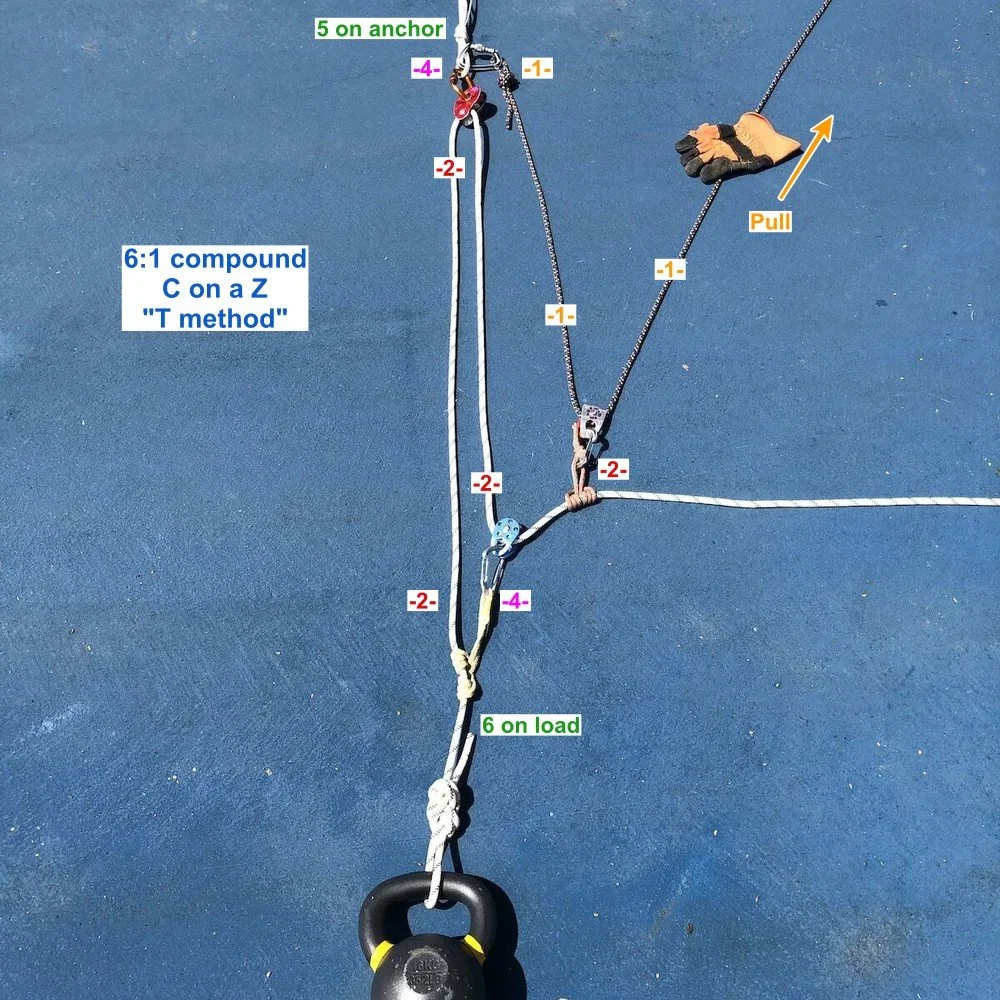
For example, have a look at this system. This is a 6 to 1 compound system, with the 2:1 “C” built on top of a 3:1 “Z”.
The end of the rope is tied onto the load, but the resulting mechanical advantage is an even number, six.
What's up with those numbers in the diagram? That's how we figure out the theoretical mechanical advantage of any hauling system with some simple math. It's called the “T method”, and here's my more detailed article on it if you want to learn more.
For a COMPLEX pulley system, the hauling systems are ADDED together.
For example, the image on the right shows complex system. The 2:1 on top of a 3:1 added together gives a 5:1.

image: https://roperescuetraining.com/raising_5-to-1.php
For more on simple, compound and complex pulley systems, see this post, “The 3 kinds of pulley systems”.
There‘s also a more (easy) math oriented way to calculate your MA. It’s called the “T-method, aka “counting tensions”.