

Premium Members can read the entire article here:
This post discusses techniques and methods used in vertical rope work. If you do them wrong, you could die. Always practice vertical rope techniques under the supervision of an experienced climber, and ideally in a progression: from flat ground, to staircase, to vertical close to the ground before you ever try them in a real climbing situation.
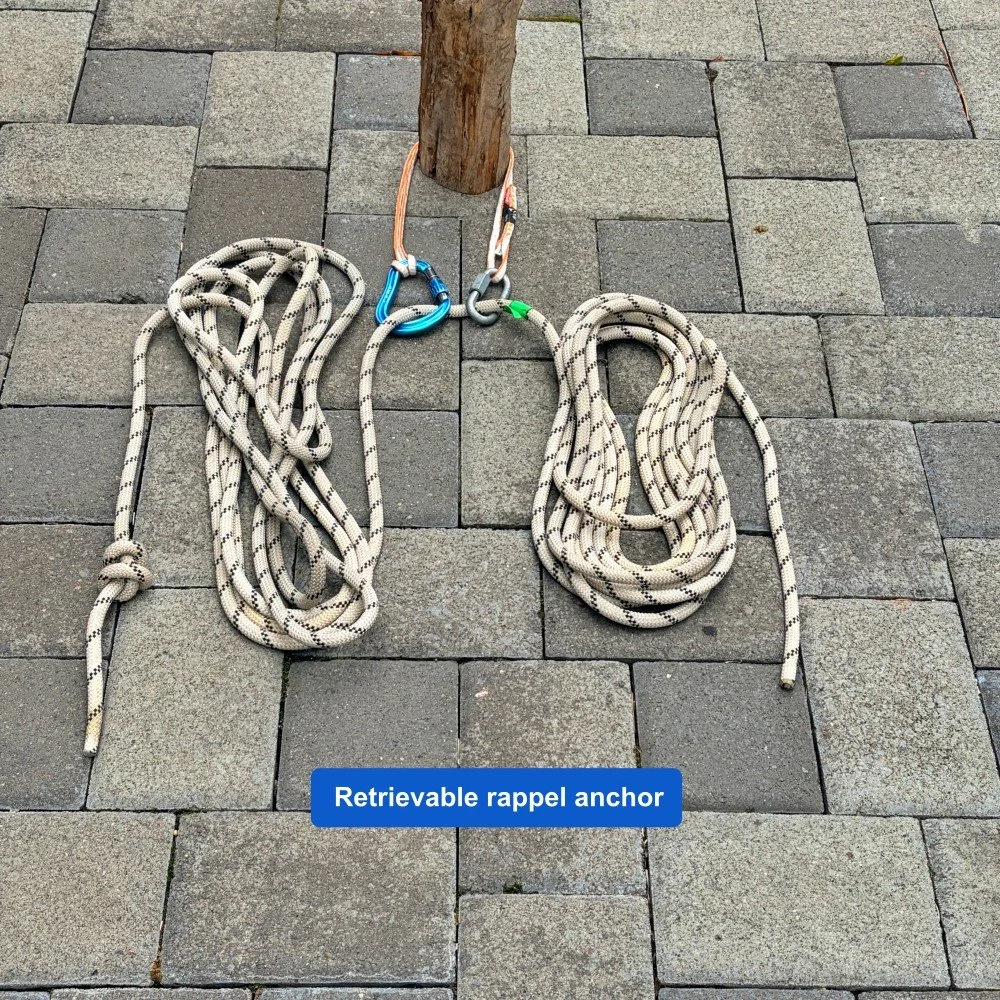
Disclaimer: I’m posting this as an interesting rigging technique that MIGHT be useful in some very niche situations. I do NOT recommend that you use this as a regular part of recreational rock climbing!
I’ve seen it used for canyoneering, a sport with all kinds of specialized rappel tricks. This is an advanced technique. If you decide to use it, practice it with a qualified instructor.
This is one of MANY ways to rig a retrievable anchor, known by some people as “ghosting”. If you want to learn more, check out Andy Kirkpatrick’s excellent book “Down”, and this great canyoneering book by my buddy Kevin Clark, “Canyoning in the Pacific Northwest: A Technical Resource”.
I can't think of many situations where climbers would want to rig a retrievable rappel anchor. But if you did, here are a few ways to rig it.
A retrievable rappel comes with a few issues:
The rappel rope is attached to your anchor rigging. That create a higher chance of something getting stuck, which includes your rope (at least with two of these methods.)
The gear gets banged up as it falls. Probably not catastrophic, but not great either.
You need to rig it on a suitable object, such as a convenient tree. This doesn’t work on a normal twin bolt climbing anchor.
For these reasons, I think it's not very applicable for recreational climbers. Having said that . . . it’s a #CraftyRopeTrick you might find interesting. Plus, it’s fun to rig it up and see how it works!
For arborists, this is standard practice.
TRee workers use a “friction saver”, or “cambium saver”, to make an anchor point in a tree without damaging the tree from rope friction, and to leave nothing in the tree when you return to the ground.
(If you really want to nerd out on this, there’s a corner of YouTube where you can learn clever ways to get these up into the tree, with your rope, and lower them down in a controlled way with a throw line. Those are more advanced applications, and I'm not going to cover them here.)
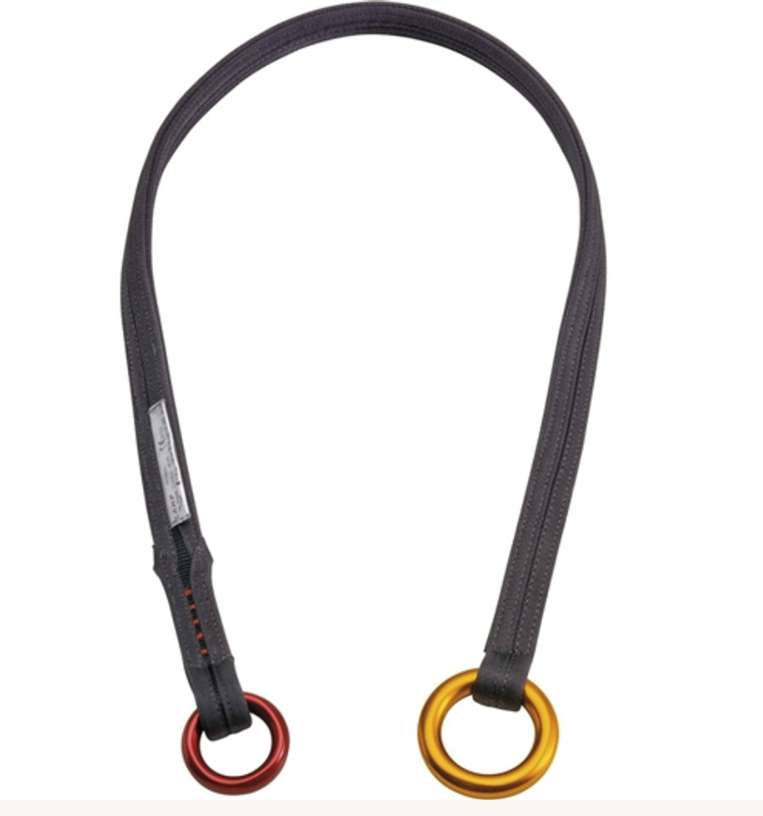
Gear you need for a retrievable anchor
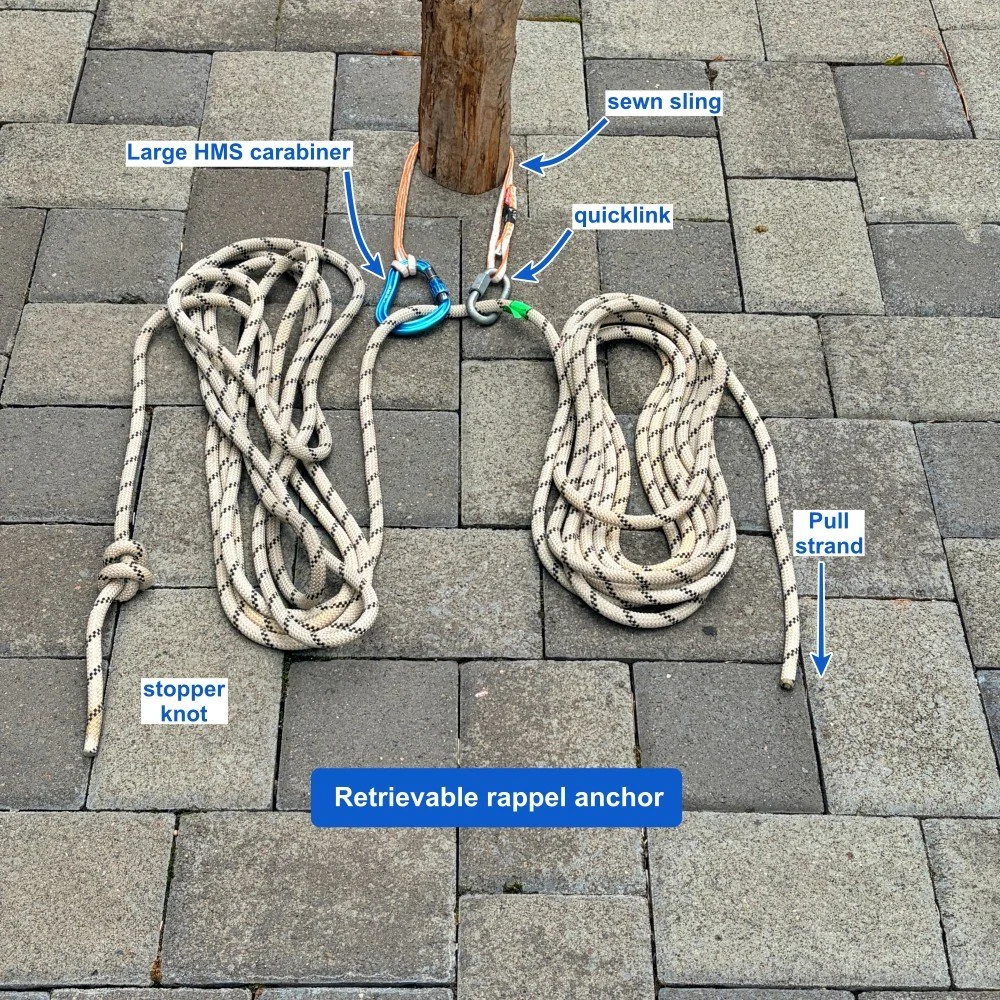
sewn sling
large gate locking carabiner (or strong metal ring)
quicklink, 6 or 8 mm
a suitable anchor point, such as a stout tree branch
General rigging procedure for a retrievable anchor
Tie a good stopper knot in the end of the rope. (Yes, this might be the only time in your life you intentionally pull your rappel rope WITH a knot in the end of it!)
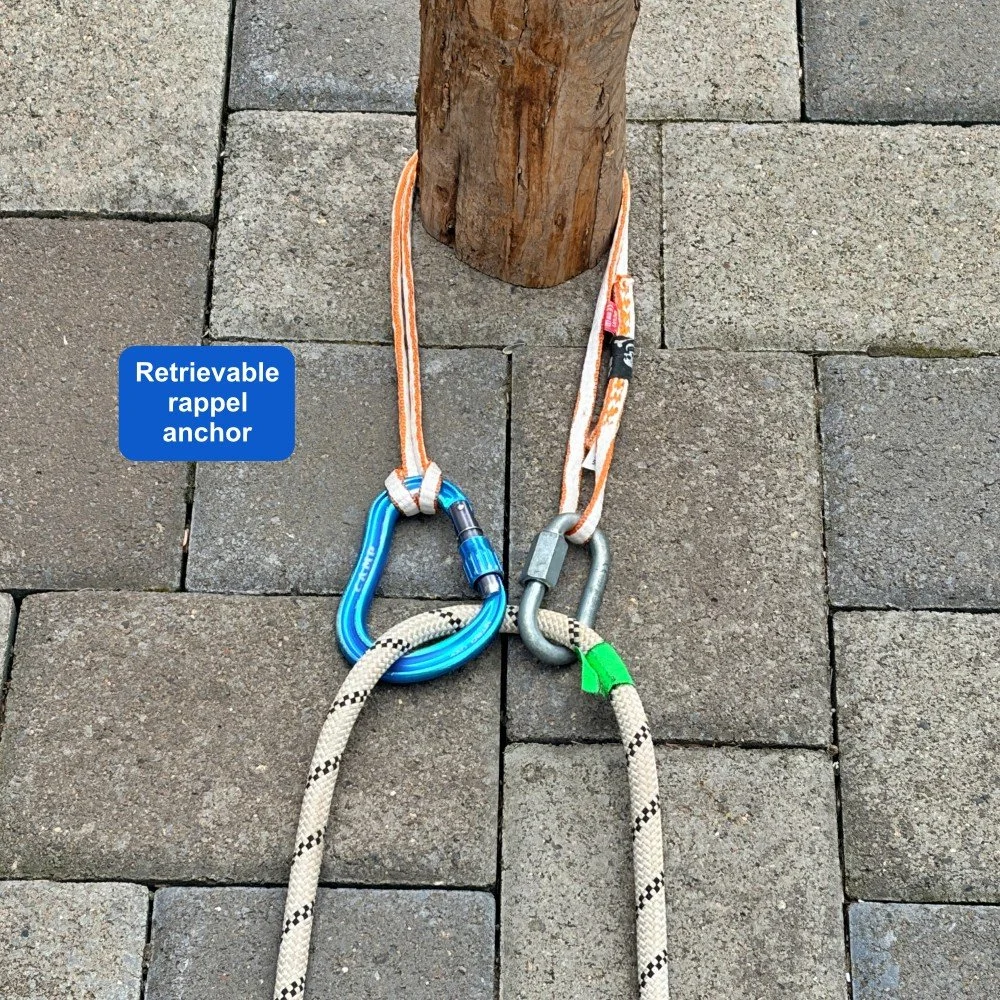
Note that the sling is girth hitched to the narrow part of the carabiner. This helps keep the carabiner in the proper orientation, with the wide part of the carabiner facing down.
Be SURE and rig the rope so when you pull, the knot passes through the big locking carabiner or ring, and gets stuck on the smaller quick link.
Be SURE and pull the rope strand that doesn’t have the knot.
Pull your rope. When the knot arrives at the anchor, it (hopefully) passes through the large carabiner or ring, get stuck on the quick link, and then pulls the anchor sling over the tree branch.
With any luck, nothing gets stuck and everything falls down happily!
Will you ever have a practical need to do this? Probably not. Is this some clever rope trickery that you might wanna play around with to see how it works? Maybe!
Here are three different ways to rig it:
HMS carabiner
Steel ring
Breakaway
Retrievable rappel anchor method 1 - HMS carabiner
The advantage to this method is using standard climbing gear.
The downside is your carabiner falls down along with the anchor rigging. Yes, I've read those studies that say “micro fractures are a myth”. Even so, I'm still not too excited about having my nice carabiner bounce down a rock face. If your rappel is pretty short and has a soft landing, then probably not a problem. If it's longer or it's gonna land on rock, not so good.
Here's a close-up of that rigging.
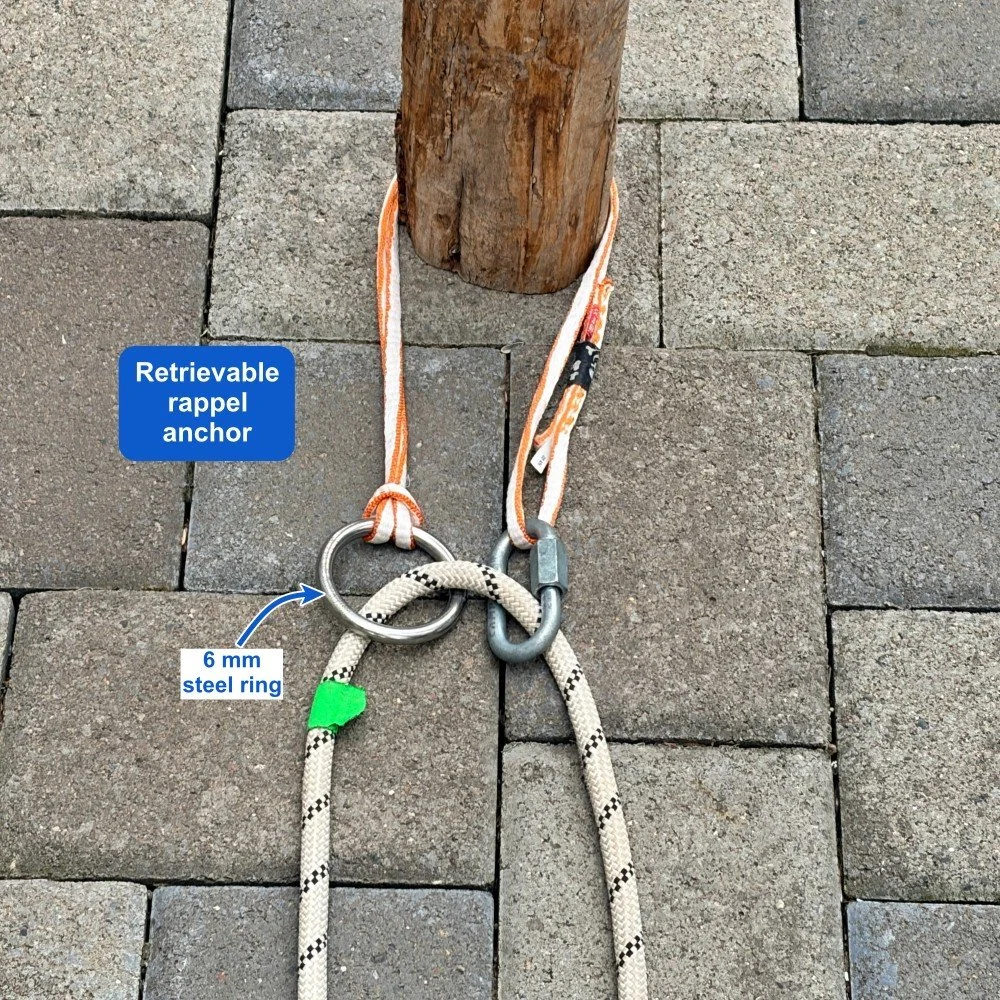
Retrievable anchor method 2 - Steel ring
Instead of an HMS carabiner that might get banged up when you pull your rope, you could use a steel ring. I bought a few online at US Stainless. This one has a diameter of 2'' / 50 mm and is 5/16” / 6 mm thick. Cost was about $5.
These do not have an MBS rating as far as I know, but it's really only supporting half of your bodyweight when you’re rappelling. A slightly thicker 10 mm stainless steel ring breaks somewhere around 80 or 90 kN(!), so I'm happy with the 6 mm.
Now, when you pull your anchor, the metal ring falls down and takes the knocks instead of your nice carabiner. Even if it gets a little banged up, it should be fine for further use.
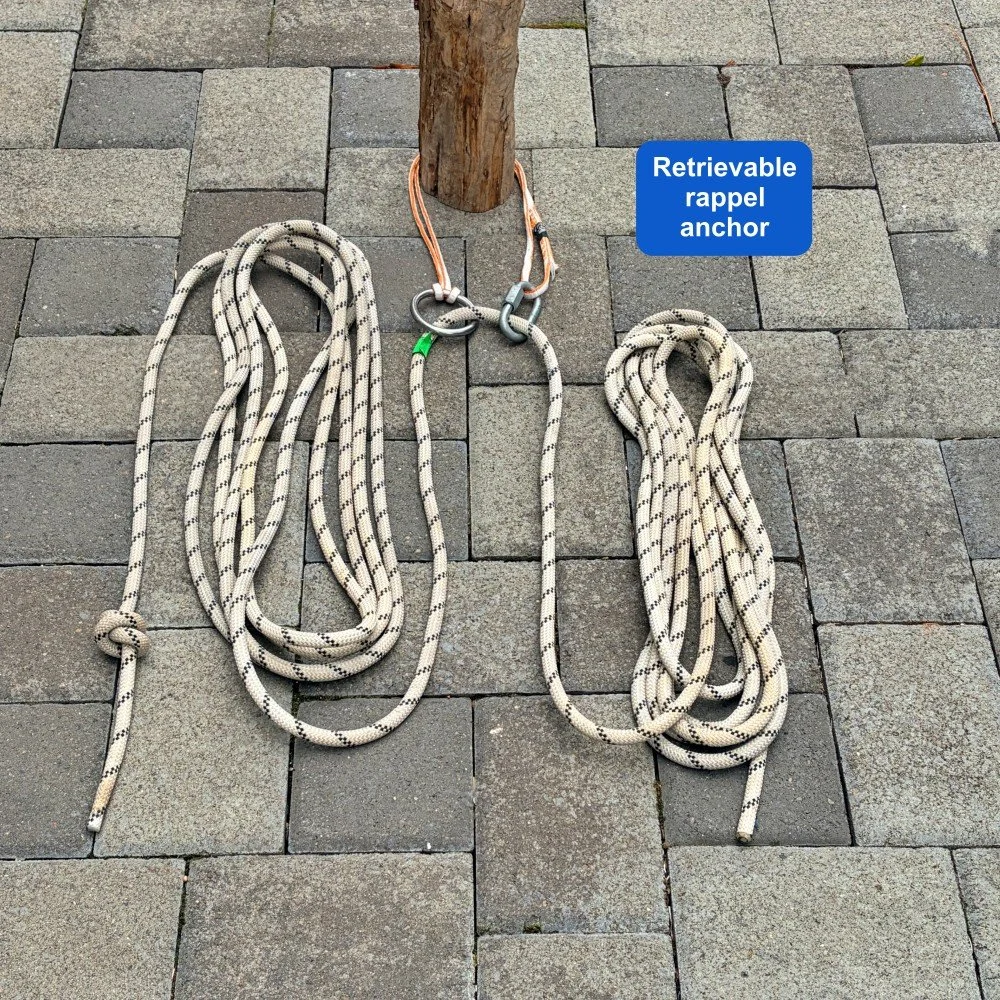
Here's a close-up of the steel ring rigging.
What's the advantage that “breakaway” rigging offers over the other two methods?
Want to see videos on all three methods in action?
How about a video of a commercial tool for arborists that does the same thing?
